
25% Tax Free Pension Lump Sum | The Essential Guide 2026
The 25% tax free pension lump sum is one of the most valuable, and most misunderstood, features of the UK pension system. Take it, and you get genuine, entirely tax-free cash in your hand. But it also permanently reduces what’s left to generate your ongoing retirement income — and the trade-off is more precisely calculable than most people realise, once you actually run the numbers rather than simply taking the cash because it’s there.
Here’s exactly how it works, the cap that applies from 2026, and what it genuinely costs you in reduced annuity income.
Site editor at MortgageToolsHub — 25% tax free pension lump sum figures cross-checked against current HMRC pension rules. Last checked July 2026.
On This Page
- What the 25% tax free pension lump sum actually is
- The £268,275 cap explained
- The trade-off: cash now vs income for life
- A real worked example
- Taking it all at once, or gradually
- The recycling rule that catches people out
- When it makes sense, and when it doesn’t
- FAQ
What the 25% Tax Free Pension Lump Sum Actually Is
The technical name is the Pension Commencement Lump Sum (PCLS), though almost everyone simply calls it the 25% tax free pension lump sum. Whenever you access a defined contribution pension — whether that’s buying an annuity, moving into flexi-access drawdown, or taking an ad-hoc withdrawal — you’re entitled to take up to 25% of that amount completely tax-free, with the remaining 75% subject to income tax at your marginal rate as you draw it.
This applies across personal pensions, SIPPs, and workplace money purchase schemes. Defined benefit (final salary) pensions offer tax-free cash too, though the mechanics work differently, typically involving “commuting” — surrendering part of your annual pension income in exchange for a lump sum, at a rate set by your specific scheme.
The £268,275 Cap Explained
For the 2026/27 tax year, the maximum tax-free lump sum you can take across all your pensions combined is capped at £268,275 by the Lump Sum Allowance (LSA) — a cap introduced alongside the abolition of the old Lifetime Allowance in April 2024. If your total pension pot is £1,073,100 or less, the standard 25% calculation applies in full. Above that figure, your tax-free cash is capped at the flat £268,275 regardless of how much larger your overall pot is, with anything taken beyond that limit taxed as income.
As a straightforward example: a £200,000 pension pot allows up to £50,000 in completely tax-free cash. A £400,000 pot allows up to £100,000 — still comfortably within the LSA cap.
It’s also worth knowing that access to your 25% tax free pension lump sum currently starts at age 55, though this is due to rise to 57 from April 2028, with some workplace schemes retaining a “protected pension age” allowing earlier access under specific circumstances.
The Trade-Off: Cash Now vs Income for Life
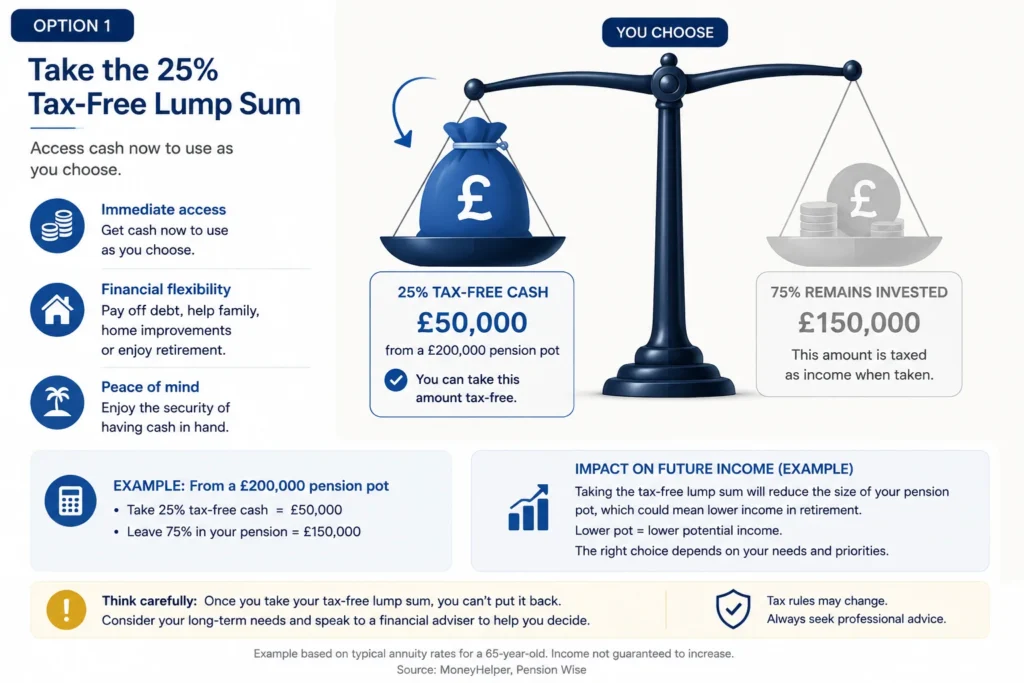
This is the part worth genuinely understanding before deciding, particularly if you’re planning to use the remainder of your pot to buy an annuity. Taking your 25% tax free pension lump sum doesn’t just hand you cash — it directly reduces the amount left to annuitise, and therefore your guaranteed income for the rest of your life.
Mathematically, the trade-off works out as: taking the lump sum is roughly equivalent to accepting an annual income reduction equal to the lump sum amount multiplied by your annuity rate, in exchange for a one-off cash payment. On a £400,000 pot, taking £100,000 tax-free leaves £300,000 to annuitise. At a representative rate of around 6.5% for a 65-year-old, that £300,000 generates roughly £19,500 a year. Annuitise the full £400,000 instead, with no lump sum taken, and the income rises to roughly £26,000 a year — a difference of £6,500 every year, for life, in exchange for the £100,000 cash.
A Real Worked Example
Picture this in break-even terms, because it makes the decision genuinely tangible. If taking £80,000 as a tax-free lump sum costs you roughly £6,000 a year in reduced annuity income, the break-even point — ignoring investment growth or further tax considerations — works out to roughly £80,000 ÷ £6,000 = 13.3 years. Live past that point, and taking the cash turns out, purely in financial terms, to have been the worse trade compared to leaving the money to generate income.
This doesn’t mean taking the lump sum is wrong — for many genuinely valuable uses of that cash (clearing debt, home improvements, helping family, a significant one-off purchase), the value of having it available now can easily outweigh a purely mathematical break-even calculation. But going in with a clear sense of what you’re actually trading away is worth far more than assuming the cash is simply “free” money on top of your pension.
Taking It All at Once, or Gradually
You don’t have to make an all-or-nothing decision with your 25% tax free pension lump sum. Crystallisation — the technical process of accessing your pension — doesn’t have to happen in one go. You can crystallise, for example, £40,000 at age 55, taking £10,000 tax-free and moving the remaining £30,000 into drawdown, then crystallise a further £40,000 the following year, and so on, with each crystallisation carrying its own 25% tax-free entitlement.
This phased approach, sometimes taken as an Uncrystallised Funds Pension Lump Sum (UFPLS) through ad-hoc withdrawals, is genuinely the most common way UK pension savers actually access their pots in practice. It offers meaningful control over which tax year your taxable income lands in, and lets you leave more of your pot invested for longer if you don’t need the full lump sum immediately.
The Recycling Rule That Catches People Out
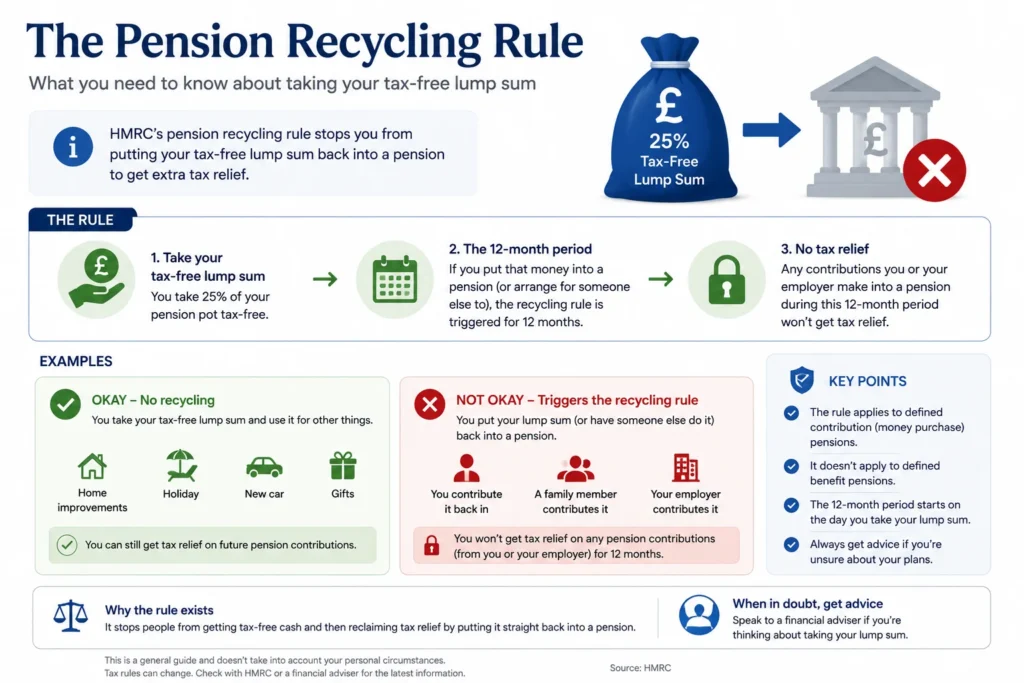
This is a genuinely underexplained detail worth flagging directly, since it’s easy to accidentally breach. HMRC’s recycling rules exist specifically to stop people taking their 25% tax free pension lump sum and then re-contributing that same money back into a pension to claim a second round of tax relief on it.
The rules are triggered if all of the following apply together: you take a PCLS of more than £7,500 within any 12-month period, and your pension contributions increase by 30% or more above your normal pattern, measured across the tax year of the lump sum plus the two years before and two years after. If your circumstances genuinely mean you’re increasing pension contributions around the same time as taking tax-free cash, for entirely unconnected reasons, it’s worth confirming with an adviser or accountant that you’re not inadvertently falling foul of these rules, since the tax consequences of breaching them can be significant.
When It Makes Sense, and When It Doesn’t
Taking your 25% tax free pension lump sum tends to make the most sense when you have a genuinely valuable, specific use for the cash — clearing high-interest debt, a meaningful home improvement, or simply having a cash reserve you’re not comfortable being without. It makes less sense as a default, automatic decision simply because it’s available, particularly if the reduced ongoing income would genuinely strain your retirement budget for essential costs.
If you’re weighing this decision alongside choosing between an annuity and drawdown more broadly, our guide to annuity vs drawdown covers that wider decision in depth, since the lump sum question and the annuity-versus-drawdown question interact closely — the amount you crystallise and take tax-free directly shapes what’s left for whichever income route you ultimately choose.
A few things worth knowing:
- The £268,275 Lump Sum Allowance applies across all your pensions combined, not per individual pension pot
- The minimum age to access your 25% tax free pension lump sum is currently 55, rising to 57 from April 2028, with some scheme-specific exceptions
- Taking only the tax-free lump sum, without touching any taxable drawdown income, does not trigger the Money Purchase Annual Allowance (MPAA) reduction
- Defined benefit pension lump sums work differently, calculated via a commutation factor rather than a straightforward 25% of a pot value
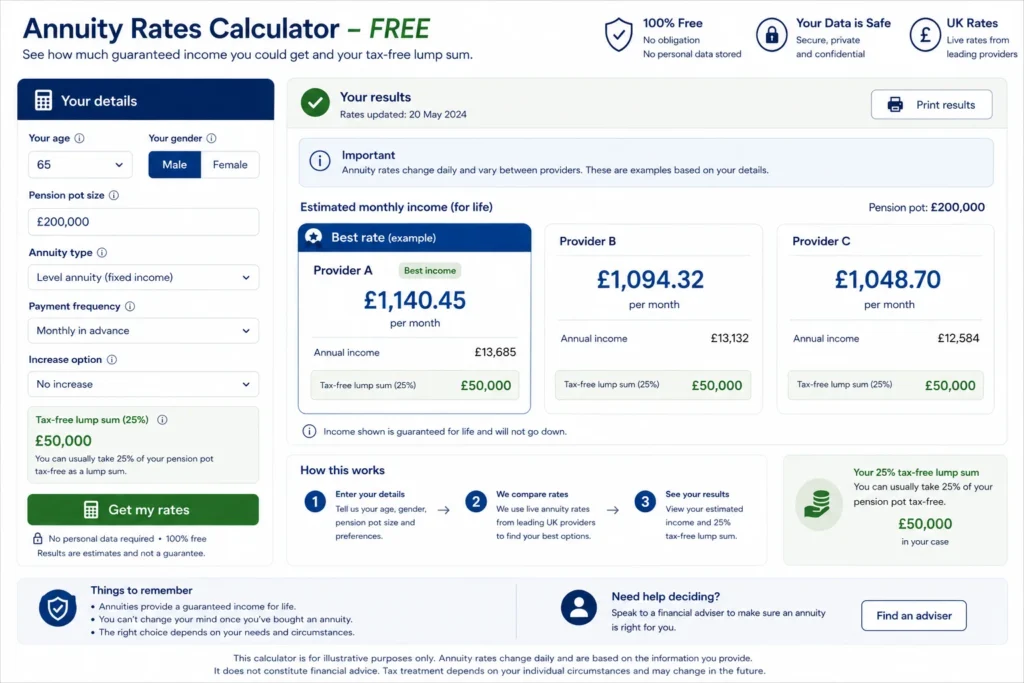
See how taking your tax-free lump sum affects your annuity income using our annuity rates calculator, which lets you model the remaining pot after your lump sum decision.
Frequently Asked Questions
What is the 25% tax free pension lump sum?
It’s the Pension Commencement Lump Sum (PCLS), allowing you to take up to 25% of your pension pot completely tax-free when you access it, whether through an annuity, drawdown, or an ad-hoc withdrawal, with the remaining 75% taxed as income when drawn.
What is the maximum tax-free pension lump sum I can take?
For the 2026/27 tax year, the maximum is capped at £268,275 across all your pensions combined, under the Lump Sum Allowance. This applies once your total pot exceeds £1,073,100, at which point the flat cap replaces the standard 25% calculation.
Does taking my tax-free lump sum reduce my annuity income?
Yes, significantly. Taking the lump sum reduces the amount available to annuitise, directly reducing your guaranteed income. On a £400,000 pot, taking £100,000 tax-free can reduce your annual annuity income by roughly £6,500 a year, depending on current rates.
Can I take my 25% tax-free lump sum in stages rather than all at once?
Yes, this is common practice. You can crystallise your pension gradually, taking tax-free cash and moving the remainder into drawdown in stages, rather than making a single all-or-nothing decision at retirement.
Does taking the tax-free lump sum trigger the MPAA?
No. Taking only the 25% tax-free lump sum does not trigger the Money Purchase Annual Allowance reduction. The MPAA is only triggered by taking taxable income from drawdown or certain other flexible pension access methods.
What are the pension recycling rules?
HMRC’s recycling rules prevent you taking a tax-free lump sum over £7,500 and then significantly increasing pension contributions (by 30% or more) around the same time, to prevent claiming a second round of tax relief on the same money. Breaching these rules can have significant tax consequences.
Official sources: check current pension rules at GOV.UK, read general pension guidance at MoneyHelper, and verify any adviser on the FCA register. See how your lump sum decision affects your annuity income with our annuity rates calculator, or browse every tool on the mortgage calculators homepage.