
Is Annuity Income Taxable? The Essential 2026 Answer
Is annuity income taxable? Yes, and the more useful question isn’t really that one — it’s how much of it gets taxed, because the answer catches a genuinely large number of retirees off guard. The full new State Pension for 2026/27 sits at £12,547 a year. The tax-free Personal Allowance is £12,570. Look at those two numbers side by side: the State Pension alone consumes almost the entire allowance, leaving just £23 of tax-free headroom for absolutely everything else — including your annuity.
Here’s exactly how the maths works, why the gap is about to disappear entirely for some retirees, and what you can genuinely do about it.
Site editor at MortgageToolsHub — annuity taxation figures cross-checked against current HMRC 2026/27 tax bands and Personal Allowance data. Last checked July 2026.
On This Page
- Is annuity income taxable? The short answer
- How the State Pension quietly eats your Personal Allowance
- The tax bands that actually apply
- A real worked example
- How the tax is actually collected
- The 2027 change that will catch more people out
- Scottish taxpayers pay differently
- What you can genuinely do about it
- FAQ
Is Annuity Income Taxable? The Short Answer
Yes. Annuity income is taxable in the UK, treated exactly the same as earned income — the same tax category as a salary, the State Pension, or drawdown withdrawals. There’s no special exemption or reduced rate for annuity payments specifically. Once you’ve taken your one-off 25% tax-free lump sum at the point of purchase, every subsequent annuity payment you receive is added to your total income for the year and taxed accordingly, exactly like any other source of earnings.
How the State Pension Quietly Eats Your Personal Allowance
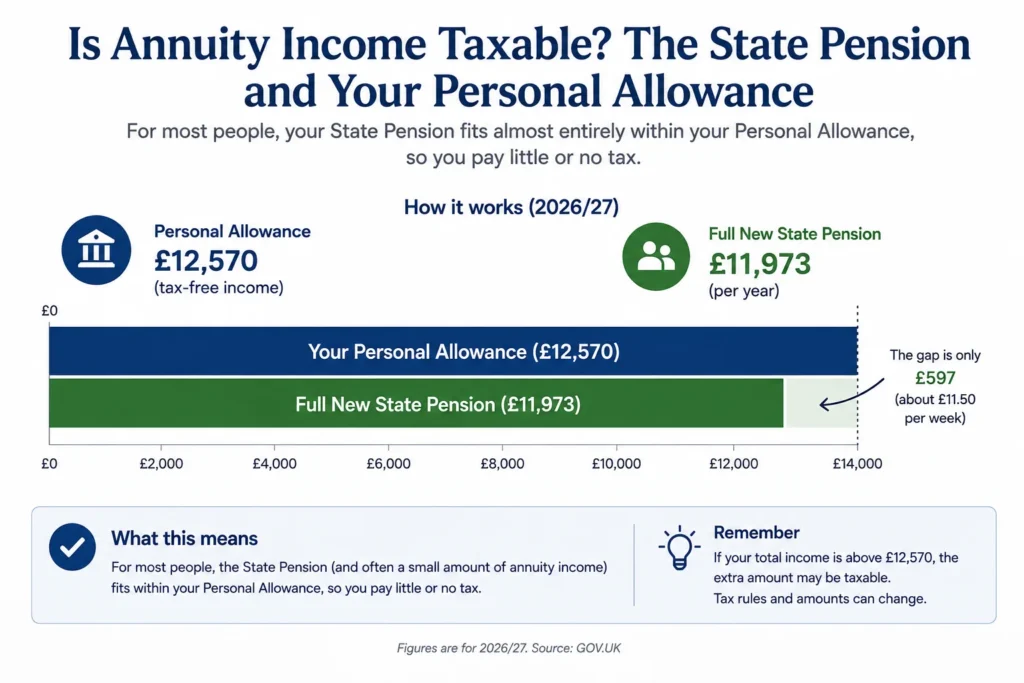
This is the detail that genuinely surprises people, and it’s the reason so many retirees end up paying tax on income they assumed would be modest enough to escape it. For the 2026/27 tax year, the standard Personal Allowance is £12,570 — the amount anyone can earn or receive before any income tax applies at all. The full new State Pension, for the same tax year, is £12,547 annually.
Put those two figures next to each other and the problem becomes obvious: the State Pension alone uses up £12,547 of your £12,570 allowance, leaving just £23 of tax-free room for literally any other income — including your annuity. This is precisely why the answer to “is annuity income taxable” matters so much in practice: for the vast majority of retirees receiving the full State Pension alongside any annuity income at all, nearly every pound of that annuity is taxed from the very first payment, not just the portion above some generous threshold most people assume exists.
The Tax Bands That Actually Apply
Once your combined income — State Pension plus annuity plus any other earnings — exceeds the £12,570 Personal Allowance, the standard UK income tax bands apply in exactly the same way they would for someone still working:
| Income band (2026/27) | Rate |
|---|---|
| Up to £12,570 | 0% (Personal Allowance) |
| £12,571 to £50,270 | 20% (basic rate) |
| £50,271 to £125,140 | 40% (higher rate) |
| Above £125,140 | 45% (additional rate) |
Your State Pension, annuity income, and any other pension or drawdown income all count together as “non-savings, non-dividend income” — they stack on top of each other before any band is applied, rather than being assessed separately. If your total income between £100,000 and £125,140 crosses that threshold, your Personal Allowance itself starts tapering away too, reducing by £1 for every £2 earned above £100,000, disappearing entirely by £125,140.
A Real Worked Example
Take a retiree receiving the full State Pension of £12,547, alongside an annuity paying £8,000 a year. Total income: £20,547. Subtract the £12,570 Personal Allowance, and £7,977 is taxable at the basic rate of 20%, working out to a tax bill of roughly £1,595 for the year — collected not as a lump sum demand, but gradually through the annuity payments themselves, as covered in the next section.
This is genuinely worth sitting with, because a £8,000 annuity income doesn’t feel, at first glance, like it should trigger a meaningful tax bill. But because the State Pension has already consumed almost the entire Personal Allowance, nearly the whole annuity payment ends up taxed at 20%, not just a small portion above some larger, more generous-feeling threshold.
How the Tax Is Actually Collected
Here’s a detail worth understanding, because it explains why your annuity payments might arrive smaller than the headline figure suggests, without an obvious separate tax bill ever landing on your doormat. The State Pension is paid gross — with no tax deducted at source by the Department for Work and Pensions. Instead, HMRC collects the tax owed on your State Pension by adjusting the PAYE tax code applied to your other pension income, including your annuity.
In practice, this means your annuity provider deducts more tax than you might expect from each payment, specifically to account for the tax due on your State Pension as well as the annuity itself, all bundled into a single adjusted tax code. If you ever see a tax code that looks unusually low, this is very often the reason — it’s not a mistake, it’s HMRC collecting State Pension tax through your other pension income, since the State Pension itself can’t have tax deducted directly. It’s genuinely worth checking your annual PAYE coding notice carefully each year, since errors in this calculation are common and can lead to under or overpayment if the figures HMRC is using don’t match your actual State Pension amount.
The 2027 Change That Will Catch More People Out
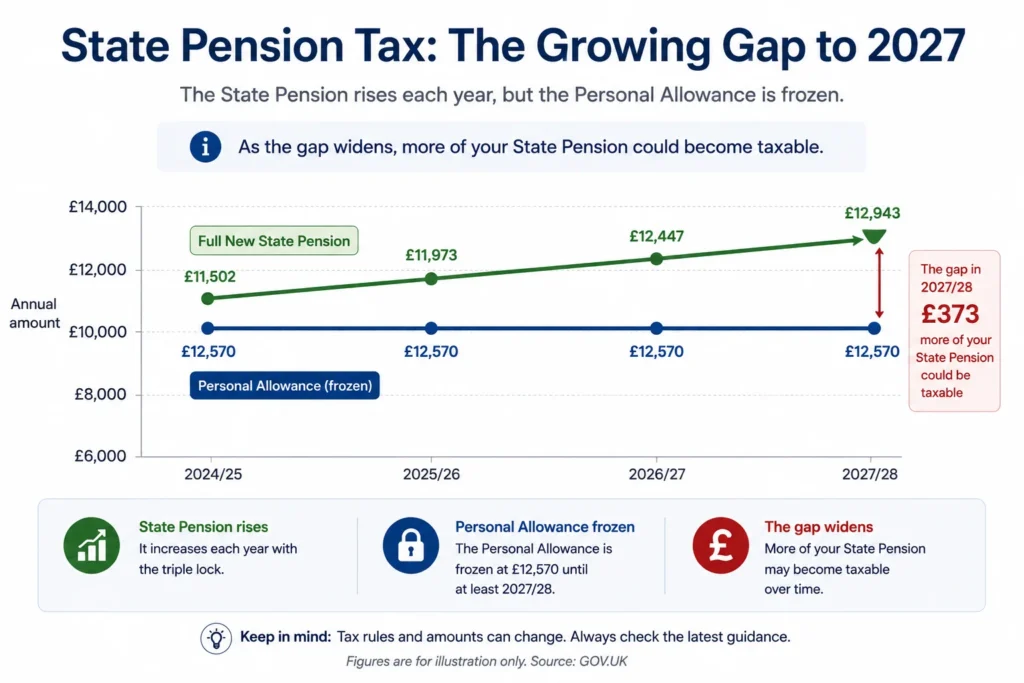
This is worth flagging directly, because it’s a genuinely significant shift on the horizon. The Personal Allowance has been frozen at £12,570 since 2021/22, and is scheduled to remain frozen until at least April 2028. The State Pension, meanwhile, continues rising each year under the triple lock mechanism. These two facts, combined, mean the gap between the State Pension and the Personal Allowance is steadily narrowing — and it’s genuinely expected to disappear entirely from April 2027, at which point retirees relying solely on the State Pension, with no other income at all, are likely to start owing tax for the very first time, purely because the State Pension itself will have crept above the frozen allowance.
For anyone currently answering “is annuity income taxable” with an assumption that a decent chunk of it will escape tax thanks to the Personal Allowance, this trend is worth factoring into longer-term retirement income planning — the tax-free headroom available to combine with any annuity or drawdown income is shrinking, not staying static, year on year.
Scottish Taxpayers Pay Differently
If you’re a Scottish resident, your annuity income is taxed under a separate set of Scottish Income Tax rates, set by the Scottish Parliament rather than the rates applying in the rest of the UK. The Personal Allowance itself remains the same £12,570, but the bands above it are split into six tiers rather than three, ranging from 19% to 48%. The practical impact can be significant at higher income levels — a Scottish pensioner with £80,000 of total income pays 45% on the portion above £75,000, whereas the same income in England wouldn’t reach the 40% higher rate threshold until £50,271. At the very top, Scotland’s 48% additional rate sits three percentage points above the rest of the UK’s 45%.
What You Can Genuinely Do About It
There’s no way to make annuity income itself tax-free — unlike money held inside an ISA, pension income of any kind, once drawn, is taxable by design. But there are legitimate strategies worth understanding as part of wider retirement tax planning: timing when you crystallise different portions of your pension, considering how an income floor strategy blends annuity income with more flexible drawdown that can be varied year to year, and understanding how your 25% tax-free lump sum decision interacts with your ongoing taxable income are all worth discussing with a qualified adviser rather than assuming nothing can be done.
A few things worth knowing:
- These figures apply to the 2026/27 tax year and are subject to change in future Budgets
- Annuity income is taxed identically to drawdown and other pension income — there’s no special tax treatment specifically for annuities
- Always check your annual PAYE coding notice from HMRC, since errors in how State Pension tax is collected through other pension income are genuinely common
- Married Couple’s Allowance and Blind Person’s Allowance can increase your effective tax-free threshold if you qualify — worth checking if either applies to your situation
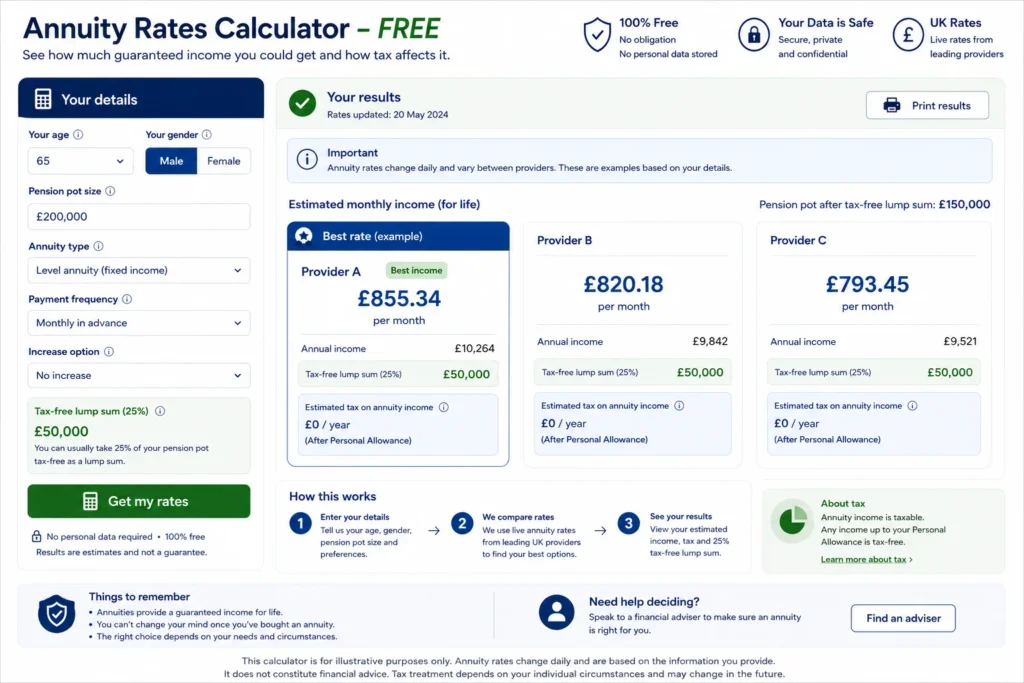
See your projected gross annuity income using our annuity rates calculator, and factor in your own tax position alongside your State Pension when planning your total retirement income.
Frequently Asked Questions
Is annuity income taxable in the UK?
Yes. Annuity income is taxed as earned income, in exactly the same category as the State Pension, drawdown income, and salary. There’s no special tax-free treatment for annuities beyond the one-off 25% lump sum taken at the point of purchase.
How does the State Pension affect tax on my annuity?
The full new State Pension for 2026/27 is £12,547, almost entirely consuming the £12,570 Personal Allowance. This means nearly all of any annuity income received alongside the full State Pension is taxed from the very first pound, typically at the basic 20% rate.
Why is tax deducted from my annuity rather than my State Pension directly?
The State Pension is paid gross, without tax deducted at source, because HMRC has no mechanism to deduct tax directly from it. Instead, HMRC adjusts the PAYE tax code applied to your other pension income, including your annuity, to collect the tax owed on both combined.
Will I definitely pay tax if I only receive the State Pension?
Currently, if the State Pension is your only income and you receive the full amount, you fall within the Personal Allowance and pay no tax. However, this is expected to change from April 2027, as the frozen Personal Allowance is overtaken by the rising State Pension under the triple lock.
Do Scottish residents pay the same tax on annuity income?
No. Scottish taxpayers use a separate set of Income Tax rates with six bands ranging from 19% to 48%, rather than the three-band system used in the rest of the UK, though the £12,570 Personal Allowance itself remains the same.
Can I reduce the tax I pay on annuity income?
There’s no way to make annuity income itself tax-free, but strategies like blending annuity income with flexible drawdown, timing pension crystallisation, and understanding your tax-free lump sum decision can all form part of a wider, legitimate tax-planning approach worth discussing with an adviser.
Official sources: check current tax bands and allowances at GOV.UK, read general pension tax guidance at MoneyHelper, and verify any adviser on the FCA register. Model your gross annuity income with our annuity rates calculator, or browse every tool on the mortgage calculators homepage.