
Remortgage vs Lifetime Mortgage | Which Costs Less?
Remortgage vs lifetime mortgage is a comparison most people never actually get to make — they just land on whichever product the search results decide to show them. Here’s a conversation that plays out constantly. Someone in their late fifties wants £60,000 out of their house — new kitchen, help for a child’s deposit, clearing some debt, whatever it is. They start searching, and within about four clicks they land on an equity release calculator, because that’s what the algorithm decided “release equity from my house” means. Nobody’s told them there’s a second, often far cheaper option sitting right next to it: simply remortgaging.
This isn’t a case of one product being good and the other bad. Both are entirely legitimate ways to get cash out of a property. But they work completely differently, they cost wildly different amounts over time, and — this is the part that actually decides most people’s choice — only one of them is available if you’re not yet 55.
Let’s go through both properly, put real numbers next to each other, and work out which one actually fits your situation.
Site editor at MortgageToolsHub — remortgage and equity release figures cross-checked against current UK lender rate data. Last checked July 2026.
On This Page
- The two products, in plain terms
- The line that actually decides most people’s choice
- Remortgage vs lifetime mortgage: what each costs in 2026
- A real worked example — same £60,000, two routes
- What happens to your monthly payment
- The affordability test nobody mentions
- If you’re self-employed
- When each one genuinely makes more sense
- Mistakes people make choosing between them
- FAQ
The Two Products, In Plain Terms
A remortgage to release equity is exactly what it sounds like: you replace your existing mortgage with a bigger one, and the difference between the old balance and the new one is paid to you in cash. You then make monthly payments on the whole new loan, just like any other mortgage — interest and, usually, some capital, every month, until it’s paid off.
A lifetime mortgage (the most common form of equity release) is a loan secured against your home too, but it works the opposite way. You take the cash, and instead of paying it back monthly, the interest is added to what you owe and compounds — meaning next year’s interest is charged on this year’s interest as well as the original loan. Nothing is repaid until you die or move into long-term care, at which point the house is sold and the loan, now considerably larger than what you borrowed, is settled from the proceeds.
Both let you access money without moving house. That’s genuinely where the similarity ends — and it’s why weighing remortgage vs lifetime mortgage properly, rather than defaulting to whichever one you heard of first, matters so much.
The Line That Actually Decides Most People’s Choice
Before cost even enters the conversation, there’s a hard eligibility cutoff that settles this for a lot of people without them needing to compare anything.
Lifetime mortgages start at age 55. Not a soft guideline — an actual minimum age across every UK provider. If you’re 48 and want cash out of your house, equity release simply isn’t on the table yet, however the search results present it.
Remortgaging has no minimum age at all. It’s the same product available to a 30-year-old or a 70-year-old, subject to the same thing every mortgage is subject to: can you afford the payments.
So the real starting question isn’t “which is cheaper” — it’s “can I actually get a lifetime mortgage in the first place, and if I can, could I also pass a remortgage affordability check?” If you’re under 55, the comparison is academic; remortgaging is your only route through a mainstream mortgage product. If you’re over 55 and still working with a steady income, you can genuinely choose — and that’s where the numbers below start to matter a great deal.
Remortgage vs Lifetime Mortgage: What Each Costs in 2026
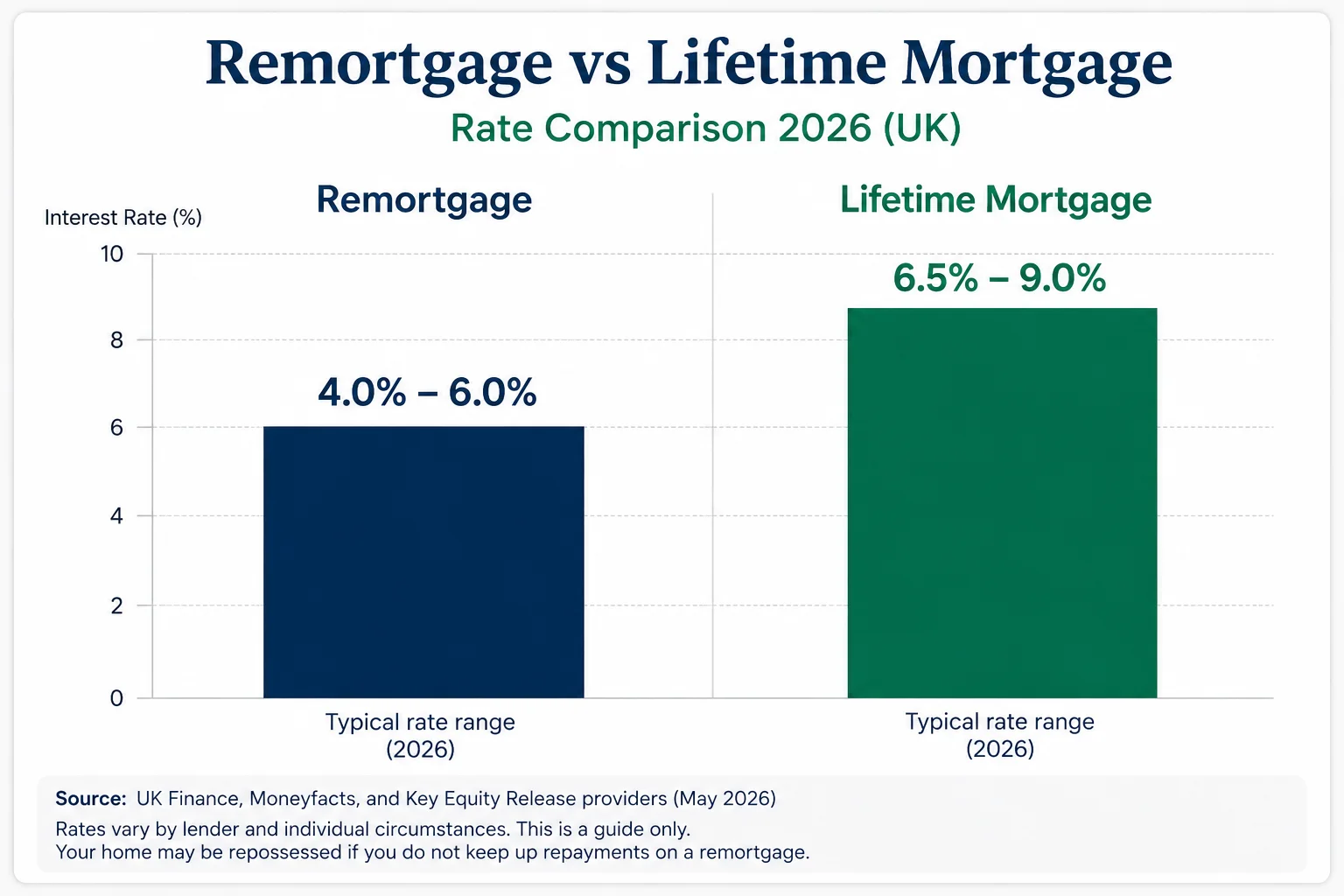
UK mortgage rates moved around a fair bit through 2026, and different sources quote slightly different snapshots depending on the exact week and LTV band. Rather than pretend there’s one precise number, here’s the honest range as of late July 2026:
| Product | Typical rate range, 2026 | How it’s structured |
|---|---|---|
| Remortgage (best-buy, low LTV) | ~4.2% – 4.8% | Paid monthly, doesn’t compound |
| Remortgage (market average) | ~5.6% – 5.8% | Paid monthly, doesn’t compound |
| Standard Variable Rate (if you don’t remortgage) | ~7% – 8.5% | What you’re moved to if a fixed deal lapses |
| Lifetime mortgage | ~6% – 8.3% MER | Rolls up and compounds, no payments required |
Look past the headline rates for a second, because the rate alone doesn’t tell the real story in a remortgage vs lifetime mortgage comparison. The rate on a remortgage is what you pay on the balance you actually still owe, every year, as it shrinks. The rate on a lifetime mortgage is charged on a balance that never shrinks and keeps growing, because you’re not paying any of it off. Even when the two rates look fairly close on paper — say 5.6% against 6.5% — the total cost over fifteen or twenty years is nowhere near close, because one of them is fighting compounding the entire time and the other isn’t.
That gap is the entire reason this comparison matters, and it’s exactly what the example below puts into real pounds.
A Real Worked Example — Same £60,000, Two Routes
You’re 62, your house is worth £400,000, and your existing mortgage balance is £120,000. You want to release £60,000.
Route one: remortgage. Your new mortgage balance becomes £180,000, at, say, 5.6% over a remaining 15-year term. Monthly payment on the full amount comes to roughly £1,490 a month. After 15 years, assuming you keep up the payments, the mortgage is fully cleared. Total interest paid over that period is in the region of £88,000.
Route two: lifetime mortgage. You take the same £60,000 as a lump sum lifetime mortgage at 6.5%, with no monthly payments. Left to compound for the same 15 years, that £60,000 grows to roughly £154,000 — meaning the interest alone has cost you around £94,000, on a loan that’s still outstanding at the end of the period rather than cleared.
Remortgage: ~£88,000 interest, debt cleared after 15 years
Lifetime mortgage: ~£94,000 interest, and you still owe £154,000
The gap gets more dramatic the longer the lifetime mortgage runs, because the remortgage’s cost is capped by the term ending, while the lifetime mortgage keeps compounding for as long as you’re alive and in the house. Run it to 25 years instead of 15, and the lifetime mortgage balance is well over £280,000 on the original £60,000 — more than four and a half times what you borrowed.
None of this makes the lifetime mortgage the “wrong” choice automatically in a remortgage vs lifetime mortgage decision. It makes it the more expensive choice, in exchange for something the remortgage doesn’t offer: no requirement to find £1,490 a month from your income. That trade-off is real, and for some households it’s worth every penny of the extra cost. But it should be a deliberate trade, not a default.
What Happens to Your Monthly Payment
This is usually where the theoretical comparison meets reality. A remortgage that releases £60,000 doesn’t just add £60,000 to your balance — it adds a monthly payment on top of whatever you were already paying, and that new payment has to fit inside your income, today and for the whole term, in the lender’s judgement.
On the £180,000 example above, the extra £60,000 alone (ignoring the original £120,000 you were already servicing) adds roughly £495 a month to what you’re paying, at 5.6% over 15 years. If your income comfortably covers that on top of your existing outgoings, remortgaging is very likely your cheaper route. If it doesn’t — if adding £495 a month would genuinely strain your budget — then the comparison isn’t really “which is cheaper,” it’s “which one can I actually get,” and the lifetime mortgage may be the only route that works, expensive as it is.
The Affordability Test Nobody Mentions
Here’s something that catches people out fairly often: even though remortgaging is usually cheaper, it isn’t always available. Every mainstream lender will stress-test your income against the new, larger monthly payment — often at a rate somewhat higher than the actual rate you’ll pay, to check you could absorb a future increase.
Retired homeowners on a fixed pension income, or anyone whose income has dropped since their last mortgage application, can genuinely fail this test even though they’d have no trouble making the payments in practice. This is precisely the gap lifetime mortgages exist to fill: no monthly payment means no affordability test in the traditional sense, which is why equity release becomes the realistic option for people who could technically afford the payments but can’t get a lender to agree on paper.
If you’re not sure where you’d land, it’s worth running your own numbers through our mortgage affordability calculator before assuming either way.
If You’re Self-Employed
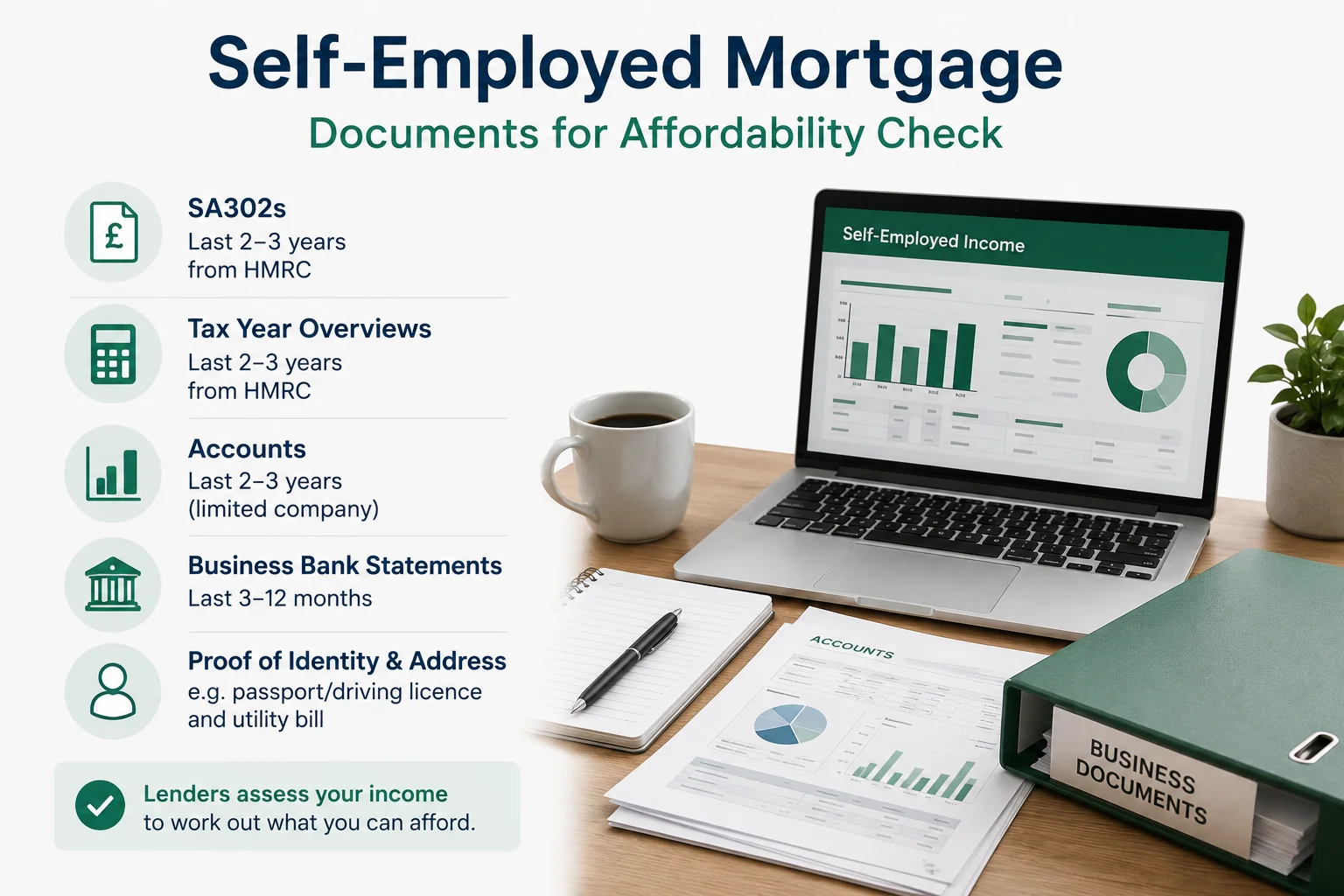
Self-employed applicants can remortgage to release equity on essentially the same basis as anyone else, but the affordability check leans harder on documented proof of income — typically two to three years of SA302 tax calculations and matching Tax Year Overviews rather than payslips. If your income has fluctuated year to year, which is common for self-employed households, this is where the affordability conversation gets more nuanced than it would be for a salaried applicant. We’ve covered exactly what lenders look for and how to get the right documents together in our guide to SA302s, which is worth reading alongside this one if self-employment is part of your situation.
When Each One Genuinely Makes More Sense
Remortgage wins when you can comfortably afford the payments. If your income covers the higher monthly cost with room to spare, remortgaging is very likely the cheaper route over any meaningful time horizon — often by tens of thousands of pounds, as the example above shows. It’s also fully reversible: pay it off early or remortgage again later, and your options stay open.
Lifetime mortgage wins when monthly payments genuinely aren’t realistic. If you’re retired on a fixed income, can’t pass an affordability stress test, or simply don’t want any monthly commitment for the rest of your life, a lifetime mortgage solves a problem remortgaging can’t. You’re paying a real premium for that flexibility — but for the right household, it’s a fair trade.
There’s a middle path worth knowing about too, sometimes called “flex and fix”: stay on a standard remortgage through your active working years while you can still service the payments, then move to a lifetime mortgage later in retirement if your income situation changes. Because remortgaging is reversible and equity release generally isn’t, doing things in that order keeps your options open for longer than committing to equity release the moment you turn 55.
A few things worth knowing before you decide:
- This comparison uses representative 2026 rates — your actual quote will depend on your credit history, property, and the specific lender’s criteria on the day
- A remortgage puts your home at risk if you fall behind on the new, larger payment — this is a real and meaningful downside that deserves as much weight as the lifetime mortgage’s compounding cost
- Equity release reduces the value of your estate and can affect means-tested benefits; a remortgage doesn’t carry either of these specific risks in the same way
- Both products involve fees — arrangement fees, valuation costs, and for equity release, mandatory independent legal advice. Neither route is entirely free to set up
Mistakes People Make Choosing Between Them
Assuming “equity release” is the only search term that applies. Because so much of the content online is written by companies that specifically sell equity release, remortgaging barely gets mentioned as an alternative, even though it’s frequently the cheaper option for anyone who can pass the affordability check.
Not stress-testing the monthly payment against a future rate rise. If you remortgage on a fixed deal, budget for what happens when that fix ends and you’re back on the market rate, not just today’s number.
Taking the maximum available rather than what’s actually needed. This applies to both products, but it matters more with a lifetime mortgage, where every extra pound compounds for potentially decades. Borrow the amount you need, not the amount you’re offered.
Not getting independent advice before choosing. Both products are regulated, and a genuinely independent broker can run the numbers for your specific circumstances — including options this guide can’t personalise, like porting an existing deal or blending a small remortgage with a smaller lifetime mortgage.
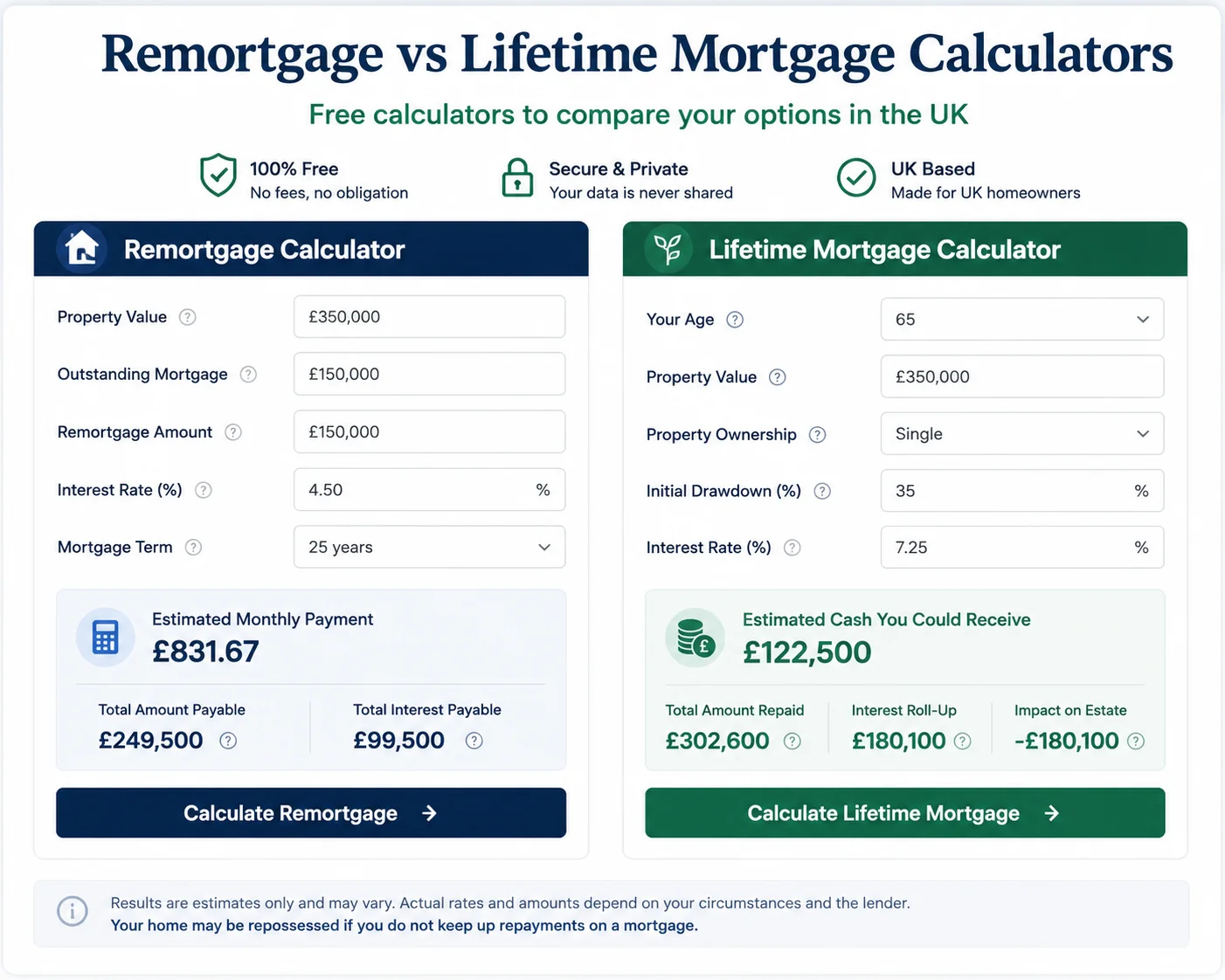
Before deciding anything, see what each route actually looks like for your property value, age, and existing balance — side by side, using your real numbers rather than an example. Try our remortgage calculator or our equity release calculator.
Frequently Asked Questions
Can I remortgage to release equity at any age?
Yes, there’s no minimum age for a standard remortgage — it’s the same product available to any homeowner, subject to the lender’s usual affordability and credit checks. A lifetime mortgage, by contrast, is only available from age 55, which is often the deciding factor rather than cost.
Is remortgaging to release equity always cheaper than a lifetime mortgage?
For someone who can pass the affordability test, yes, usually, sometimes by a wide margin, because you’re paying the interest as you go rather than letting it compound. The comparison only tilts toward a lifetime mortgage when the applicant can’t service monthly payments on the extra borrowing, in which case remortgaging isn’t realistically available anyway.
How much equity can I release through a remortgage?
Most lenders will lend up to 80-85% of your property’s value in total, so your maximum release is that percentage of your home’s value minus your current mortgage balance, subject to passing the lender’s income and affordability checks on the new, larger loan.
Does remortgaging to release equity affect my credit score?
A remortgage application involves a credit check and a hard search, which can cause a small, temporary dip in your score — the same as any mortgage application. A lifetime mortgage also involves underwriting, though credit history typically plays a smaller role since affordability isn’t being assessed in the same way.
What happens if I can’t afford the higher payments after remortgaging?
Your home is at risk if you fall behind on payments on any mortgage secured against it, including a remortgage. This is precisely why lenders stress-test affordability before approving a larger loan, and why anyone considering releasing a significant sum through a remortgage should model the higher payment carefully first — not just at today’s rate, but against a plausible future rise.
Can I switch from a lifetime mortgage to a normal remortgage later?
In principle yes, if your income and affordability profile changes, though in practice this is uncommon since most lifetime mortgage customers are already past typical working age. It’s more common to see people avoid a lifetime mortgage in their late 50s or early 60s specifically because they still have earning years ahead and can service a remortgage instead.
Official sources: read guidance on releasing equity at MoneyHelper, check current standards at the Equity Release Council, and verify any adviser on the FCA register. Browse every tool on the mortgage calculators homepage.