
How Much Equity Do I Have? The Easy 5-Minute Answer
How much equity do I have? It’s one of those questions people carry around for years without ever actually answering it. You know roughly what your mortgage payment is each month. You’ve got a vague sense your house has “probably gone up a bit.” But the actual number — what you’d genuinely walk away with if you sold tomorrow — most homeowners couldn’t tell you within £50,000 either way.
That’s not a criticism. It’s just not a number your bank statement shows you. The good news is it takes about five minutes to work out properly, and once you know it, a surprising number of financial decisions get easier.
Site editor at MortgageToolsHub — UK equity figures cross-checked against current lender LTV data and IMLA market reports. Last checked July 2026.
On This Page
- The formula (it’s genuinely this simple)
- What counts as your “property value”
- Where to find your outstanding mortgage balance
- A real example
- How much equity does the average UK homeowner have?
- Why this number actually matters
- What can move it up or down
- FAQ
The Formula (It’s Genuinely This Simple)
Here’s the entire calculation, and there’s no trick hiding in it:
Home equity = Property value − Outstanding mortgage balance − Any other secured loans
That’s it. Whatever your house is worth today, minus everything that’s still owed against it, is what you actually own. Everyone overcomplicates this in their head because “equity” sounds like a technical finance word, but the underlying idea is exactly the same as asking how much of your car you actually own versus how much the finance company still has a claim on.
What Counts as Your “Property Value”
This is the one part of the equation that isn’t a fixed number sitting in a document somewhere — it’s an estimate, and getting a reasonable one matters.
The most accurate figure comes from a formal valuation, which is what a lender will actually use if you go on to remortgage or apply for equity release. Short of paying for one, a genuinely useful free alternative is looking at recent sold prices for similar properties nearby — not asking prices, which tend to run optimistic, but what homes have actually completed for. Online estimate tools can give you a starting figure too, though they’re best treated as a rough guide rather than gospel, since they don’t know about that extension you added or the kitchen that badly needs replacing.
If you’re working out equity as a genuine starting point for a decision — remortgaging, equity release, just wanting to know where you stand — err on the side of a slightly conservative estimate rather than an optimistic one. It’s a more honest number to plan around.
Where to Find Your Outstanding Mortgage Balance
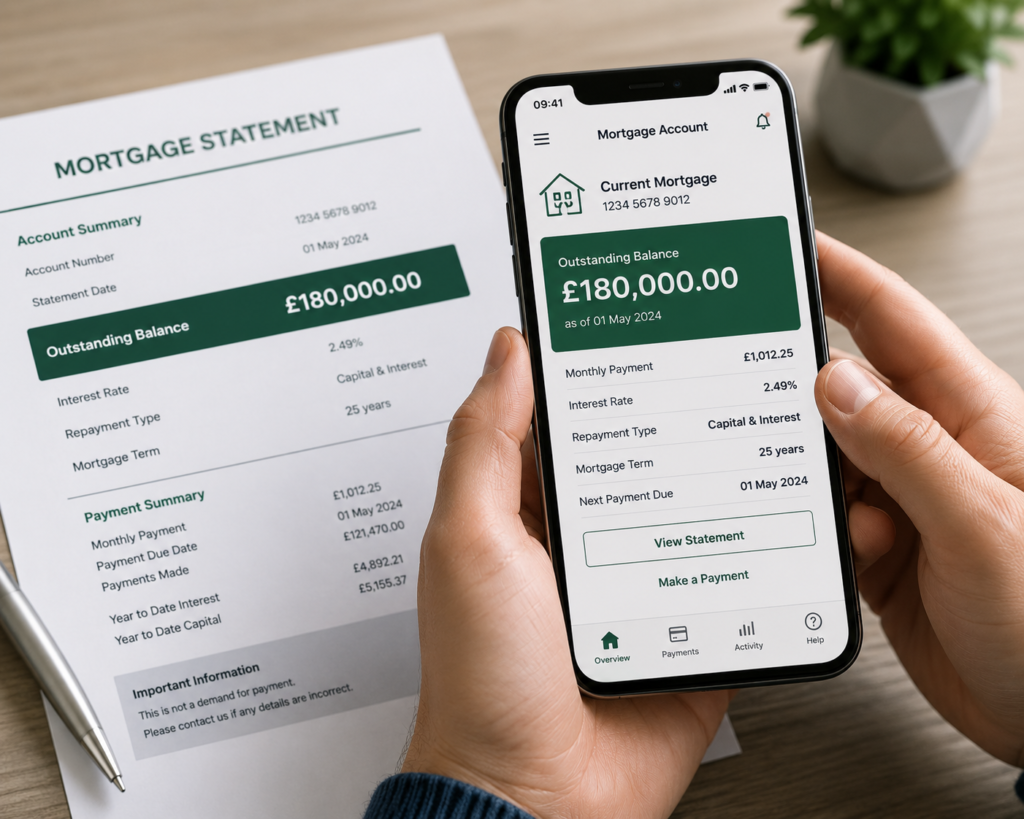
Unlike your property value, this one’s exact and easy to find. Your most recent mortgage statement will show it, or you can log into your lender’s app or online account for a real-time figure. It’s worth checking this directly rather than estimating from memory or from what you originally borrowed — mortgage balances reduce at different speeds depending on your rate and repayment structure, and the number in your head is often out of date by more than people expect.
If you have any other secured borrowing against the property — a second charge mortgage, a secured loan for home improvements, or an existing further advance — that comes off too. Equity is about everything secured against the house, not just your main mortgage.
A Real Example
Say your home is worth £320,000 based on recent sales of similar properties on your street. Your mortgage statement shows a balance of £185,000, and you have no other secured borrowing.
£320,000 − £185,000 = £135,000 of equity. As a percentage, that’s 42% of the property’s value — meaning your loan-to-value (LTV) sits at 58%.
That LTV figure matters almost as much as the equity itself, because it’s the number lenders actually price against. Landing just inside a lower LTV band — 60%, 75%, 80% — can noticeably change the interest rate you’re offered on a remortgage, sometimes by a meaningful margin.
How Much Equity Does the Average UK Homeowner Have?
This is genuinely worth knowing, because it gives you something to measure your own number against. According to IMLA’s 2026 market data, the average mortgaged UK home now holds just over 40% equity — and across the country as a whole, an estimated £677 billion of housing equity has built up since the financial crisis, through a combination of mortgage repayment and rising property values.
Most people carrying a mortgage sit somewhere in a fairly wide range, but 40% as a national average gives you a rough benchmark: if your own figure comes out noticeably below that, it doesn’t mean anything’s wrong — it might just reflect when you bought, how large a deposit you started with, or how much of your mortgage term remains. If it’s noticeably above, you’re likely in a stronger position than most for remortgaging onto a better rate.
Why This Number Actually Matters
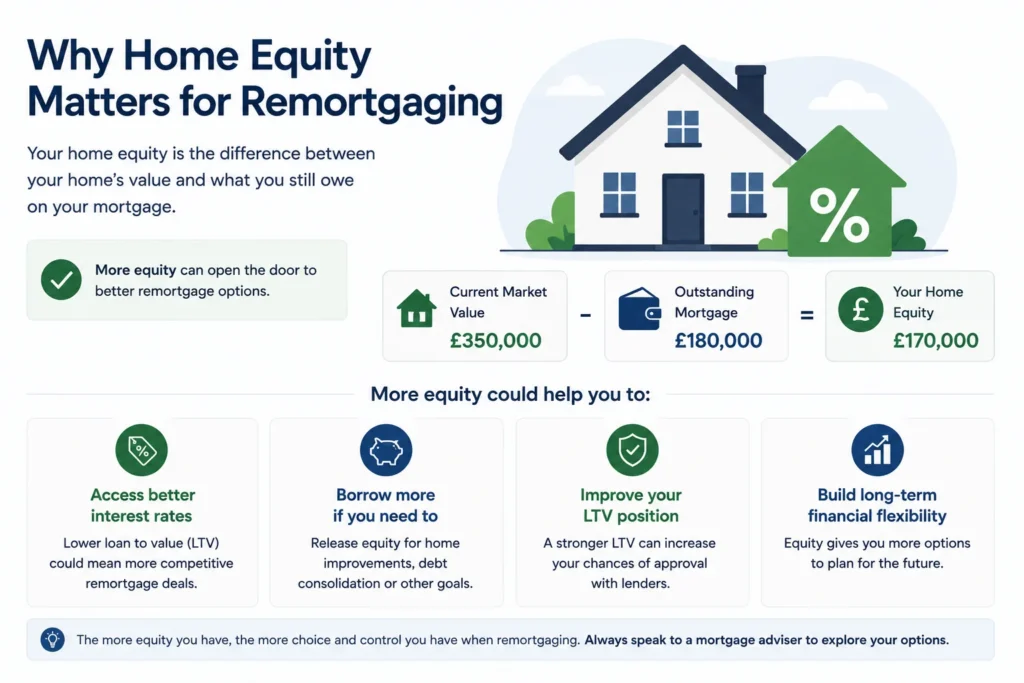
Knowing your equity isn’t just satisfying curiosity. It directly affects three things people tend to only think about once they’re already mid-decision:
Your remortgage rate. Lenders price deals in LTV bands, and the difference between sitting at 61% LTV and 59% LTV — just either side of a common threshold — can be the difference between a middling rate and a genuinely competitive one.
Whether you can release cash from the property. Both remortgaging and equity release depend entirely on how much equity you’re sitting on. Knowing your real number, rather than guessing, means you walk into those conversations with a realistic sense of what’s actually available.
Whether you’re paying for mortgage protection insurance you don’t need. Some insurance products are priced or structured around loan-to-value assumptions — knowing your actual equity position helps you sense-check whether cover levels still make sense for your circumstances.
What Can Move It Up or Down
Equity moves in two ways, and only one of them is within your control. Paying down your mortgage — through regular payments or voluntary overpayments — increases equity guaranteed, pound for pound, because you’re directly reducing the debt secured against the property. Property value changes move the other side of the equation, but this is entirely outside your control and can go either direction depending on your local market.
If you’re specifically looking to build equity faster on purpose, overpaying is the one lever you can actually pull with certainty. Our loan overpayment calculator shows exactly how much extra equity a given overpayment builds over time, which is a useful way to see the effect in real numbers rather than the abstract.
A few things worth knowing:
- Your property value is always an estimate until a formal valuation happens — treat online figures as a starting point, not a fixed number
- LTV bands and the rates attached to them vary by lender, so your own mortgage provider’s specific criteria matters more than any general rule of thumb
- If you have an interest-only mortgage, your equity only grows through property value change, since the capital balance doesn’t reduce through your regular payments the way a repayment mortgage does
- Equity figures don’t account for selling costs — estate agent fees, legal costs, and moving expenses would come off any actual sale
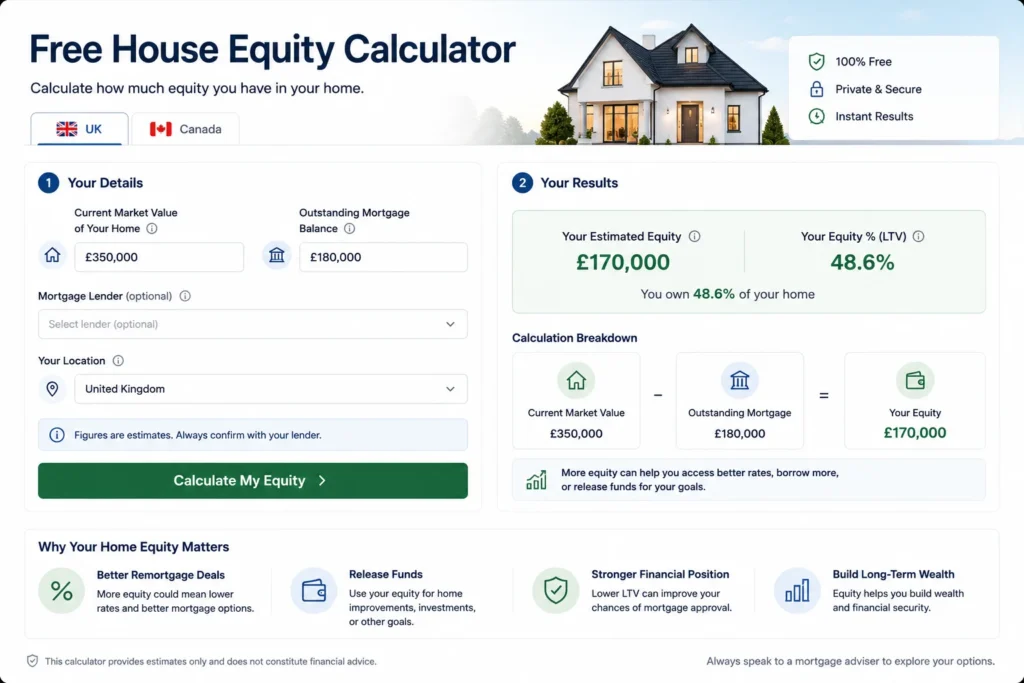
Rather than working this out with a calculator app and a mortgage statement open in two tabs, our house equity calculator does the whole thing instantly, and shows your LTV band alongside it, so you can see exactly where you stand and what it might unlock.
Frequently Asked Questions
How do I calculate the equity in my house?
Take your property’s current market value and subtract everything secured against it — your outstanding mortgage balance plus any second charges or secured loans. What’s left is your equity, both in pounds and as a percentage of the property’s value.
How much equity does the average UK homeowner have?
According to IMLA’s 2026 market data, the average mortgaged UK home holds just over 40% equity, with an estimated £677 billion of housing equity built up nationwide since the financial crisis.
What is loan-to-value and how is it different from equity?
LTV is the flip side of equity — it’s the percentage of your property’s value that’s still secured by debt, while equity is the percentage you own outright. If your equity is 40%, your LTV is 60%, and the two always add up to 100%.
Does overpaying my mortgage build equity faster than home improvements?
Overpaying builds equity guaranteed, pound for pound, because you’re directly reducing secured debt. Home improvements can increase value, but the actual return varies significantly by project and local market, with no guarantee it matches what you spent.
Do I need a professional valuation to know my equity?
Not to get a useful working estimate — recent sold prices for similar nearby properties give a reasonably accurate figure. A formal valuation only becomes necessary once you’re actually applying for a remortgage or equity release, since that’s what the lender will use.
How often should I check my equity?
There’s no fixed rule, but checking once a year, or whenever you’re considering a financial decision involving your home, is a sensible habit — property values and mortgage balances both move steadily enough that a figure from several years ago can be meaningfully out of date.
Official sources: check current UK equity market data from IMLA, general guidance on remortgaging at MoneyHelper, and verify any lender or adviser on the FCA register. Work out your own figure with our house equity calculator, or browse every tool on the mortgage calculators homepage.