
Equity Release Compound Interest | The Shocking Real Cost
Equity release compound interest is the single most misunderstood number in later-life finance, and it’s not really the industry’s fault — compounding is just genuinely hard to picture in your head. Someone releases £50,000 against their home, feels reassured that “there are no monthly payments,” and moves on with their life. Fifteen years later, that £50,000 has quietly become something closer to £130,000, and nobody actively did anything wrong. The interest just did what interest does when nobody’s paying it down.
This is the bit worth understanding properly before you sign anything, because it’s the whole story of what equity release actually costs.
Site editor at MortgageToolsHub — equity release interest calculations checked against standard UK lender compounding methodology. Last checked July 2026.
On This Page
- Why “no monthly payments” is a double-edged phrase
- How compound interest actually works, step by step
- Real numbers: what £100,000 becomes over time
- Why the growth speeds up the longer it runs
- What actually determines how fast yours grows
- Ways to slow it down
- The no negative equity guarantee — what it does and doesn’t fix
- FAQ
Why “No Monthly Payments” Is a Double-Edged Phrase
Every piece of equity release marketing leads with this line, and it’s technically true — you genuinely don’t have to pay anything back each month. What that phrase quietly leaves out is what happens to the interest instead. It doesn’t disappear. It gets added to your loan balance, and from that point forward, you’re being charged interest on that interest too, on top of the original amount you borrowed.
This is the defining feature of a lifetime mortgage, and it’s exactly what separates it from an ordinary loan. A standard mortgage or personal loan charges interest only on what you currently owe, and that balance falls every month as you pay it down. Equity release interest, left untouched, only ever moves in one direction: up.
How Compound Interest Actually Works, Step by Step
Picture a £100,000 loan at 6.5%. In year one, £6,500 of interest gets added, bringing the balance to £106,500. Here’s the part that’s easy to miss: in year two, that 6.5% interest is calculated on £106,500, not on the original £100,000 — so the interest charged is £6,922.50, not £6,500. You’re now paying interest on interest you were charged last year, even though you never touched a penny of the money.
Roll this forward year after year, and the amount added each year keeps growing, because the balance it’s calculated against keeps growing too. Nothing dramatic happens in any single year — it’s the accumulation over a decade or two that catches people off guard.
Real Numbers: What £100,000 Becomes Over Time
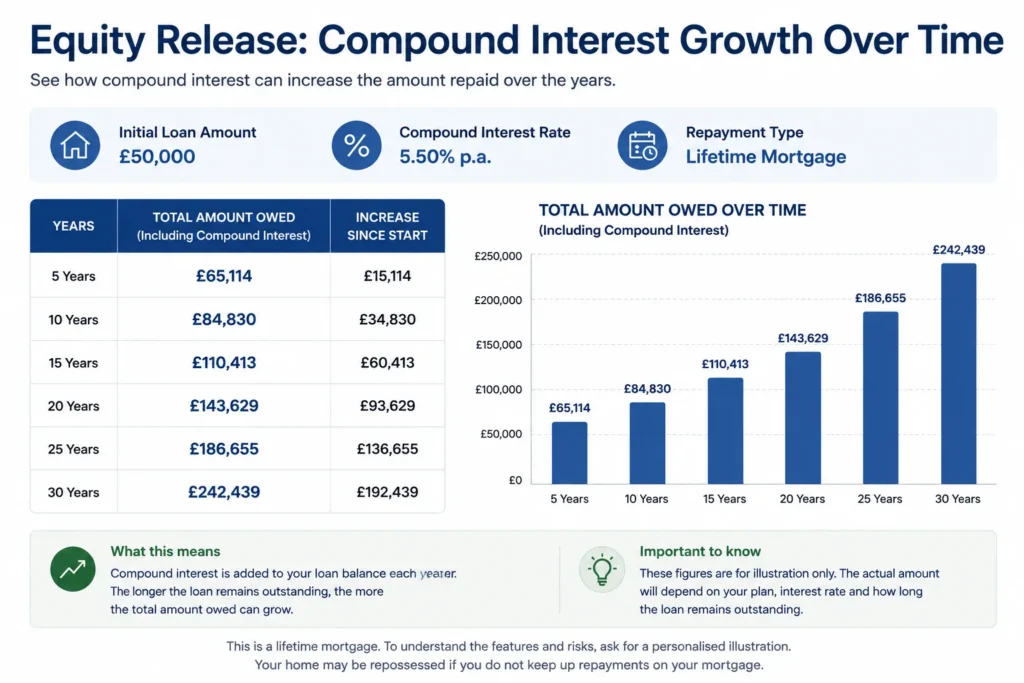
Here’s a £100,000 loan at a representative 2026 rate of 6.5%, with no repayments made at any point:
| Years | Balance owed | Growth from original £100,000 |
|---|---|---|
| 5 years | ~£137,000 | +37% |
| 10 years | ~£188,000 | +88% |
| 15 years | ~£257,000 | +157% |
| 20 years | ~£352,000 | +252% |
| 25 years | ~£482,000 | +382% |
Look at the gap between the 5-year mark and the 25-year mark. In the first five years, the balance grows by £37,000. In the last five years shown here (from 20 to 25), it grows by roughly £130,000 — over three and a half times as much, on the exact same rate, purely because the balance it’s compounding against has grown so much larger by then.
This is precisely why the age you take out equity release, and realistically how long you’ll live afterwards, matters more to the total cost than almost any other factor — including the rate itself.
Why the Growth Speeds Up the Longer It Runs
The technical term for this is exponential growth, and it’s worth understanding intuitively rather than just accepting the table above at face value. Every year, the interest is calculated on a bigger number than the year before. It’s not that the rate changes — 6.5% stays 6.5% throughout — it’s that the base the rate is applied to keeps expanding.
A rough rule of thumb that’s genuinely useful: at 6.5%, a compounding balance doubles roughly every eleven years. Borrow £80,000 at 65 and live another 22 years, and you’re looking at a balance in the region of £320,000 by 87 — quadrupled, not doubled, because two full eleven-year doubling periods have passed.
What Actually Determines How Fast Yours Grows
The interest rate does the most obvious work — equity release rates in 2026 typically range from around 5.8% to 8.3%, and even a one-percentage-point difference compounds into a genuinely large gap over fifteen or twenty years.
How long the loan runs matters just as much, if not more, and it’s the one variable nobody can predict with certainty, since it depends on how long you live in the property. This uncertainty is exactly why providers price the product the way they do.
Whether you make any repayments at all has an outsized effect, covered properly below, because even modest voluntary repayments interrupt the compounding in a way that saves far more than the repayment amount itself over time.
Ways to Slow It Down
This is the part that gets left out of most explanations, and it genuinely changes the picture. Most Equity Release Council plans allow voluntary repayments, typically up to 10% of the original loan each year, without triggering an early repayment charge.
If you pay just the monthly interest — the amount that would otherwise be added to your balance — the debt stops growing entirely. On a £100,000 loan at 6.5%, that’s roughly £542 a month. Pay it consistently for twenty years, and you still owe £100,000, not the £352,000 shown in the table above. That’s a difference of over a quarter of a million pounds, for a monthly commitment many households could genuinely plan around if their retirement income allows for it.
Even repaying something smaller than the full interest slows the growth meaningfully, because every pound repaid stops compounding from that point onward. Our equity release repayment calculator shows exactly how much a given monthly repayment saves over the life of a real plan, using your own numbers rather than a general example.
The No Negative Equity Guarantee — What It Does and Doesn’t Fix
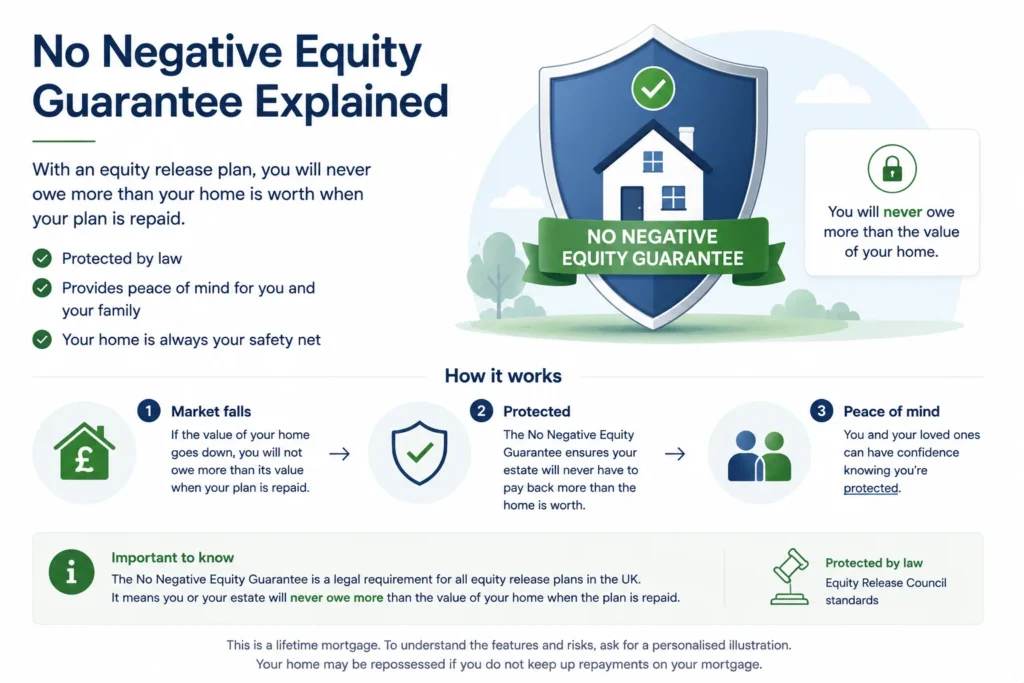
It’s worth being precise about what protection actually exists here, because this gets misunderstood almost as often as compounding itself. Every Equity Release Council member plan carries a no negative equity guarantee: you, or your estate, will never owe more than the property is worth when it’s eventually sold, however large the compounded balance has grown on paper.
What that guarantee does not do is protect your inheritance. It caps your debt, not your equity. If the compounding balance genuinely overtakes the value of the home — which becomes a real possibility over a very long plan, particularly if property growth is modest — your estate simply receives nothing. Nobody owes anything extra, but nobody inherits anything either. Understanding that distinction is the entire reason modelling the growth properly, rather than just trusting “it’ll be fine,” matters so much before you commit to a plan.
A few things worth knowing:
- These figures use a representative 2026 rate and standard compounding assumptions — your actual rate and plan terms will vary by lender and your own circumstances
- Rates on equity release plans are fixed for life once agreed, so they won’t move with future changes to the Bank of England base rate
- Voluntary repayment allowances and rules vary by lender — always check your specific plan’s terms before relying on this as a strategy
- Property value growth works in the opposite direction to the debt, and modelling both together, not the debt alone, gives the full picture of what’s left for your estate
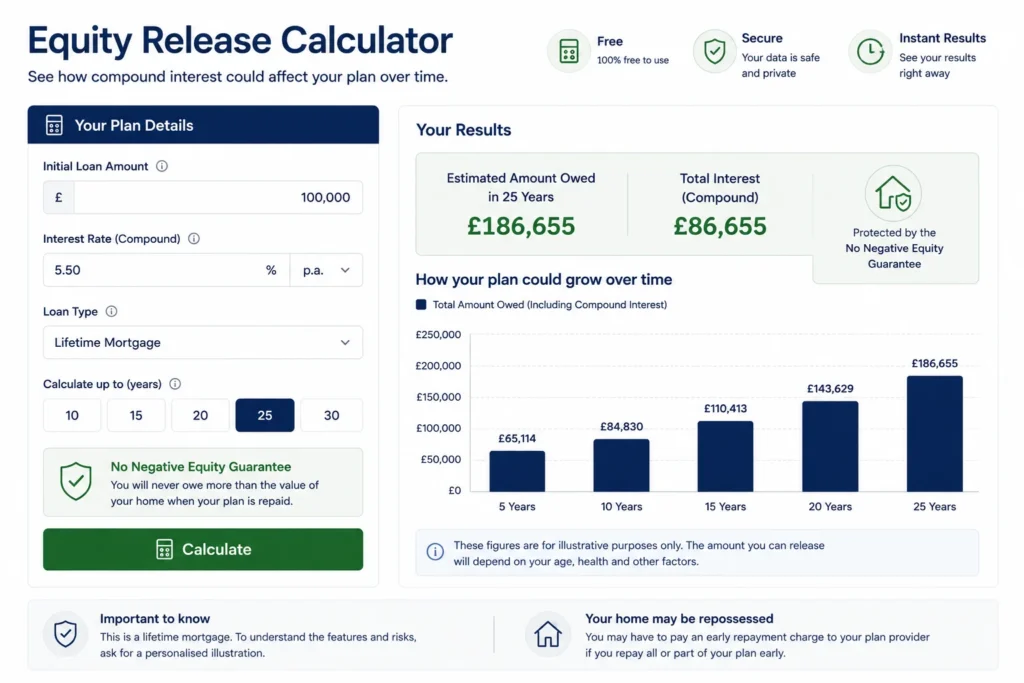
See exactly how compounding would affect your own numbers, and how much a repayment plan could slow it down, using our equity release calculator.
Frequently Asked Questions
How much interest will I owe on equity release over time?
This depends heavily on your rate and how long the plan runs, but as a guide, a £100,000 loan at 6.5% grows to roughly £137,000 after 5 years, £188,000 after 10 years, and £352,000 after 20 years, assuming no repayments are made.
Why does equity release interest grow faster the longer I have it?
Because it’s compound interest — each year’s interest is calculated on a balance that already includes all the previous years’ interest, not just the original amount borrowed. The growth accelerates as the balance itself gets larger.
Can I stop equity release interest from compounding?
Yes, if you make regular repayments. Paying just the monthly interest stops the balance from growing at all, and most plans allow voluntary repayments of up to 10% of the original loan each year without penalty.
Will I ever owe more than my house is worth?
No, provided your plan meets Equity Release Council standards, which include a no negative equity guarantee. However, this only means you won’t owe extra — it doesn’t guarantee anything is left for your estate if the balance catches up to the property’s value.
Does the interest rate on equity release ever change?
No, for the vast majority of plans, the rate is fixed for the life of the loan once it’s agreed, so it won’t move even if the Bank of England base rate changes significantly afterwards.
Is compound interest on equity release worse than a normal mortgage?
It’s structured differently rather than simply worse. A normal mortgage also charges compound interest, but you’re paying it down every month, so the balance shrinks rather than grows. Equity release compounds without repayment, which is why the balance moves in the opposite direction over time.
Official sources: check current standards at the Equity Release Council, get free impartial guidance from MoneyHelper, and verify any adviser on the FCA register. Model your own numbers with our equity release calculator, or browse every tool on the mortgage calculators homepage.