
How Commercial Mortgages Are Calculated | The Complete Guide
Ask most business owners how their commercial mortgage was worked out and you’ll get a shrug. It’s genuinely one of the most opaque corners of UK lending — partly because how commercial mortgages are calculated has almost nothing in common with the residential mortgage most people are already familiar with, and partly because lenders each apply their own spin on the same underlying formulas.
There’s no income multiple here. No “4.5 times your salary.” Commercial lending runs on two ratios most applicants have never heard of before they need them, and understanding both before you apply changes how you structure a deal, not just how you interpret the result.
Site editor at MortgageToolsHub — commercial mortgage calculation methods cross-checked against current UK lender criteria. Last checked July 2026.
On This Page
- Why commercial mortgages aren’t calculated like residential ones
- ICR: the test for investment property
- DSCR: the test for owner-occupied and trading businesses
- The stress rate — the number that actually decides your maximum
- LTV and deposit requirements
- A real worked example
- What can push your maximum up or down
- Common mistakes that shrink the loan
- FAQ
Why Commercial Mortgages Aren’t Calculated Like Residential Ones
A residential lender mostly asks one question: does your income comfortably cover this loan, at roughly 4 to 5 times what you earn? A commercial lender asks something closer to: does the asset or the business itself generate enough income to cover the debt, with a safety margin built in for when things go wrong?
That distinction matters because commercial lending splits into two genuinely different assessments depending on what you’re actually buying the property for:
- Investment property, where a tenant pays rent and you service the mortgage from that rental income
- Owner-occupied or trading premises, where your own business operates from the building and services the mortgage from its trading profit
Each uses a different formula. Get the wrong one in your head going into a conversation with a lender, and you’ll misjudge your own numbers before you’ve even applied.
ICR: The Test for Investment Property
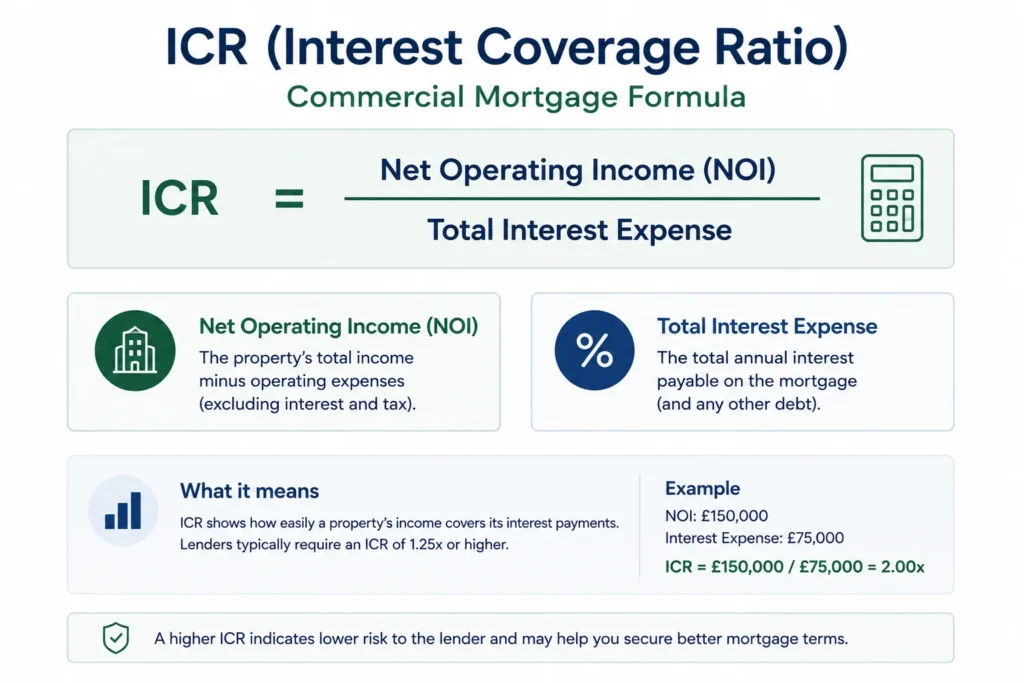
If you’re buying a commercial property to let out — a shop unit, an office suite, an industrial building with a tenant already in place — lenders use the Interest Coverage Ratio (ICR).
The formula is straightforward: annual rental income divided by the annual interest payment at the lender’s stressed rate. The result is expressed as a percentage.
ICR = Annual rental income ÷ Annual interest (at stress rate)
Most lenders want to see this land at 125% for limited companies, and somewhat higher — typically 140% to 145% — if you’re borrowing as an individual rather than through a limited company structure. In plain terms, if your mortgage interest works out to £20,000 a year, a lender wanting 125% cover needs to see at least £25,000 in annual rent before they’ll consider the loan at that level.
Notice what’s not in that formula: your own personal income, your salary, anything about you as an individual beyond your ability to hold the asset. ICR is fundamentally about whether the property pays for itself.
DSCR: The Test for Owner-Occupied and Trading Businesses
If you’re buying the premises your own business will operate from — a restaurant unit, a warehouse, a dental practice — the test changes to Debt Service Coverage Ratio (DSCR), and it works off your business’s trading profit rather than rental income.
DSCR = EBITDA (or adjusted net profit) ÷ Total annual debt service (capital + interest)
This is the more demanding of the two ratios, and there’s a reason for that: unlike a rented investment property, which keeps producing income even if you personally hit a rough patch, an owner-occupied mortgage depends entirely on your own business continuing to trade profitably.
Most lenders want a minimum of 1.25x to 1.50x cover, meaning your EBITDA needs to be at least one and a quarter to one and a half times your total annual mortgage payment, including capital, not just interest. Some specialist lenders will accept as low as 1.35x for businesses with a genuinely strong trading history and covenant, but 1.50x is the more common baseline you should plan around.
The Stress Rate — The Number That Actually Decides Your Maximum
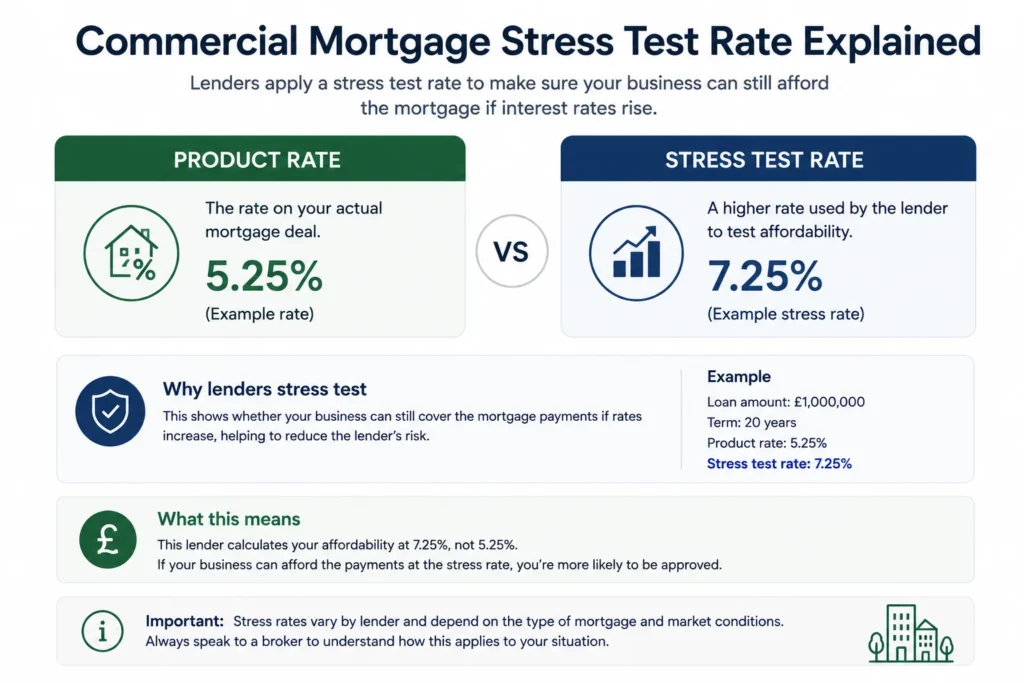
Here’s the part that catches almost everyone off guard: neither ICR nor DSCR is calculated using the rate you’ll actually pay. Lenders apply a stressed rate instead — a deliberately higher, hypothetical figure — to check the deal still stacks up if interest rates rise in the future.
With the Bank of England base rate sitting around 3.75% through much of 2026, most commercial lenders stress-test at somewhere between 5.75% and 8%, depending on the lender’s own risk appetite and the type of property involved. High street banks tend to sit at the higher end of that range; specialist lenders occasionally sit a little lower for particularly strong deals.
This is precisely why two identical properties, with identical rent, can produce different maximum loan sizes depending purely on which lender you approach — one running a 6% stress test and another running 7.5% will land on meaningfully different maximums for exactly the same real-world numbers.
LTV and Deposit Requirements
Even once your income comfortably clears the ICR or DSCR bar, there’s a second constraint working alongside it: loan-to-value. Standard commercial LTV sits at 65% to 75%, meaning you’ll typically need a deposit of 25% to 40% of the purchase price. Owner-occupier premises can sometimes stretch to 75-80%, and certain professional practices with genuinely strong covenants — established GP surgeries or veterinary practices, for instance — occasionally reach 80% or higher with specialist lenders.
Your actual maximum loan is always the lower of the two figures: whatever ICR or DSCR allows, and whatever the LTV cap allows. It’s entirely possible for a property to easily support a bigger loan on rental income alone, only for the LTV cap to be the thing that actually limits how much you can borrow — or the reverse, where the property’s value would support a large loan, but the rental income genuinely can’t cover it.
A Real Worked Example
You want to buy an investment property for £400,000, with a tenant already in place paying £28,000 a year in rent. You’re borrowing through a limited company.
Step one — LTV cap. At 70% LTV, the maximum loan on value alone is £280,000, requiring a £120,000 deposit.
Step two — ICR test. The lender stress-tests at 7%. On a £280,000 loan, annual interest at that stressed rate would be £19,600. Dividing your £28,000 rent by that £19,600 gives an ICR of roughly 143% — comfortably above the 125% threshold for a limited company borrower.
In this case, both tests pass at the full £280,000, so your maximum loan is genuinely £280,000, deposit permitting. Now change one number: if the rent were only £22,000 instead of £28,000, your ICR at the same £280,000 loan would drop to roughly 112%, below the 125% threshold — meaning the lender would reduce the maximum loan until the rent-to-interest ratio climbed back to 125%, even though the LTV cap alone would have allowed the full £280,000.
That’s the mechanic in practice: whichever test bites hardest sets your real maximum, not the more generous of the two.
What Can Push Your Maximum Up or Down
A stronger covenant — a well-established, profitable tenant on a long lease — can occasionally soften ICR requirements slightly with specialist lenders, since the income is seen as more secure.
A shorter fixed-rate period sometimes attracts slightly better stress-test terms than a longer one, though this varies considerably by lender and shouldn’t be assumed without checking.
Void periods and management costs are sometimes deducted from gross rent before the ICR calculation runs, depending on the lender’s own policy — always ask whether the figure you’re being quoted is based on gross or net rental income, since the gap between the two can meaningfully change your result.
A weaker or shorter trading history, for DSCR-assessed applications, typically pushes lenders toward the higher end of their coverage requirement, since there’s less evidence the business can sustain the payment through a downturn.
A few things worth knowing:
- ICR and DSCR thresholds vary by lender — the figures here are representative of the current market, not a guarantee from any specific lender
- Legal and valuation costs on commercial mortgages typically run from £3,000 to £12,000, considerably more than a residential purchase
- Most commercial mortgage terms run 10-25 years, shorter than the typical 25-35 year residential term
- Fixed-rate periods on commercial deals usually run 2-10 years, after which the rate typically reverts to variable
Common Mistakes That Shrink the Loan
Assuming the quoted product rate is what gets used in the affordability calculation. It isn’t — the stress rate does the real work, and it’s often two to three percentage points higher than what you’ll actually pay.
Using gross rent without checking whether the lender wants net. If voids, management fees, or maintenance costs need deducting first, your real ICR can come in noticeably lower than a quick back-of-envelope calculation suggests.
Not shopping the deal across multiple lenders. Because stress rates and ICR/DSCR thresholds genuinely differ by lender, the same deal can be declined by one bank and comfortably approved by another purely on the numbers, before personal preference even enters the picture.
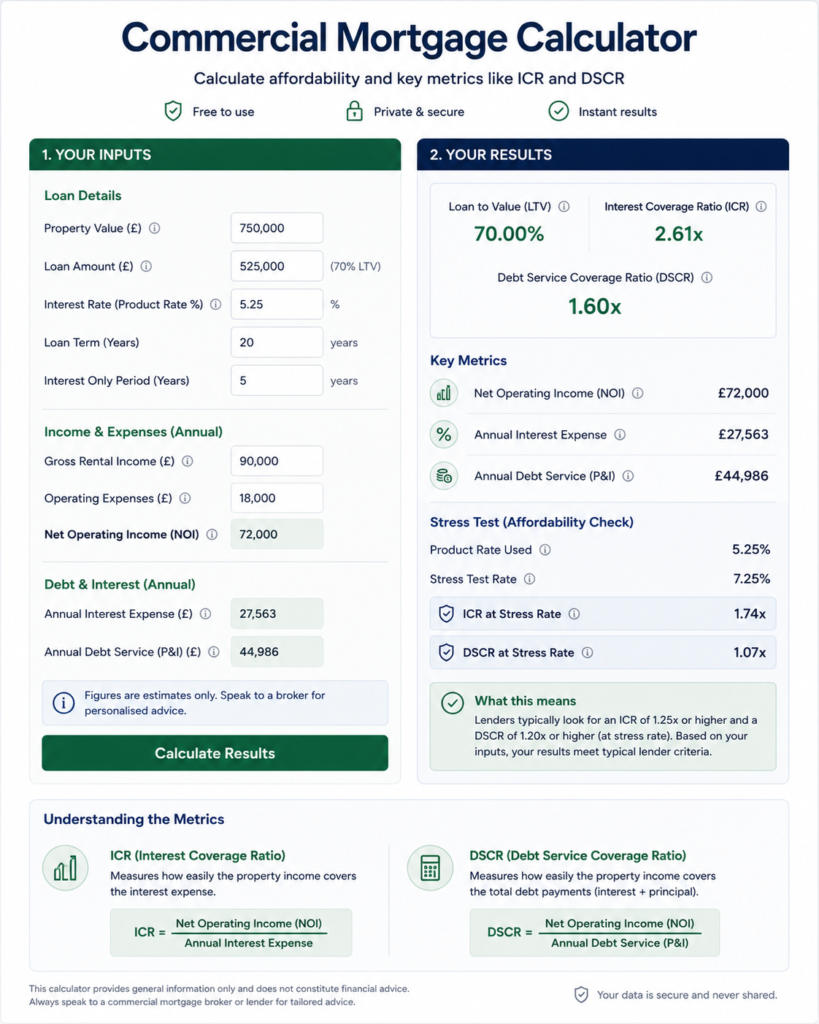
Run your own figures through our commercial mortgage calculator to see how ICR, DSCR, and stress-tested rates apply to your specific property and income before you approach a lender.
Frequently Asked Questions
What is the ICR on a commercial mortgage?
The Interest Coverage Ratio is the test lenders apply to investment commercial property, dividing annual rental income by the annual interest payment at a stressed rate. Most lenders require at least 125% for limited companies and 140-145% for personal name borrowers.
What is the difference between ICR and DSCR?
ICR is used for investment property with a third-party tenant, measured against rental income. DSCR is used for owner-occupied or trading business premises, measured against the business’s own EBITDA or adjusted profit, and includes capital as well as interest in the calculation.
Why do lenders use a stress rate instead of my actual mortgage rate?
To check the loan would still be affordable if interest rates rise in the future. With the Bank of England base rate around 3.75% in 2026, most commercial stress rates sit between 5.75% and 8%, considerably higher than typical product rates.
How much deposit do I need for a commercial mortgage?
Most commercial mortgages require a 25% to 40% deposit, reflecting typical LTV caps of 65% to 75%. Owner-occupier premises and strong professional practices can sometimes access higher LTVs.
What’s a good DSCR for a commercial mortgage?
Most lenders want a minimum of 1.25x to 1.50x, meaning your business’s EBITDA should be at least one and a quarter to one and a half times your total annual debt payment, including capital repayment.
Can rental income alone determine my commercial mortgage size?
Not entirely — your maximum loan is always the lower of what ICR allows based on rental income, and what the LTV cap allows based on the property’s value. Both constraints apply simultaneously.
Official sources: check current base rate decisions at the Bank of England, and verify any lender or broker on the FCA register. Run your own numbers through our commercial mortgage calculator, or browse every tool on the mortgage calculators homepage.