
Home Reversion Plan | The Hidden Alternative to Equity Release
Type “equity release” into any search engine and you’ll be buried under lifetime mortgage results within seconds. A home reversion plan barely gets a mention, despite being a completely legitimate, FCA-recognised way to unlock cash from your home — and for a specific kind of homeowner, it can genuinely beat a lifetime mortgage. It’s not that it’s a secret. It’s just that almost nobody sells it, because almost no advisers specialise in it, because almost no providers still offer it.
Here’s what it actually is, how the numbers work, and honestly, where it falls short too.
Site editor at MortgageToolsHub — home reversion figures cross-checked against current UK provider data and Equity Release Council standards. Last checked July 2026.
On This Page
- What a home reversion plan actually is
- How much of your home you’d sell, by age
- Home reversion vs lifetime mortgage
- Why the discount exists (and why it’s so steep)
- A real worked example
- Who it genuinely suits
- The risks nobody glosses over
- FAQ
What a Home Reversion Plan Actually Is
A home reversion plan isn’t a loan. That’s the single most important thing to understand before anything else, because it separates it entirely from a lifetime mortgage. You’re not borrowing against your house — you’re selling part of it, outright, to a specialist provider, in exchange for a tax-free lump sum, a regular income, or a mix of both.
In return, you get something called a lifetime lease: a legally binding promise that you can carry on living in the property, usually rent-free, for the rest of your life or until you move permanently into long-term care. When that day comes, the house is sold, the provider takes whatever share they own, and the rest — your remaining share — passes to you or your estate.
There’s no interest. There’s no compounding. There’s no monthly bill. Once the sale of that percentage is agreed, that’s the transaction complete. What happens afterwards is purely about what the property is eventually worth when it’s sold.
How Much of Your Home You’d Sell, By Age
This is where home reversion plans genuinely reward age in a way that feels almost blunt when you first see the numbers written down.
| Age | Typical offer as % of market value | On a £300,000 home, selling a 40% share |
|---|---|---|
| 65 | Around 25% | ~£30,000 |
| 75 | Around 35-40% | ~£42,000-£48,000 |
| 85 | Around 50% | ~£60,000 |
| 90 | Up to 60% | ~£72,000 |
Notice what’s happening here: it’s not that the house is worth less at 65. It’s that the provider expects to wait far longer before they can sell it and get their money back, and they price that waiting time into the offer. The older you are, the shorter that expected wait, the higher the percentage of true value you’re offered.
Most providers set a minimum age of 60, and many prefer applicants closer to 65 or above — noticeably older than the 55 minimum you’ll find on a standard lifetime mortgage. That age gap alone rules a home reversion plan out for a chunk of people who’d otherwise consider it.
Home Reversion vs Lifetime Mortgage
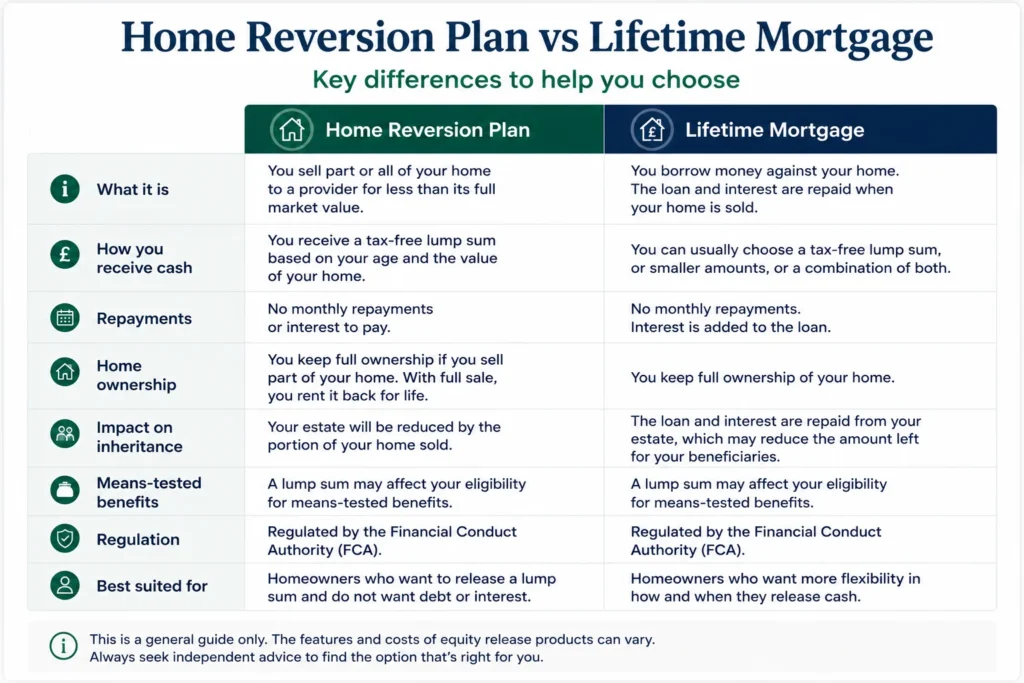
| Home reversion plan | Lifetime mortgage | |
|---|---|---|
| What you’re doing | Selling a share of your home | Borrowing against your home |
| Interest | None — it’s a sale, not a loan | Compounds, often 6-8.3% MER |
| Minimum age | Usually 60-65 | 55 |
| What you get | A discounted percentage of market value | Full loan amount, at the agreed rate |
| Future house price growth | Belongs proportionally to the provider | Belongs entirely to you |
| Predictability of estate value | Fixed percentage, more predictable | Depends entirely on how long the loan runs |
| Reversibility | Permanent — can’t buy the share back except at full value | Can sometimes be repaid or refinanced |
The trade genuinely comes down to this: a lifetime mortgage lets you keep 100% ownership, but the debt can grow in a way that’s hard to predict decades out. A home reversion plan gives up ownership of a fixed share immediately, but from that point on, your remaining share is simply yours — no compounding eating into it, no debt that can spiral past the home’s value. For someone who wants certainty over what’s left for their family, rather than the biggest possible number, that predictability is the whole appeal.
Why the Discount Exists (and Why It’s So Steep)
It’s worth being genuinely honest about this, because the discount can feel jarring the first time you see it. A real example that’s been reported: someone sold a 60% share of a £250,000 property for £60,000 — a share that, at full market value, would have been worth around £150,000. That’s a gap of roughly £90,000 given up, before any fees enter the conversation at all.
The provider justifies that gap with one simple fact: they can’t sell their share, or realise any return on it, until you die or move into care — which could be five years away or thirty. During that entire time, they’re not earning rent, they’re not getting interest, and they’re carrying all the uncertainty of not knowing when the property will actually change hands. The discount is effectively the price of that uncertainty, priced in upfront.
There’s a second layer to it too: future growth on the share you sell belongs to the provider, not you. If your £300,000 home doubles in value over the next twenty years, the provider’s 40% share doubles right along with it — value you no longer have any claim to, because you sold that percentage outright rather than borrowing against it.
A Real Worked Example
You’re 70, your home is worth £350,000, and you want £70,000. At your age, a provider might offer you something in the region of 35% of market value for the share needed to raise that amount, meaning you’d be selling roughly a 57% share of the property to reach £70,000 in cash (since 35% of a 57% share works out close to the target figure — providers will run the exact maths for your specific case).
Twenty years later, say the property has grown to £550,000 through ordinary market appreciation. The provider’s 57% share is now worth roughly £313,500, and your remaining 43% share is worth around £236,500. That £236,500 is what passes to your estate — a fixed, known proportion, unaffected by any compounding debt, however long you lived in the property.
Compare that to a lifetime mortgage for the same £70,000 at 6.5%, left to compound for the same 20 years: the debt alone would grow to roughly £244,700 — meaning if the same £550,000 home value applied, your estate would be left with around £305,300. In this particular scenario, the lifetime mortgage actually leaves more for the estate, purely because of how much the property appreciated. Flip the growth assumption to something more modest, or run the numbers over 25-30 years instead of 20, and the outcome can tilt the other way entirely — which is exactly why running your own numbers, rather than trusting a single example, matters so much here.
Who It Genuinely Suits
A home reversion plan tends to make the most sense for homeowners who are older (closer to 70-90 than 55-60, where the percentages become far more competitive), who prioritise predictability over maximising the final number, and who are comfortable with the idea of giving up ownership of a portion of their home permanently in exchange for that certainty.
It can also suit someone in poorer health, where a shorter life expectancy tends to work in their favour on the percentage offered, in much the same way an enhanced lifetime mortgage rewards health conditions with better terms.
The Risks Nobody Glosses Over
It’s permanent. Once you’ve sold a share, you cannot simply change your mind and buy it back at the price you sold it for — only at full current market value, which defeats the purpose entirely if property prices have risen since.
Not all providers are Equity Release Council members, and home reversion plans historically haven’t carried quite the same weight of FCA-specific regulation as lifetime mortgages, though standards have tightened. Checking ERC membership before signing anything isn’t optional — it’s the single easiest way to confirm you’re getting the standard protections, including the guaranteed right to remain in your home for life.
Releasing a lump sum can affect means-tested benefits like Pension Credit or Council Tax Reduction, exactly as it can with a lifetime mortgage, if the cash pushes your savings above the usual thresholds.
You lose all future growth on the share you sell. If you believe strongly that property prices in your area are heading meaningfully upward, that’s value you’re giving away permanently, not borrowing against.
A few things worth knowing:
- Percentages offered vary considerably by provider, health, and property type — the figures here are representative, not a quote
- You’ll need independent legal advice before any home reversion plan can complete, and your solicitor cannot be connected to the provider
- Maintenance of the property remains your responsibility, even for the share you no longer own
- Selling less than 100% is common, and most people don’t sell their entire home — you choose the percentage based on how much cash you actually need
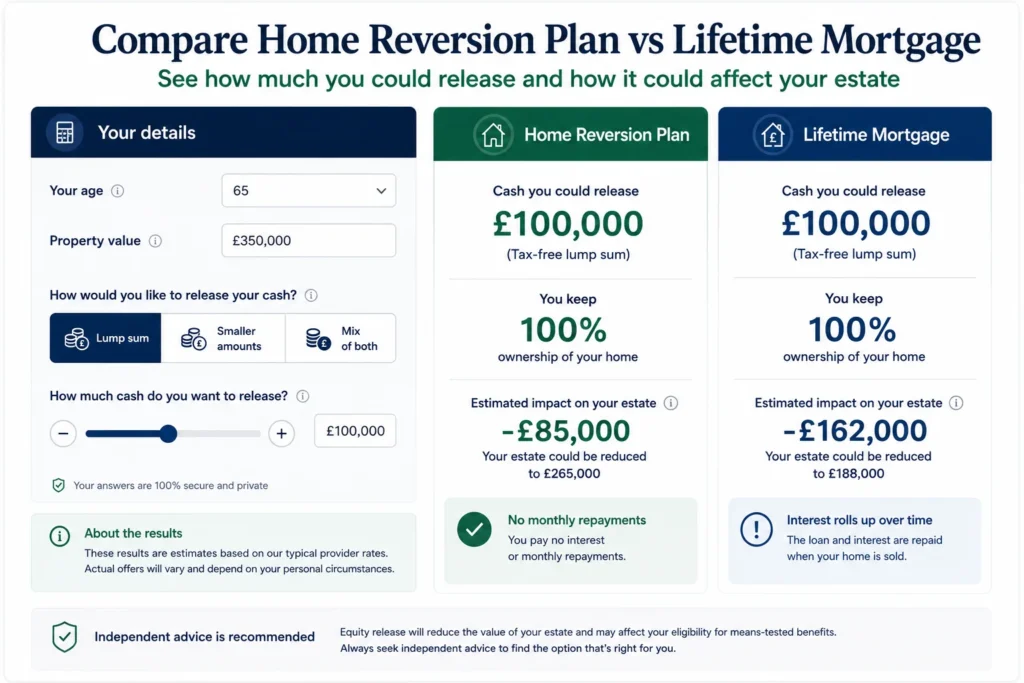
Before deciding between the two, it’s worth seeing both routes modelled against your own numbers rather than a generic example. Our equity release calculator compares all four equity release routes — including a home reversion estimate — on what’s genuinely left for your estate.
Frequently Asked Questions
What is a home reversion plan?
A home reversion plan lets you sell all or part of your home to a specialist provider for a tax-free lump sum, income, or both, while keeping the legal right to live there rent-free for the rest of your life or until you move into long-term care.
How much of my home would I need to sell?
This depends on your age, the amount you need, and the percentage of market value the provider offers — typically 25% at 65, rising to around 60% by 90. Most people sell somewhere between 20% and 60% of their property, not the whole thing.
Is a home reversion plan the same as equity release?
Home reversion is one of two main types of equity release, alongside the far more common lifetime mortgage. The key difference is that a home reversion plan involves selling a share outright, with no interest or compounding, whereas a lifetime mortgage is a loan that grows over time.
What happens to my home reversion share if house prices rise?
The growth on the percentage you’ve sold belongs to the provider, not you. Only the growth on your remaining share benefits your estate.
Can I change my mind after taking out a home reversion plan?
Not easily. Once a share has been transferred, you can’t buy it back at the original price — only at current market value — which makes this one of the least reversible decisions in later-life lending.
Does a home reversion plan affect my benefits?
It can. Releasing a lump sum may push your savings above the thresholds for means-tested benefits such as Pension Credit, so it’s worth checking your specific position before proceeding.
Official sources: check current standards at the Equity Release Council, get free impartial guidance from MoneyHelper, and verify any adviser on the FCA register. Compare this against a lifetime mortgage using our equity release calculator, or browse every tool on the mortgage calculators homepage.