
Best Savings Rate UK 2026 | The Simple Guide to Earning More
Finding the best savings rate UK providers actually offer right now isn’t the hard part — comparison sites do that for you in seconds. The genuinely hard part, the bit that costs people real money year after year, is knowing which type of account to even be comparing in the first place. Easy access, fixed bonds, regular savers, Cash ISAs — they’re not competing products chasing the same job. Each one exists for a different kind of money, and picking the wrong one for your situation quietly costs you more than a slightly lower rate ever would.
Let’s go through what’s actually available in 2026, and more importantly, how to work out which account your money should be sitting in.
Site editor at MortgageToolsHub — savings rate figures cross-checked against current UK provider data. Last checked July 2026.
On This Page
- What the best savings rate UK accounts are paying right now
- Easy access, fixed bonds, regular savers and ISAs — the real differences
- The tax trap that catches more people than you’d think
- Why headline “best” rates aren’t always the best choice
- FSCS protection — the number that actually changed
- A simple way to decide where your money should go
- FAQ
What the Best Savings Rate UK Accounts Are Paying Right Now
Rates move constantly, sometimes within the same week, so treat this as a snapshot rather than a fixed number — but here’s roughly where the market sits as of late July 2026:
| Account type | Typical top rate | What it’s for |
|---|---|---|
| Easy access | ~4.5% – 5% | Money you might need at short notice |
| Easy access Cash ISA | ~4.5% – 4.7% | Same, but tax-free |
| 1-year fixed bond/ISA | ~4.5% – 4.85% | Money you’re confident you won’t need for a year |
| 5-year fixed ISA | Up to ~4.81% | Long-term cash you’re happy to lock away |
| Regular saver | Up to ~7% | Small monthly amounts, building a saving habit |
Two things worth noticing immediately. First, high street banks typically sit one to two percentage points behind the actual best savings rate UK challenger banks and app-based providers offer — the account your bank shows you in their app is very rarely the best one available to you. Second, regular savers pay noticeably more than everything else, but almost always with a catch: a monthly deposit cap, often somewhere between £200 and £400, so the higher rate only applies to a relatively small pot.
Easy Access, Fixed Bonds, Regular Savers and ISAs — The Real Differences
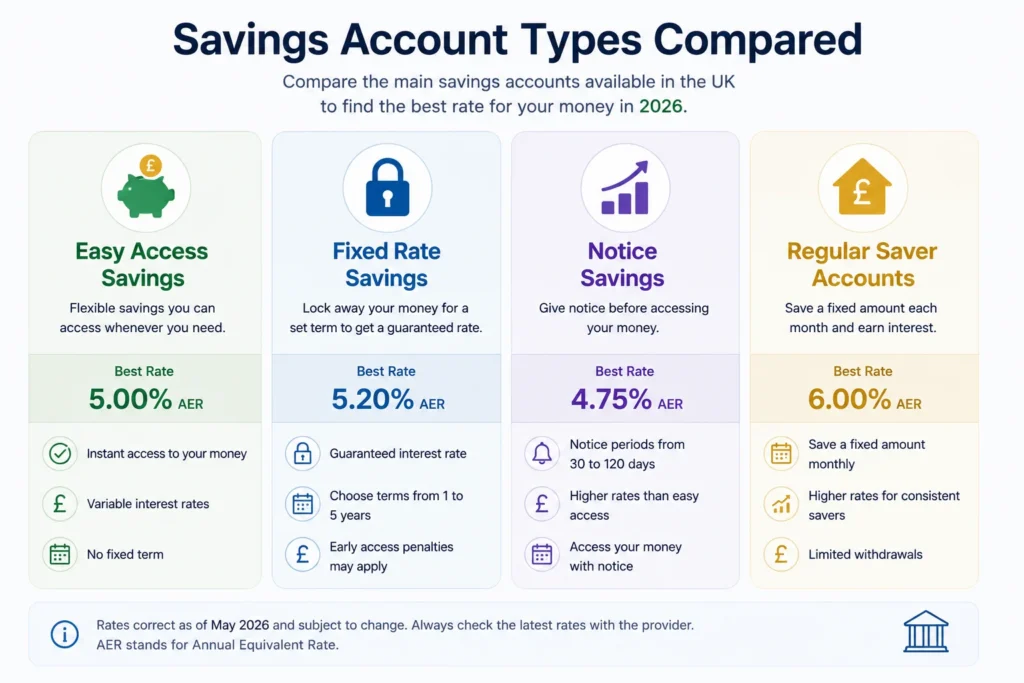
Easy access does exactly what it says — withdraw whenever you need to, no notice, no penalty. It’s the right home for an emergency fund or money you genuinely might need at short notice, and it should almost always be the first account you fill before considering anything else, regardless of what rate it’s paying compared to a fixed alternative.
Fixed bonds lock your rate in for a set term — commonly one to five years — in exchange for a typically higher rate than easy access. The trade is real: early access is often either impossible or comes with a meaningful loss of interest. These suit money you’re genuinely confident you won’t need before the term ends.
Regular savers reward a savings habit rather than a lump sum, usually requiring a fixed monthly deposit within a cap, and often locking you out of withdrawals without losing the bonus rate. They’re excellent for building a habit or saving toward something specific over a year, less useful as a place to park a large existing sum.
Cash ISAs aren’t really a separate rate category — they’re a tax wrapper that can sit around an easy access, fixed, or notice account, shielding the interest from tax entirely. Whether that wrapper is worth choosing over an equivalent non-ISA account depends entirely on your tax position, which brings us to the part that trips up more people than any of the account types themselves.
The Tax Trap That Catches More People Than You’d Think
Every basic-rate taxpayer gets a Personal Savings Allowance (PSA) of £1,000 a year in tax-free interest. Higher-rate taxpayers get £500. Additional-rate taxpayers get nothing at all.
Here’s where it catches people: with the best savings rate UK accounts now sitting comfortably above 4%, it takes far less capital than most people assume to breach that allowance. A higher-rate taxpayer with roughly £12,500 sitting in a standard account at 4% is already at their £500 limit — and anything beyond that starts getting taxed at their marginal rate. A basic-rate taxpayer needs around £25,000 at the same rate before hitting their £1,000 ceiling.
If you’re anywhere near those thresholds, a Cash ISA stops being a nice-to-have and becomes the meaningfully better choice, since every penny of interest inside it is entirely tax-free regardless of how much you hold or what your total income looks like. The 2026/27 ISA allowance is £20,000, resetting every 6 April — though it’s worth knowing this changes from April 2027, when the cash ISA allowance drops to £12,000 for most savers, with over-65s retaining the full £20,000.
Why Headline “Best” Rates Aren’t Always the Best Choice
The account topping a comparison chart isn’t automatically the right one for your money, and this is worth internalising before you chase a rate blindly. A 5-year fixed ISA paying the single highest number on the page is a poor choice for your emergency fund, however attractive the headline rate looks, because you genuinely can’t get at it without a penalty if your boiler breaks in month eight.
Equally, leaving a large sum sitting in easy access “just in case” when you know realistically you won’t touch it for years means quietly accepting a lower rate than a fixed alternative would have paid, for flexibility you’re never actually using. The best savings rate UK for your situation is the best rate available for the specific account type your money genuinely needs — not the single highest number on any comparison table.
FSCS Protection — The Number That Actually Changed
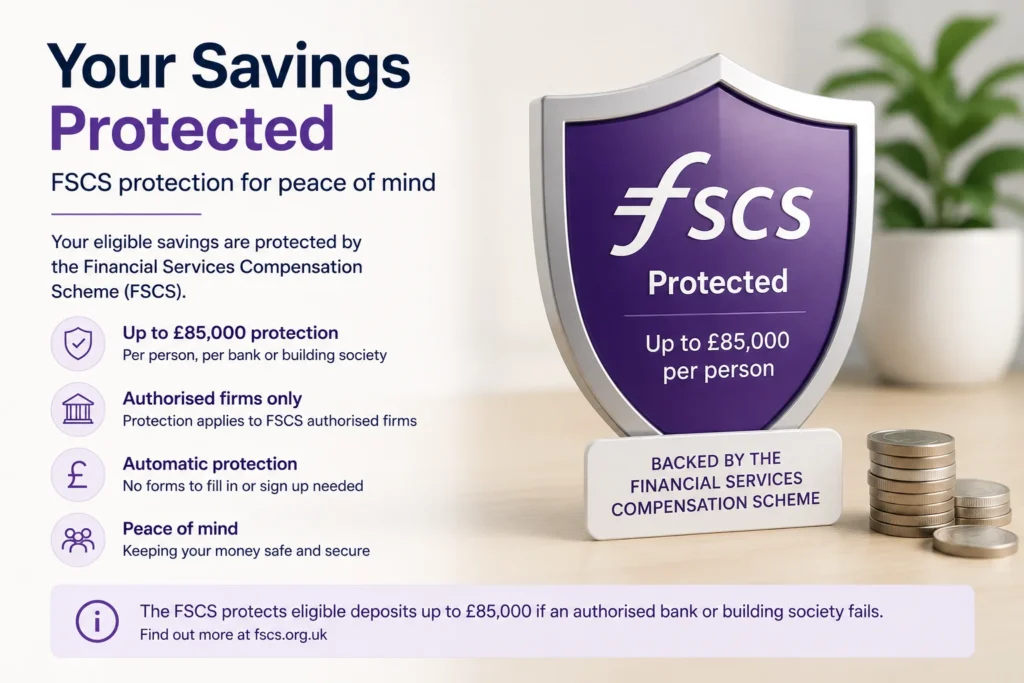
This is worth flagging directly because the figure has moved and a lot of older content online still quotes the outdated number. The Financial Services Compensation Scheme (FSCS) protects eligible deposits up to £120,000 per person, per UK-regulated institution — an increase from the previous £85,000 limit.
If you’re holding savings above that threshold with a single provider, it’s worth spreading the excess across separate institutions, since protection applies per banking licence, not per account — some banking brands actually share a licence with another, which occasionally trips people up when they assume they’ve diversified but haven’t. It’s a five-minute check worth doing if you hold significant savings.
A Simple Way to Decide Where Your Money Should Go
Rather than starting from “what’s the best rate,” start from “what is this specific money for.” An emergency fund of three to six months’ essential outgoings belongs in easy access, full stop, regardless of the rate gap to a fixed alternative. Money earmarked for something specific in twelve months or more — a deposit, a known future expense — can reasonably sit in a fixed bond or fixed ISA for the better rate. Small, regular monthly savings toward a habit or short-term goal suit a regular saver. And once you’re within striking distance of your Personal Savings Allowance, shift new saving into an ISA before adding more to a taxable account.
A few things worth knowing:
- Rates change frequently, sometimes within days — treat any specific number here as a snapshot rather than a live quote
- The best savings rate UK challenger banks offer often requires opening an account with a provider you haven’t heard of before — check they’re FSCS-protected before depositing
- Regular saver bonus rates typically only apply for 12 months, after which the account often reverts to a much lower standard rate
- Fixed bonds generally can’t be topped up after the initial deposit, unlike easy access and some regular savers
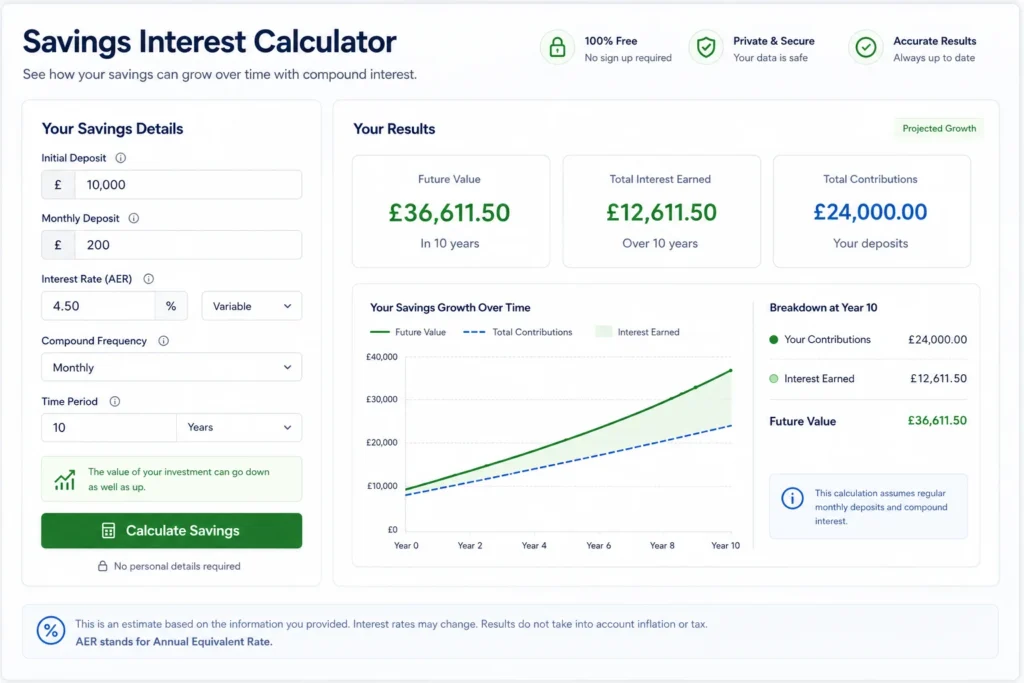
See exactly how much a given rate would earn on your own savings, with monthly top-ups and compound growth modelled properly, using our savings interest calculator.
Frequently Asked Questions
What is the best savings rate in the UK right now?
This changes frequently, but as of mid-2026, top easy access accounts pay around 4.5-5%, top fixed bonds around 4.5-4.85%, and regular savers up to around 7% on capped monthly amounts. Always check current comparison tables, since rates can move within days.
Should I choose a Cash ISA or a regular savings account?
It depends on your tax position. If your total savings interest is likely to exceed your Personal Savings Allowance (£1,000 for basic-rate taxpayers, £500 for higher-rate), a Cash ISA shelters that interest from tax entirely, often making it the better choice even at an identical or slightly lower headline rate.
How much can I hold safely with one savings provider?
FSCS protection covers up to £120,000 per person, per UK-regulated institution. Above that threshold, spreading savings across separate institutions is worth considering, since protection applies per banking licence rather than per account.
Is a fixed savings bond better than easy access?
It depends what the money is for. Fixed bonds typically pay a higher rate in exchange for locking your cash away for a set term, usually with penalties for early access. They suit money you’re confident you won’t need before the term ends, not an emergency fund.
How much is the ISA allowance in 2026?
For the 2026/27 tax year, the ISA allowance is £20,000, resetting every 6 April. This is set to change from April 2027, when the cash ISA allowance reduces to £12,000 for most savers, though those aged 65 and over will retain the full £20,000.
Are high street bank savings rates competitive?
Generally not. High street banks typically pay one to two percentage points less than challenger banks and app-based providers for equivalent account types, so it’s worth comparing beyond your own current bank before depositing new savings.
Official sources: check current ISA allowances and rules at GOV.UK, read general savings guidance at MoneyHelper, and confirm protection limits at the FSCS. Model your own savings growth with our savings interest calculator, or browse every tool on the mortgage calculators homepage.