
RIO Mortgage Explained: The Option Between a Normal Mortgage and Equity Release
Ask most people what happens to their mortgage options once they retire, and you’ll get one of two answers: either they think the door closes entirely, or they assume equity release is the only thing left. A RIO mortgage — retirement interest-only — sits quietly in between the two, and it’s genuinely one of the least talked-about products in later-life lending, despite frequently being the cheaper choice.
If you’ve got an interest-only mortgage that’s about to mature with no repayment plan in place, or you’re simply retired and want to borrow against your home without the compounding cost of equity release, this is worth ten minutes of your time before you go anywhere near a lifetime mortgage calculator.
Site editor at MortgageToolsHub — RIO mortgage criteria and rates cross-checked against current UK lender data. Last checked July 2026.
On This Page
- What a RIO mortgage actually is
- Who can get one
- RIO mortgage rates in 2026
- RIO vs equity release — the real difference
- Why people take one out
- What lenders check
- The costs involved
- When a RIO isn’t the right fit
- FAQ
What a RIO Mortgage Actually Is
A RIO mortgage lets you borrow against your home and pay back only the interest, every month, for as long as you own the property. The amount you originally borrowed — the capital — never reduces during your lifetime. It sits there, untouched, and gets repaid in full from the sale of your home when you die, move into permanent long-term care, or choose to sell and pay it off yourself.
There’s no fixed end date the way there is with a standard 25-year repayment mortgage. It simply continues until one of those trigger events happens. That’s the “retirement” part of the name doing real work: it’s built around the idea that your income in later life is often fixed and predictable — a pension, rental income, investment income — rather than a salary that grows over time, so a fixed monthly interest payment fits how retirement finances actually behave.
The critical thing that separates a RIO mortgage from equity release, and it’s worth sitting with this for a second: the interest doesn’t roll up. You’re paying it as you go, every month, so the debt stays exactly the same size for as long as you own the home. That single difference changes the entire cost comparison with equity release, which we’ll get into properly below.
Who Can Get a RIO Mortgage
Most UK lenders set a minimum age of 55, though a handful go as low as 50, and there’s genuinely no maximum age at the other end — some lenders will lend to borrowers well into their 80s, provided the income and affordability checks stack up. Halifax, Lloyds, Santander, and NatWest all set 55 as their entry age; a few specialist and building society lenders sit slightly lower.
The property itself has to be your main residence — not a second home or buy-to-let — and lenders typically want you to already hold a reasonable amount of equity, often around 50% or more, though this varies by lender. Loan-to-value caps on RIO mortgages tend to sit lower than a standard residential mortgage, usually somewhere in the 50% to 65% range rather than the 85-90% you’d see on a typical first-time buyer product.
RIO Mortgage Rates in 2026
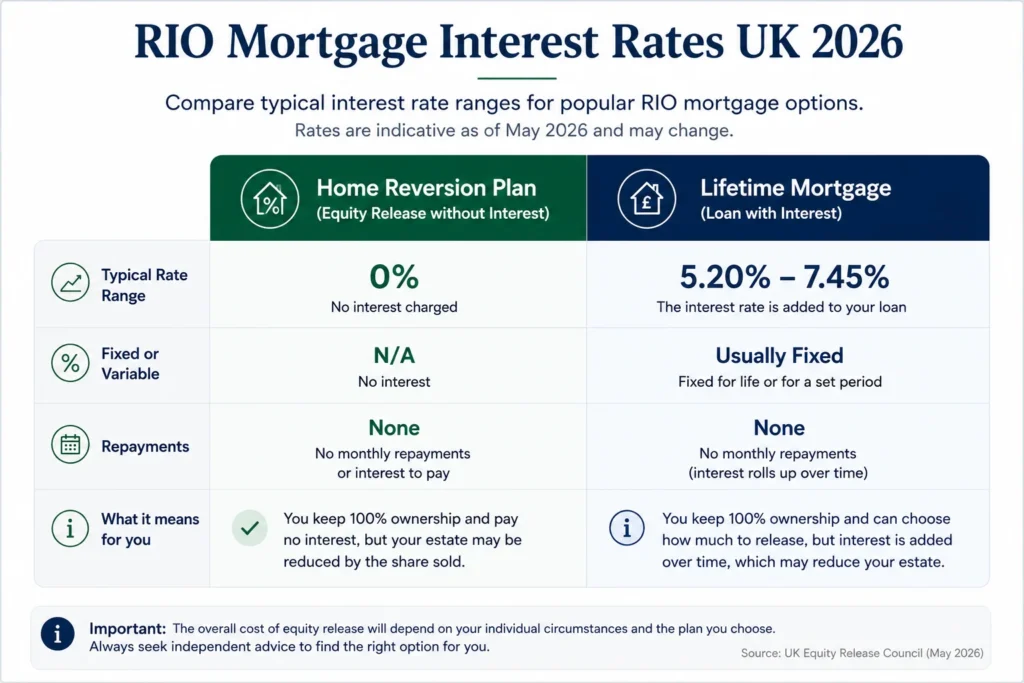
Rates vary meaningfully by lender, age, and loan-to-value, but here’s a representative snapshot of where the market sits in 2026:
| Lender | Indicative rate | Max LTV |
|---|---|---|
| Leeds Building Society | ~4.49% (fixed) | 55% |
| Lloyds Bank | ~4.59% (rate) / 6.0% APRC over-70s | 50-65% |
| NatWest | ~5.19% APRC | 65% |
| Market range overall | ~4.5% – 7% | 50-65% |
Compare that against a lifetime mortgage, where rates in 2026 typically sit between 6% and 8.3% MER, and you can already see why a RIO mortgage is often the cheaper route for someone who can actually service the monthly interest. The rate itself being lower matters, but it’s not even the main event — the real saving comes from the fact that RIO interest doesn’t compound. We’ll put real numbers against that in the next section.
RIO vs Equity Release — The Real Difference
This is the comparison that actually matters, and it’s the reason a RIO mortgage exists at all: it’s built to sit directly between “get a normal mortgage” and “take out equity release,” picking up the households that don’t fit neatly into either.
Say you need to borrow £50,000 against your home at 65. On a lifetime mortgage at 6.5%, left to compound with no payments, that £50,000 becomes roughly £128,000 after 15 years — you still owe it all, now more than double, and it comes out of your estate when you eventually pass away or move into care.
On a RIO mortgage at 5%, you’d be paying roughly £208 a month in interest. After 15 years, you’ll have paid around £37,500 in total interest — but the capital is still exactly £50,000. Not £128,000. Fifty thousand. The debt hasn’t grown by a single pound, because you’ve been servicing it the whole way through rather than letting it accumulate.
The trade-off is obvious once you see it laid out: a RIO mortgage costs you a real, ongoing monthly payment. A lifetime mortgage costs you nothing monthly but considerably more overall. Neither is universally “better” — it genuinely comes down to whether £208 a month is affordable against your retirement income, because if it is, the numbers tilt heavily toward the RIO.
Why People Take Out a RIO Mortgage
Clearing an interest-only mortgage with no repayment plan. This is one of the most common reasons. If you took out an interest-only mortgage years ago and the term is approaching with no way to clear the capital, a RIO mortgage lets you move onto a product with no fixed end date, buying you certainty without needing a lump sum to pay off the balance.
Releasing cash without the compounding cost of equity release. Home improvements, helping family with a deposit, consolidating debt — the same reasons people consider equity release, but for a household with reliable retirement income who’d rather keep the debt static than watch it grow.
Staying in the family home rather than downsizing. For some people, moving to release equity simply isn’t something they want to do, and a RIO mortgage offers a way to access value in the property without leaving it.
What Lenders Actually Check
Affordability is assessed almost entirely on your retirement income — state pension, private pension, annuity income, rental income, and in some cases investment income. What’s notably different from a standard mortgage is that lenders generally don’t factor in employment income the way they would for a working-age applicant, even if you’re still working part-time; the assessment is built around what your income looks like once you’re relying on retirement sources.
Because there’s no fixed term to plan around, lenders focus heavily on whether the interest payment is sustainable indefinitely, not just affordable today. This is actually a point in your favour compared to a standard mortgage: since the debt never needs full repayment during your lifetime, the affordability bar is often described by brokers as more forgiving than a conventional interest-only product, precisely because retirement income tends to be stable and predictable rather than fluctuating.
If self-employment income is still part of your picture in the years leading up to a RIO application, our guide to SA302s covers exactly what lenders want to see as proof of income, which is useful groundwork even if the RIO itself will ultimately be assessed on retirement income.
The Costs Involved
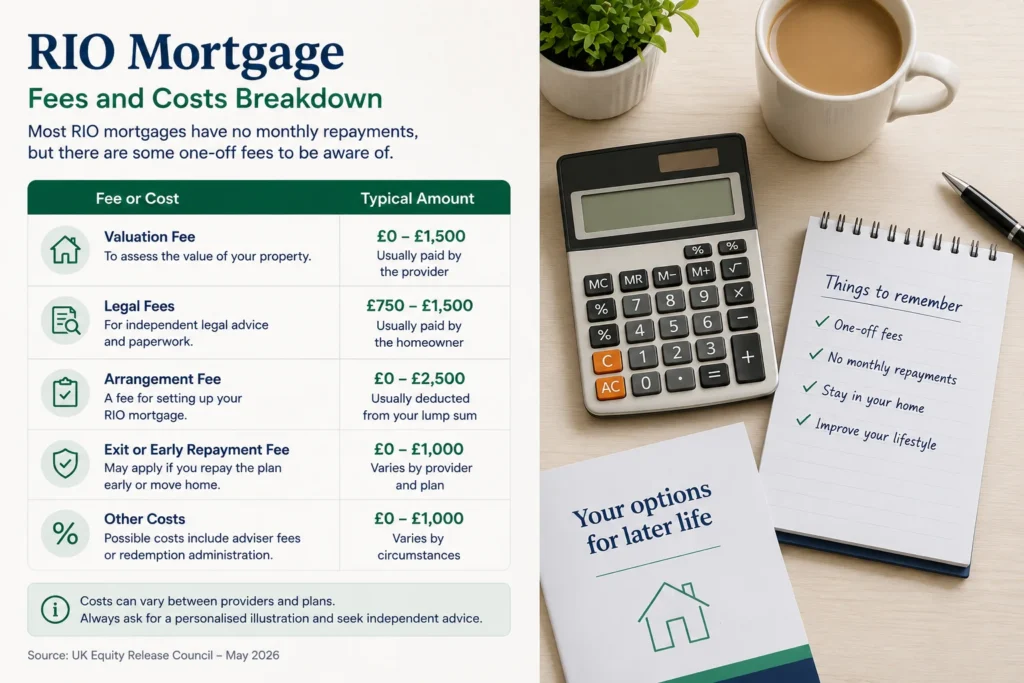
A RIO mortgage carries broadly the same set-up costs as any mortgage: a valuation fee so the lender can confirm the property is suitable security, legal fees for conveyancing and title checks, and in many cases an advice fee if you go through a broker or adviser — often in the region of £1,500 to £2,000, though this varies considerably by firm.
Unlike equity release, there’s no mandatory independent legal advice requirement built into the regulation specifically for RIO products, though most brokers will still recommend it given the size and long-term nature of the commitment.
When a RIO Mortgage Isn’t the Right Fit
If your retirement income genuinely can’t stretch to a monthly interest payment — even a modest one — a RIO mortgage isn’t realistically available to you, regardless of how much equity you hold. This is precisely the gap equity release exists to fill, and it’s worth being honest with yourself about affordability before spending time on an application that’s unlikely to pass underwriting.
It’s also worth thinking carefully if your income could become less predictable in the years ahead. A RIO mortgage assumes the monthly payment continues indefinitely; if there’s real uncertainty about whether that will remain affordable ten or twenty years from now, that’s a conversation worth having with an adviser before committing, since falling behind on payments puts your home at risk in exactly the way any mortgage does.
A few things worth knowing:
- RIO rates and LTV limits vary considerably by lender — the figures here are representative, not a quote
- Your home is at risk if you fall behind on the monthly interest payments, the same as any mortgage secured against your property
- Some lenders allow optional capital repayments on top of the interest, which can reduce the balance over time if you choose to make them
- Always compare a RIO mortgage against equity release using your own numbers before deciding, since the right answer depends heavily on how much you need, your age, and your monthly income
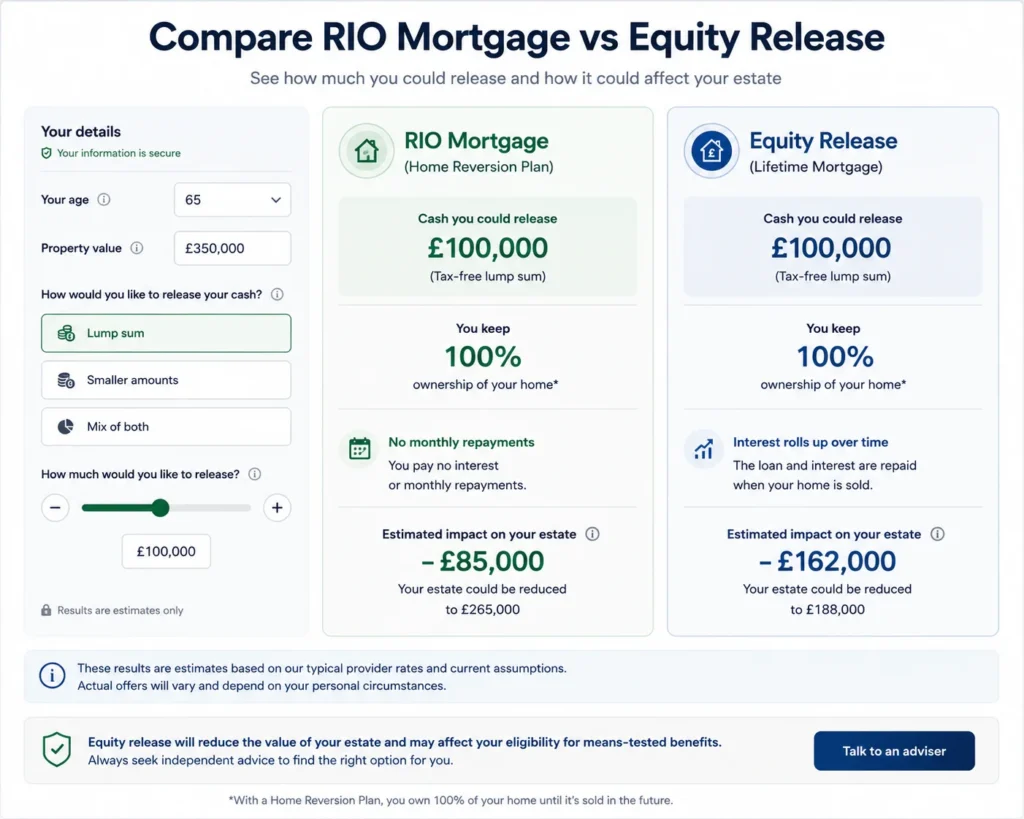
If you want to see how a RIO-style monthly payment compares against equity release for your own numbers, our equity release calculator models both a lump sum and an interest-served route side by side, and our mortgage affordability calculator can help you sanity-check whether a monthly interest payment fits your income before you approach a lender.
Frequently Asked Questions
What is a RIO mortgage?
A retirement interest-only (RIO) mortgage lets you borrow against your home and pay back only the interest each month, with the capital repaid when you die, move into long-term care, or sell the property. Unlike a standard mortgage, there’s no fixed end date.
What age can I get a RIO mortgage?
Most UK lenders set a minimum age of 55, though some go as low as 50. There’s generally no maximum age, provided you can evidence sustainable retirement income to cover the monthly interest.
Is a RIO mortgage cheaper than equity release?
For someone who can comfortably afford the monthly interest payment, yes, usually significantly, because the debt doesn’t compound the way it does with a lifetime mortgage. The trade-off is the ongoing monthly commitment, which equity release doesn’t require.
How much can I borrow with a RIO mortgage?
This depends on the lender and your income, but loan-to-value caps typically sit between 50% and 65% of your property’s value, lower than a standard residential mortgage.
Do I need a good credit score for a RIO mortgage?
Credit history is assessed as part of the application, though the primary focus for most lenders is whether your retirement income can sustainably cover the monthly interest payment for the life of the loan.
Can I still get a RIO mortgage if I’m self-employed in retirement?
Yes, though lenders will generally want proof of sustainable retirement income rather than relying on ongoing self-employment income, since the whole product is built around retirement-stage finances rather than working income.
Official sources: read general guidance on later-life mortgages at MoneyHelper, and verify any lender or adviser on the FCA register. Compare this against equity release using our equity release calculator, or browse every tool on the mortgage calculators homepage.