
Self Employed Mortgage Rejected? The Essential Fix in 2026
A self employed mortgage rejection or a low offer doesn’t usually mean what people assume it means. Here’s a number that explains why more than anything else: two lenders looked at the exact same limited company director, with the exact same accounts, in the exact same year. One assessed his income at £52,000. The other assessed the identical business at £114,000. Same person. Same figures on paper. More than double the assessed income, purely because of which lender happened to look at the file.
If you’ve been turned down for a self employed mortgage, or quoted a number that felt insultingly low compared to what you know you actually earn, this is very often the real reason — not that you don’t earn enough, but that you applied to a lender whose method of reading your income doesn’t suit how your business is structured.
Site editor at MortgageToolsHub — self employed mortgage assessment methods cross-checked against current UK lender criteria. Last checked July 2026.
On This Page
- Why the same income produces such different self employed mortgage offers
- The two ways lenders read your income
- What sole traders need to show
- What limited company directors need to show
- What contractors and freelancers need to show
- The document lenders actually trust
- How income multiples work once your figure is set
- What genuinely hurts a self employed mortgage application
- What to actually do next
- Common myths that put people off applying at all
- FAQ
Why the Same Income Produces Such Different Self Employed Mortgage Offers
Employed applicants have it relatively simple: a lender looks at a payslip, sees a salary, multiplies it by roughly 4 to 4.5, and that’s most of the affordability conversation done. Self employed income doesn’t arrive in that tidy a package, and every lender has built its own method for turning a set of accounts into a single number they’re comfortable lending against.
That’s the entire source of the gap. It’s not that self employed applicants are riskier borrowers by definition — mortgage lending data consistently shows self employed borrowers repay their mortgages at broadly similar rates to employed borrowers once approved. It’s that the same set of facts gets interpreted completely differently depending on the lender’s internal policy, and most applicants only ever see one interpretation before assuming that’s simply what they’re worth.
This is precisely why so many people end up with a self employed mortgage offer that doesn’t reflect their real earning power, when the actual issue is far more fixable than it first appears.
The Two Ways Lenders Read Your Income
Broadly, every self employed applicant falls into how their income is actually structured, and that structure decides which assessment applies.
Sole traders and partnerships are generally assessed on net profit — what’s left after business expenses, shown on your Self Assessment tax return and matching SA302. This is fairly consistent across lenders, though the number of years they average, or whether they take the latest year alone, still varies meaningfully.
Limited company directors are where things genuinely diverge, and where the biggest gaps open up. Some lenders assess you on salary plus dividends — what you’ve personally drawn from the company. Others assess you on salary plus net profit — the company’s actual profit, including anything retained in the business rather than paid out to you as dividends. If you deliberately keep profit in the business rather than drawing it all out (a common, sensible tax strategy for many directors), the salary-plus-dividends approach can dramatically understate what your business genuinely earns.
This is exactly the mechanism behind the £52,000 vs £114,000 example above: one lender saw only what was drawn out personally; the other looked at the company’s actual profit and credited the director with their full ownership share of it.
What Sole Traders Need to Show
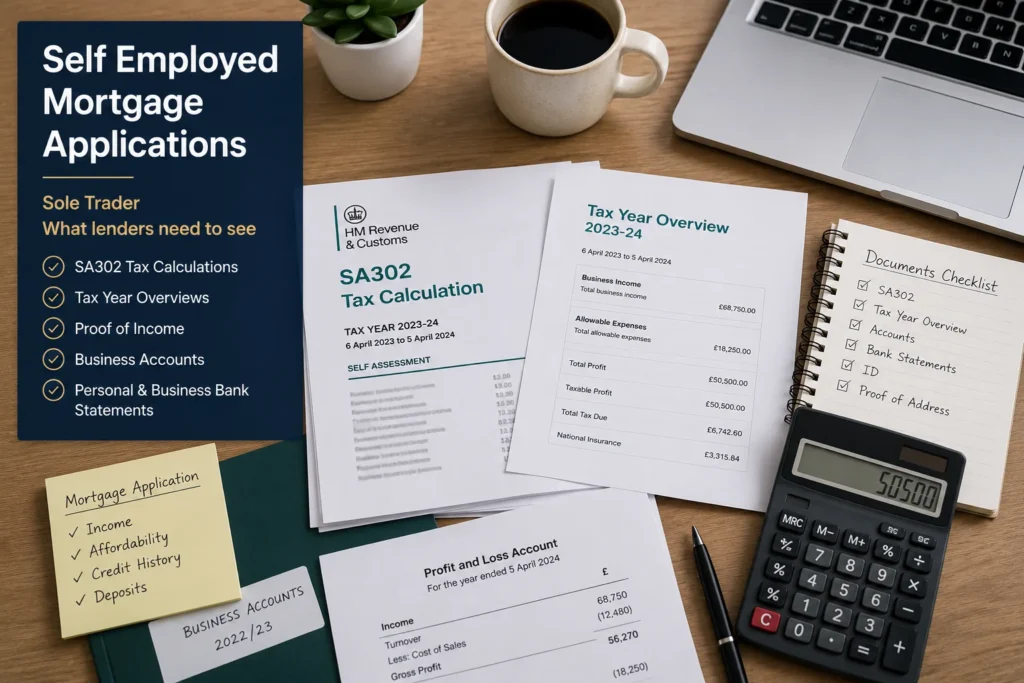
Most lenders want two to three years of SA302 tax calculations and matching Tax Year Overviews for a self employed mortgage application, though a genuine minority will consider just one year, particularly if you have strong relevant employment history in the same field before going self employed. How your income across those years gets combined varies by lender: some average two or three years together, some use the latest year alone (useful if your income is growing), and a few deliberately take the lower of the years shown, which can work against you if one year was unusually strong.
If you’re not sure exactly what an SA302 shows or how to get one from HMRC, we’ve covered that in detail in our guide to SA302s, including the timing quirks that catch people out — particularly the 72-hour wait after filing before HMRC will let you print it.
What Limited Company Directors Need to Show
Directors typically need certified accounts covering two to three years, prepared by a qualified accountant, alongside SA302s reflecting personal income. The critical decision point, as covered above, is whether the lender you approach reads your income as salary-plus-dividends or salary-plus-net-profit — and this is genuinely worth asking about directly before you apply for a self employed mortgage, rather than discovering it after a disappointing decision in principle lands in your inbox.
Some lenders will also factor in retained profits — money the company has earned but hasn’t yet distributed as dividends — treating it as evidence of the business’s real earning capacity even though you personally haven’t drawn it out. This is becoming more common but is far from universal, and it’s precisely the kind of detail a broker with whole-of-market access is genuinely useful for identifying before you commit to an application.
What Contractors and Freelancers Need to Show
If you work through your own limited company on a contract basis, some specialist lenders will assess your self employed mortgage application on your day rate rather than your accounts at all, multiplying your contracted daily rate by typical working days in a year to arrive at an assessed income — often a far more generous figure than a traditional net-profit or dividend-based assessment, particularly if you’re early in your contracting career and haven’t yet built up two or three years of accounts.
This route tends to sit with specialist lenders rather than mainstream high street banks, and it’s worth specifically asking whether day-rate assessment is available if you’re a contractor who’s found mainstream lenders unwilling to look past a short trading history.
The Document Lenders Actually Trust
Whatever your income structure, the document that carries the most weight in any self employed mortgage assessment is one that’s independently verified rather than self-reported. For sole traders, that’s the SA302 — HMRC’s own calculation of what you declared and paid tax on. For directors, it’s certified accounts from a qualified accountant. Lenders lean on these specifically because self employed income doesn’t come with the built-in third-party verification that a payslip does, so the documents that replace that verification matter enormously to how smoothly your application moves.
Bank statements showing regular business income landing in your account can also support an application, though they’re rarely sufficient on their own — lenders want to see the underlying declared, taxed income, not just cash movement that could theoretically include anything.
How Income Multiples Work Once Your Figure Is Set
Once a lender has settled on your assessed income, the multiple applied to your self employed mortgage is broadly similar to what an employed applicant would get: typically 4x to 4.5x, occasionally stretching to 5x or even 6x for certain professionals — solicitors, doctors, and similar roles are sometimes offered higher multiples by specific lenders who view those professions as lower risk.
But look at what this means in practice against the earlier example. At 4.5x, an assessed income of £52,000 supports borrowing of roughly £234,000. The identical business, assessed at £114,000 by a different lender, supports roughly £513,000 at the same multiple. The multiple never changed — only the base figure it was applied to. This is precisely why chasing the lowest headline rate before checking how a lender assesses your specific income type is often the wrong priority entirely when arranging a self employed mortgage.
What Genuinely Hurts a Self Employed Mortgage Application
Declaring unusually low profit to minimise tax. It’s a completely legitimate strategy for reducing your tax bill, but it directly reduces the income figure most lenders will use, since they’re working from the same declared figures HMRC has. There’s a genuine trade-off here worth thinking through if a mortgage application is on the horizon in the next couple of years — sometimes it’s worth accepting a slightly higher tax bill in the run-up to an application to present stronger declared income.
Inconsistent or declining income year to year. Lenders are looking for a pattern they can trust to continue, and a business that’s shrinking, even if still profitable, tends to get assessed more cautiously than one showing steady or growing profit. A dip caused by something explainable — parental leave, a specific contract ending, a one-off investment in the business — is worth explaining clearly in your application rather than leaving a lender to guess.
Incomplete or late accounts. If your latest year’s accounts aren’t finalised when you apply, some lenders simply can’t use that year at all for your self employed mortgage assessment, falling back on older, potentially less favourable figures. Getting your accounts filed promptly each year isn’t just good practice for HMRC — it keeps your most recent, and often strongest, year available whenever you need it.
Applying to the wrong lender for your income shape. This is the one that catches the most people out, and it’s entirely avoidable with the right preparation and the right advice before you submit anything formally.
What to Actually Do Next

If your current self employed mortgage offer doesn’t reflect what you know your business genuinely earns, the single most useful next step is finding out specifically how the lender assessed you — salary and dividends, or salary and net profit, latest year or an average — before assuming the number reflects your true borrowing capacity. A different lender using a different method on the identical accounts can produce a materially different result, as the opening example shows starkly.
A broker who specialises in self employed mortgage applications earns their fee here precisely because they know which lenders use which method, and can place your application somewhere your actual income shape is read favourably, rather than somewhere it happens to look weak on paper. This isn’t about finding a lender willing to bend the rules — it’s about matching your genuine income to the assessment method that actually captures it properly.
It’s also worth reviewing your own accounts with your accountant before applying again, specifically asking: “if a lender wanted to assess me as generously as possible within the rules, what would that figure look like, and which lenders use that method?” That’s a conversation most accountants can genuinely help with, even though it’s slightly outside their usual remit.
Common Myths That Put People Off Applying at All
“Self employed people can’t get mortgages at all.” This one stops people from even trying. Self employed mortgages are a completely standard, well-established part of the UK market — the difference is in the documentation and assessment method, not in whether the product exists.
“I need five years of accounts before anyone will consider me.” Most lenders want two to three years for a self employed mortgage, and a genuine minority will consider just one, particularly with relevant prior employment. Five years has never been a standard requirement.
“My income has to be perfectly consistent every single year.” Lenders expect some natural variation in self employed income and have built assessment methods that account for it — averaging, or taking the latest year, or the lower of two years, all exist precisely because perfect consistency isn’t the reality of running a business.
A few things worth knowing:
- Income multiples and assessment methods vary meaningfully by lender — the figures here are representative of the current market, not a guarantee
- Most lenders want a minimum of one to two years of self employment history, though this varies, and some specialist lenders consider shorter trading periods with strong prior employment in the same field
- A larger deposit can sometimes offset a more conservative income assessment on a self employed mortgage, since it reduces the lender’s overall risk on the loan
- Credit history and existing commitments are assessed alongside income for everyone, self employed or not, and can meaningfully affect the final offer
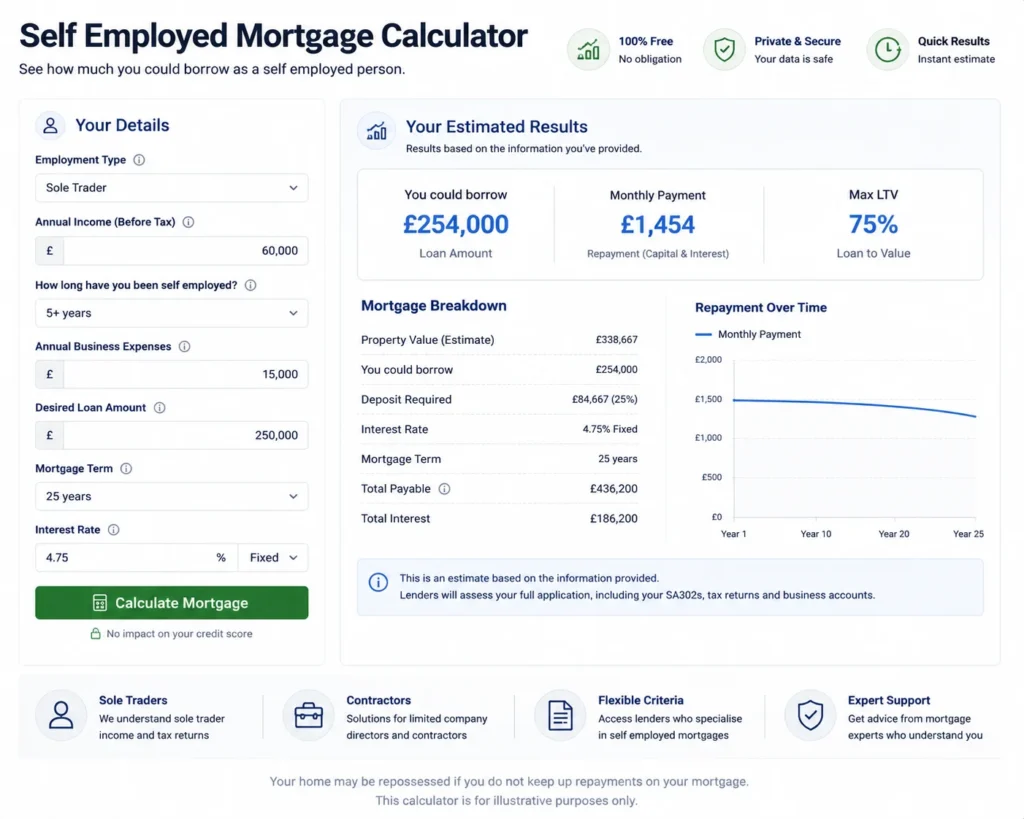
Before approaching a lender, run your figures through our self-employed mortgage calculator, which models net profit, salary-plus-dividends, and day-rate assessment separately, so you can see how differently your own numbers look depending on the method used.
Frequently Asked Questions
Why was my self employed mortgage application rejected even though I earn enough?
The most common reason is that the lender assesses self employed income in a way that doesn’t suit how your earnings are structured — for instance, using salary-plus-dividends when most of your business’s profit is retained rather than drawn out. A different lender’s method can produce a significantly higher assessed income for the identical accounts.
How many years of accounts do I need for a self employed mortgage?
Most UK lenders want two to three years of accounts or SA302 tax calculations, though a minority will consider just one year, particularly with strong relevant employment history beforehand.
Do lenders average my income or use the latest year for a self employed mortgage?
This varies by lender. Some average two or three years together, some use only your most recent year (helpful if your income is growing), and some deliberately use whichever year is lower, which can work against you.
Can retained company profits count toward my self employed mortgage income?
With some lenders, yes. If you’re a limited company director who leaves profit in the business rather than drawing it all as dividends, certain lenders will include your ownership share of that retained profit in their assessment, which can substantially increase your assessed income.
Should I use a broker for a self employed mortgage?
It’s genuinely more valuable for self employed applicants than almost any other borrower type, precisely because the gap between lenders’ assessment methods can be so large. A broker who knows which lenders suit your specific income structure can meaningfully change your outcome.
How much can I borrow on a self employed mortgage?
Typically 4x to 4.5x your assessed annual income, occasionally up to 5x or 6x for certain professionals. The bigger variable is how that income figure itself is calculated, which can differ dramatically between lenders for identical circumstances.
Official sources: get your SA302 and Tax Year Overview at GOV.UK, read general mortgage guidance at MoneyHelper, and verify any broker or adviser on the FCA register. Model your own income through our self-employed mortgage calculator, or browse every tool on the mortgage calculators homepage.