
Whole of Life vs Term Insurance | The Essential 2026 Guide
[IMAGE 1 — Alt text: “whole of life vs term insurance UK 2026”. Suggestion: a family at home, warm natural setting, or a parent with young children, genuine and relatable rather than stiff stock-photo energy]
Whole of life vs term insurance sounds like a small technical decision until you see the actual price gap between them. A healthy 35-year-old non-smoker can get £250,000 of term cover for roughly £8 to £15 a month. The exact same cover as a whole of life policy costs £80 to £150 a month — five to ten times more, for what looks on paper like the same £250,000 death benefit.
That gap isn’t a pricing mistake or one product simply being worse value. It reflects something genuinely different about what each policy promises to do, and once you understand that difference, the “which one” question mostly answers itself.
Site editor at MortgageToolsHub — life insurance premium figures cross-checked against current UK provider rate data. Last checked July 2026.
On This Page
- The one-sentence difference that explains the whole price gap
- Real UK premium costs, side by side
- Why term life insurance is what most people actually need
- When whole of life genuinely earns its higher cost
- The inheritance tax angle nobody explains properly
- Over 50s plans — a specific type of whole of life
- Can you have both?
- What actually determines your premium
- FAQ
The One-Sentence Difference That Explains the Whole Price Gap
Term life insurance pays out only if you die within a fixed period — 10, 20, 25 years, whatever term you choose. Whole of life insurance pays out whenever you die, guaranteed, however long that turns out to be.
That single distinction is the entire reason for the price gap. With term insurance, most people simply outlive the policy — a 35-year-old buying 25-year term cover has a genuinely high chance of still being alive when it expires, meaning the insurer never pays out at all in the majority of cases. Term premiums are priced around that low probability. Whole of life insurance carries no such escape for the insurer: everyone dies eventually, so a claim is a mathematical certainty, not a possibility. The premium has to reflect that certainty, which is why it costs so much more for identical cover.
Real UK Premium Costs, Side by Side
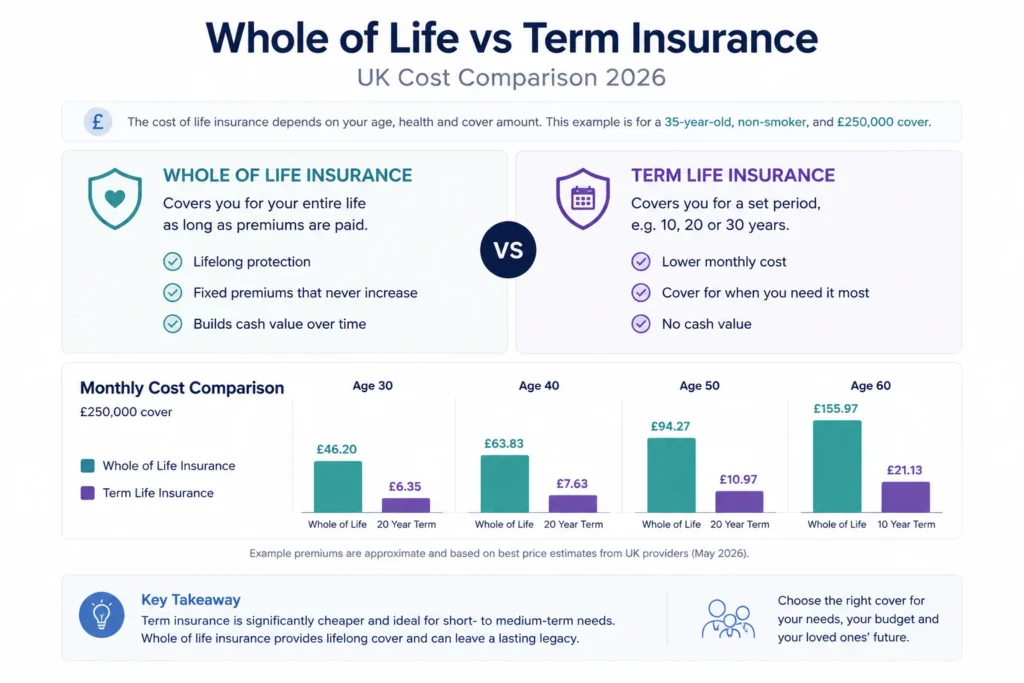
| Term life (25-year, £250,000 cover) | Whole of life (£250,000 cover) | |
|---|---|---|
| Healthy 35-year-old non-smoker | ~£8 – £15/month | ~£80 – £150/month |
| Payout guaranteed? | Only if death occurs within the term | Yes, guaranteed, whenever you die |
| Cash value | None | Rarely, on modern protection-focused UK policies |
| Cost multiple | Baseline | 5x – 10x more expensive |
Worth being precise about the “cash value” row, because a lot of older or US-focused content muddies this. Some whole of life policies, particularly unit-linked versions, do build a cash value tied to fund performance — but modern, straightforward UK protection-focused whole of life policies very often have no cash-in value at all. If you stop paying and cancel, you typically get nothing back, the same as a term policy. Don’t assume every whole of life plan doubles as a savings vehicle; check the specific policy type before assuming that feature exists.
Why Term Life Insurance Is What Most People Actually Need
For the overwhelming majority of UK buyers, term life insurance is the right product, and it’s worth being direct about that rather than dancing around it. Most people buy life insurance to cover a specific, time-limited obligation: a mortgage that will eventually be paid off, children who will eventually become financially independent, a period where dependents would genuinely struggle without your income.
Once that obligation ends — the mortgage is cleared, the kids are grown — the need for that specific cover ends too. Paying five to ten times more for a policy that also covers you at 85, when your mortgage was cleared decades earlier and your children have been independent for years, is money spent protecting against a need that no longer exists by then.
A decreasing term policy, priced around 30-40% cheaper than level term, specifically tracks a repayment mortgage balance as it falls — the cheapest, most tightly matched option if mortgage protection is your only goal. A level term policy keeps the payout fixed throughout, better suited to income replacement or a family’s ongoing needs regardless of when death occurs within the term.
When Whole of Life Genuinely Earns Its Higher Cost
This isn’t a case of term always winning — there are specific, legitimate reasons whole of life exists, and they’re worth taking seriously rather than dismissing as unnecessary.
Funeral and final expense planning. If your goal is simply ensuring your family isn’t left covering funeral costs, regardless of when you die, a whole of life policy guarantees that money arrives whenever the claim happens, unlike term, which could quietly expire the year before you actually need it.
Inheritance tax planning. Covered properly in the next section, but this is genuinely the strongest, most common reason whole of life makes financial sense for the right estate.
Providing for a lifelong dependent. If you support someone with a disability or lifelong care need, a policy that pays out no matter when you die, rather than one that might expire while they still depend on you, removes a genuine long-term risk.
A change in health mid-term. Some term policies include a conversion option, letting you switch to whole of life cover without fresh medical underwriting if your health changes during the term — worth checking for at the point you buy, even if you don’t expect to need it.
The Inheritance Tax Angle Nobody Explains Properly
This is where whole of life insurance does its most genuinely useful work, and it’s worth walking through properly rather than glossing over.
The UK inheritance tax nil-rate band is £325,000, plus up to £175,000 of residence nil-rate band if you’re leaving your home to direct descendants — giving many individuals a combined threshold of £500,000 before IHT applies, or up to £1,000,000 for a married couple using both allowances. Above that threshold, IHT is charged at 40% on the excess.
If your estate sits above that line, a whole of life policy, sized to cover the expected tax bill, guarantees your beneficiaries have the cash to pay HMRC without needing to sell the family home or other assets to settle it. Crucially, this only works properly if the policy is written in trust — doing so keeps the payout outside your estate for IHT purposes, meaning it doesn’t itself add to the tax bill it’s meant to cover. Setting up a trust at the outset is usually free through the insurer; doing it later via a solicitor typically costs somewhere in the region of £200 to £500.
Over 50s Plans — A Specific Type of Whole of Life

Over 50s plans are a distinct category worth understanding separately, since they’re often marketed heavily and sit at a very different price point to standard whole of life. They offer guaranteed acceptance with no medical questions, which sounds appealing but comes with two important trade-offs: lower payouts relative to premium than fully underwritten cover, and a typical waiting period of 12 to 24 months before full cover applies — if you die from natural causes within that window, many policies only refund premiums paid rather than the full sum assured.
These plans suit people who’d struggle to get accepted for standard cover due to health, but they’re rarely the most cost-effective route for someone in good health who could pass medical underwriting on a standard whole of life or term policy instead.
Can You Have Both?
Yes, and for a meaningful number of people, this is actually the most sensible structure rather than an either-or decision. A common approach: a larger, affordable term policy covering the mortgage and family income needs through your working years, alongside a smaller whole of life policy, sized specifically for funeral costs or a known inheritance tax liability, that continues after the term policy expires.
This combination often costs less overall than a single large whole of life policy covering everything, while still guaranteeing the specific things — the funeral, the IHT bill — that genuinely need a guaranteed-whenever payout rather than a time-limited one.
A few things worth knowing:
- These premium figures are representative for a healthy, non-smoking 35-year-old — your own quote will vary by age, health, smoking status, and the specific insurer
- Smokers typically pay 80-150% more than non-smokers for identical cover on either product type
- Every five-year age bracket typically adds roughly 15-25% to the premium, so buying earlier is usually meaningfully cheaper
- Whole of life premiums on some policies are “reviewable,” meaning they can rise significantly in later life — check whether your quote is guaranteed or reviewable before committing
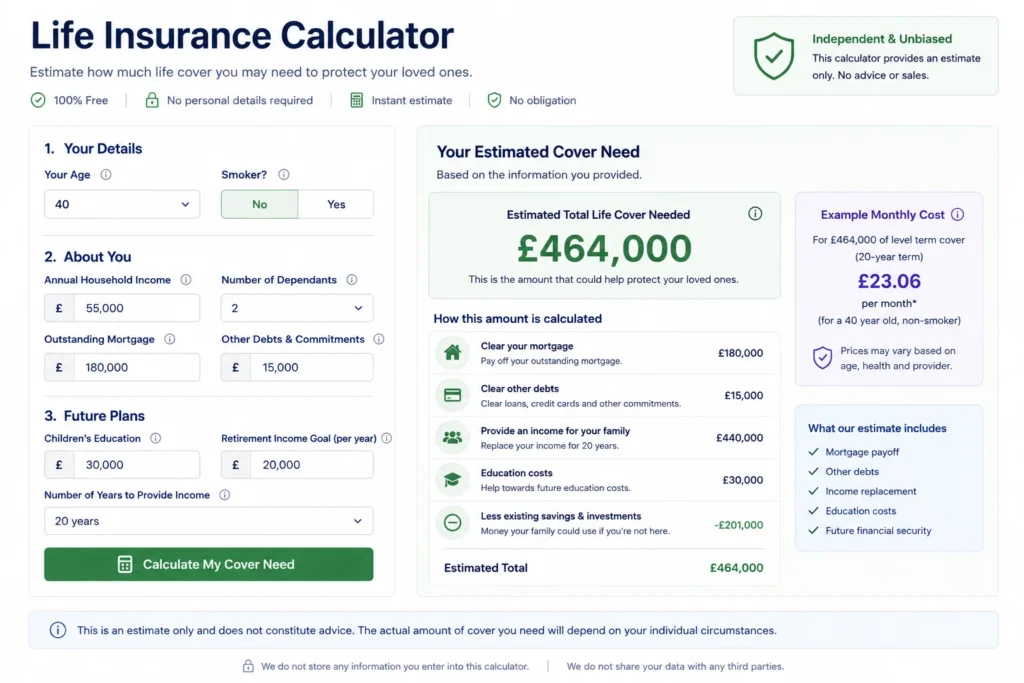
Work out how much cover you actually need, and see estimated premiums for both term and whole of life, using our life insurance calculator or our dedicated life assurance calculator for whole of life and estate planning scenarios.
Frequently Asked Questions
Is term or whole of life insurance cheaper?
Term life insurance is substantially cheaper — typically 5 to 10 times less expensive than whole of life for identical cover, because term only pays out if you die within a fixed period, while whole of life guarantees a payout whenever you die.
Which is better, whole of life or term insurance?
Neither is universally better — it depends on your goal. Term suits time-limited needs like a mortgage or dependent children. Whole of life suits guaranteed lifelong needs like funeral costs or inheritance tax planning, where the payout must arrive whenever death occurs, not just within a set period.
Does whole of life insurance build up cash value in the UK?
Not always. Some unit-linked whole of life policies do build cash value tied to fund performance, but many modern UK protection-focused whole of life policies have no cash-in value at all, working purely as insurance rather than a savings product.
Can I switch from term to whole of life insurance later?
Some term policies include a conversion option allowing you to switch to whole of life without new medical underwriting, which is worth checking for when you first buy, even if you don’t expect to need it.
Why would someone choose whole of life insurance for inheritance tax?
If an estate exceeds the £325,000 nil-rate band (or £500,000 combined with the residence nil-rate band), a whole of life policy written in trust guarantees funds are available to cover the 40% tax bill without beneficiaries needing to sell assets, while keeping the payout itself outside the taxable estate.
Are over 50s life insurance plans the same as whole of life?
Over 50s plans are a type of whole of life insurance offering guaranteed acceptance with no medical questions, but typically with lower payouts and a waiting period of 12 to 24 months before full cover applies, compared to standard fully underwritten whole of life cover.
Official sources: check inheritance tax thresholds at GOV.UK, read general life insurance guidance at MoneyHelper, and verify any insurer or adviser on the FCA register. Work out your cover needs with our life insurance calculator, or browse every tool on the mortgage calculators homepage.