
UK Annuity Rates 2026 | The Surprising Truth About the Trend
Ask most people what UK annuity rates 2026 should look like and they’ll give you the same confident, entirely reasonable-sounding answer: the Bank of England has been cutting the base rate, so annuity rates must be falling too. It’s a logical guess. It’s also wrong, and the reason it’s wrong tells you almost everything worth knowing about how annuity pricing actually works.
The base rate dropped from 5.25% in August 2023 to 3.75% through 2025 and into 2026 — a meaningful, sustained fall. Over that same period, annuity rates for a healthy 65-year-old didn’t fall with it. They’ve stayed above 7% since 2022, consistently above 7.5% since early 2025, and in March 2026 the underlying gilt yields that actually drive annuity pricing hit their highest level since 2008.
Here’s why that disconnect happened, and what it means for anyone weighing up whether now is a sensible time to buy.
Site editor at MortgageToolsHub — UK annuity rates 2026 figures cross-checked against Retirement Line, Standard Life and Which? published data. Last checked July 2026.
On This Page
- The myth: base rate cuts should mean lower annuity rates
- What actually drives UK annuity rates 2026
- Real numbers: how rates have moved since 2020
- Why gilt yields decoupled from the base rate
- What a 7.69% rate actually means in pounds
- Should you buy now, or wait?
- How much rates vary between providers
- FAQ
The Myth: Base Rate Cuts Should Mean Lower Annuity Rates
It’s an intuitive assumption, and it’s not a stupid one — for most of financial history, the base rate and annuity income have moved in roughly the same direction. When the Bank of England cuts rates, borrowing gets cheaper, and it feels natural to assume investment and pension income falls alongside it.
UK annuity rates 2026 are the clearest recent example of why that intuition, however reasonable, doesn’t reliably hold. The Bank of England cut the base rate four times in 2025 alone, most recently in December, taking it from 4% down to 3.75%. Annuity income didn’t move meaningfully in response. As one industry pricing analyst put it plainly: cuts to the base rate “does not appear to have had a major effect on annuities.”
What Actually Drives UK Annuity Rates 2026
The base rate isn’t actually what prices your annuity. Gilt yields are — specifically, the yield on medium and long-term UK government bonds, which insurers hold to fund the guaranteed income they pay you. When gilt yields rise, insurers earn more on the underlying investment backing your annuity, and pass a meaningful share of that extra return on to you as higher income.
The base rate and gilt yields are related, but not tightly, and definitely not instantly. Gilt yields respond to a much wider set of forces: government borrowing levels, inflation expectations, global demand for safe assets, and market sentiment about where interest rates are genuinely heading over the next decade or two — not just where the Bank of England has set the base rate this month. This is precisely the mechanism behind the disconnect that’s defined UK annuity rates 2026: gilt yields have stayed stubbornly high even as the base rate itself has fallen, because markets are pricing in higher government borrowing and structurally elevated inflation over the medium term, regardless of where the base rate sits today.
Real Numbers: How Rates Have Moved Since 2020
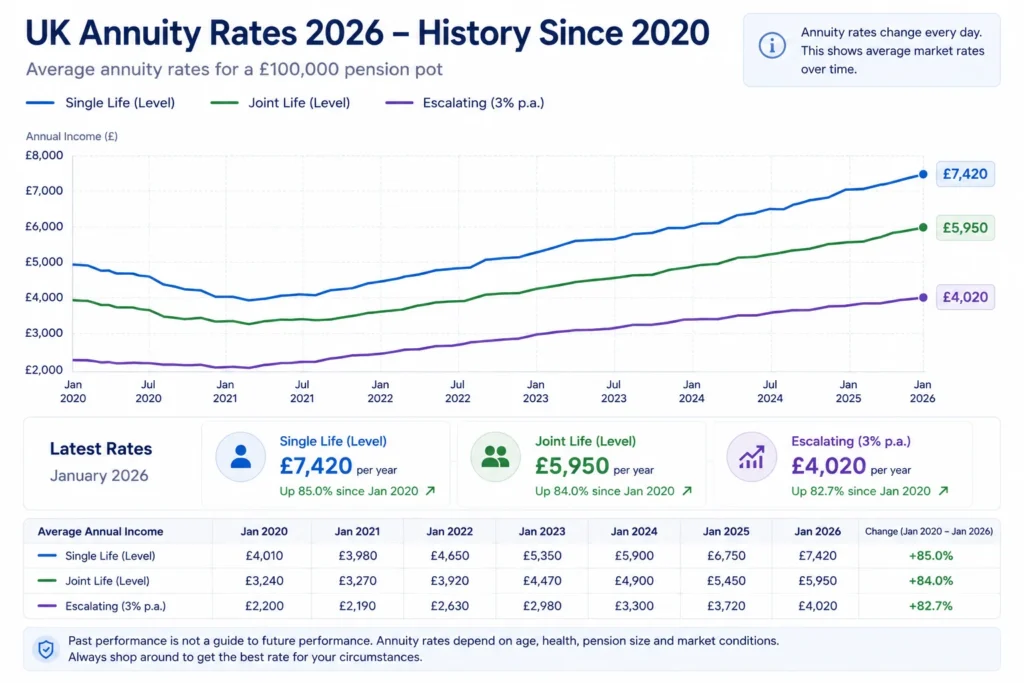
| Period | Approximate rate for healthy 65-year-old | Income on £100,000 pot |
|---|---|---|
| 2020 (near historic lows) | ~5% | ~£5,000/year |
| 2022 | Above 7% | ~£7,000+/year |
| Early 2025 | Above 7.5% | ~£7,500+/year |
| January 2026 | ~7.69% | ~£7,688/year |
| March 2026 (gilt yields peaked) | ~7.62% | ~£7,620/year |
UK annuity rates 2026 sit somewhere between 30% and 50% higher than the near-historic lows seen in 2020. That’s a genuinely substantial difference in retirement income for identical pension savings — a £100,000 pot that might have bought around £5,000 a year of guaranteed income in 2020 is now buying closer to £7,600 to £7,700, purely because of where gilt yields have moved, before any change in your own personal savings.
Why Gilt Yields Decoupled From the Base Rate
Government bond markets are ultimately pricing in expectations about the future, not just reacting to the current base rate decision. Through 2025 and into 2026, several forces kept gilt yields elevated even as the Bank of England eased the base rate: sustained government borrowing needs, market expectations that inflation would prove more persistent than headline figures suggested, and broader global uncertainty pushing investors to demand a higher yield for holding long-dated UK government debt.
Gilt yields actually surged to their highest level since 2008 in March 2026, pushing annuity pricing up by roughly 1.46% compared to the end of 2025, according to industry tracking data. This happened at precisely the moment the base rate itself was at its lowest point in the cycle — the clearest possible illustration that these two figures, while related, are not the same thing, and shouldn’t be treated as interchangeable when you’re trying to understand UK annuity rates 2026.
What a 7.69% Rate Actually Means in Pounds
It’s worth sitting with the actual number rather than just the percentage. A rate of 7.69% on a £100,000 pot delivers a guaranteed annual income of roughly £7,688, for life, regardless of how long you live or what happens to markets afterwards. Compare that against a commonly cited “safe” drawdown withdrawal rate of around 3.5% to 4%, and the annuity is paying roughly double — the trade-off being that drawdown keeps your capital invested and flexible, while an annuity converts it into a fixed, guaranteed income stream you can’t get back as a lump sum.
Neither is universally right. But understanding that UK annuity rates 2026 are paying close to double what a conservative drawdown withdrawal would generate is the number that should genuinely be shaping this decision, not vague assumptions about where interest rates “feel” like they’re heading.
Should You Buy Now, or Wait?
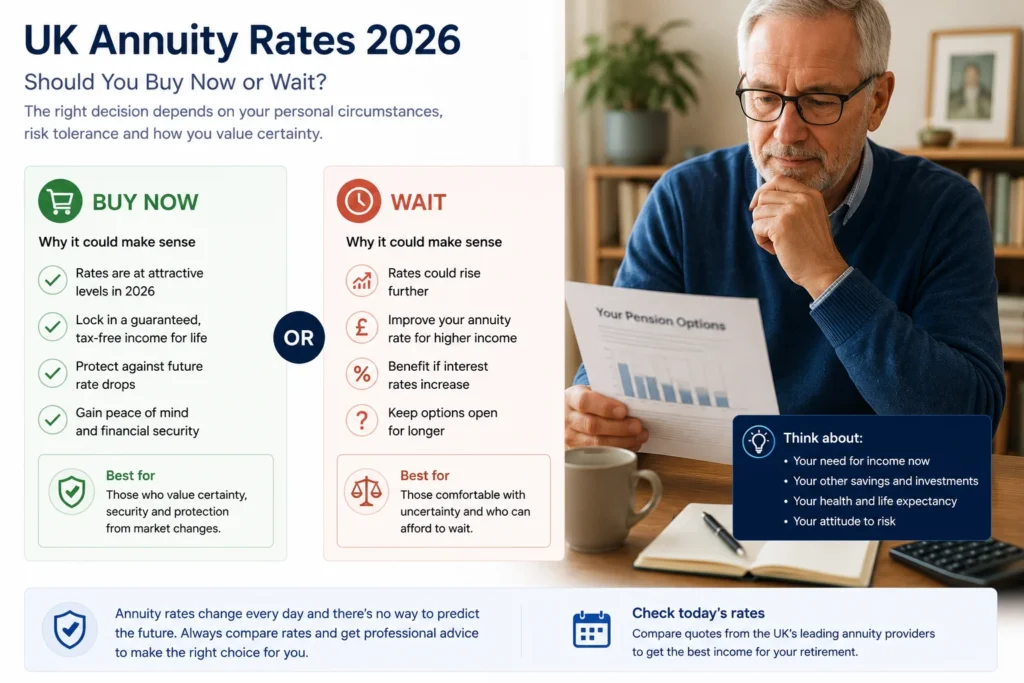
Nobody, genuinely nobody, can reliably time this. Analysts have been forecasting modest fluctuations of plus or minus a few percent through the rest of 2026, dependent on whether inflation proves stickier than expected (which would likely keep rates elevated or push them higher) or whether the economy weakens enough to justify more aggressive base rate cuts feeding through to gilt yields eventually (which would likely push rates down, albeit probably with a lag).
The most consistent, genuinely useful advice across the industry commentary on UK annuity rates 2026 is this: don’t try to perfectly time the market based on interest rate forecasts. Focus on your personal circumstances — your age, your health, whether you need the income now, and whether the current rate already represents excellent value against a long-run historical average, which by any reasonable measure, it currently does.
How Much Rates Vary Between Providers
This matters just as much as the timing question, and it’s far more within your control. UK annuity rates 2026 can vary by as much as 25% between providers for the exact same person, same age, same pot size. Rates can also move by around 1% in a single week, so a quote you were given a month ago may no longer reflect what’s currently available.
This is precisely why shopping the whole market, rather than accepting the first quote from your existing pension provider, matters enormously — a 25% gap between the best and worst offer on the market is a considerably larger swing than anything the base rate versus gilt yield debate is likely to move your income by.
A few things worth knowing:
- Annuity rates quoted here are indicative for a healthy 65-year-old — your own rate depends on age, health, and the specific annuity type you choose
- Enhanced annuities, available for certain health and lifestyle factors, can push your rate meaningfully higher than the standard figures shown here
- Joint-life and escalating annuities pay a lower starting rate than single-life level annuities, in exchange for continuing income to a partner or protection against inflation
- Always get a live, whole-of-market quote before committing — the figures in this guide are illustrative, not a personal quote
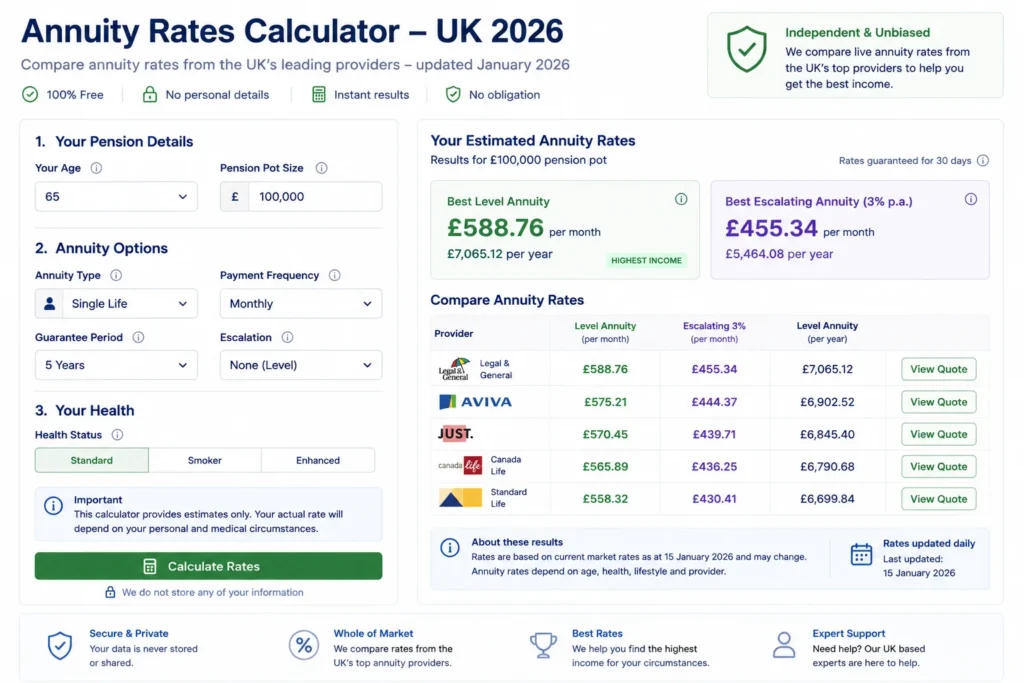
See what your own pension pot could generate at current rates, including enhanced and joint-life options, using our annuity rates calculator, or model annuity against drawdown with our pension annuity calculator.
Frequently Asked Questions
Why haven’t UK annuity rates fallen even though the base rate has been cut?
Because annuity rates are primarily driven by gilt yields, not the base rate directly. Gilt yields have stayed elevated through 2025 and into 2026 due to government borrowing levels and persistent inflation expectations, even as the Bank of England reduced the base rate from 5.25% to 3.75%.
What is a good annuity rate in the UK in 2026?
A rate above 7% for a healthy 65-year-old is currently considered strong, with some providers quoting around 7.5-7.7% as of early to mid-2026. This is significantly higher than the roughly 5% rates seen during the historic lows of 2020.
Will UK annuity rates rise or fall for the rest of 2026?
Most industry forecasts expect modest fluctuations of a few percentage points either way, depending on inflation and gilt yield movements, rather than a dramatic change in either direction. Timing the market precisely is genuinely very difficult, even for professional forecasters.
How much does an annuity rate vary between providers?
Rates can vary by as much as 25% between providers for the same person and pot size, which is why comparing the whole market before buying is genuinely important, potentially worth far more than trying to time your purchase for a slightly better rate.
How much income would £100,000 generate at current UK annuity rates?
At a representative rate of around 7.5-7.7% for a healthy 65-year-old in 2026, a £100,000 pot would generate roughly £7,500 to £7,700 a year in guaranteed lifetime income, before any enhancement for health or lifestyle factors.
Is now a good time to buy an annuity?
By historical standards, current UK annuity rates 2026 are strong — 30-50% higher than the lows of 2020. Whether now is right for you depends more on your personal circumstances, income needs, and health than on trying to predict short-term rate movements.
Official sources: compare current rates via MoneyHelper’s annuity calculator, read the latest market analysis at Which?, and check Bank of England base rate decisions at the Bank of England. Model your own pot with our annuity rates calculator, or browse every tool on the mortgage calculators homepage.