
Annuity Rates Gilt Yields | The Genuine Link Explained 2026
Annuity rates gilt yields — understanding this link is the single most useful piece of financial knowledge for anyone approaching retirement, and almost nobody outside the pensions industry actually understands the mechanism properly. Most people assume annuity rates simply follow whatever the Bank of England is doing with the base rate. They don’t, not directly. The real driver is a specific corner of the bond market that most retirees have never had reason to think about before — and understanding it explains almost everything about why annuity income has moved the way it has in recent years.
Here’s the actual mechanism, explained properly, not just asserted.
Site editor at MortgageToolsHub — annuity rates gilt yields mechanism cross-checked against industry pricing methodology and Bank of England data. Last checked July 2026.
On This Page
- What a gilt actually is
- Why insurers hold gilts to back your annuity
- The actual mechanism, step by step
- Why the base rate isn’t the real driver
- What moves gilt yields themselves
- How this played out through 2025 and 2026
- What this means for your own annuity timing
- FAQ
What a Gilt Actually Is
A gilt is simply a UK government bond — the government borrowing money from investors, promising to pay a fixed rate of interest (the yield) over a set period, then repaying the original amount at the end of the term. They’re called “gilts” from the historical practice of gilt-edged certificates, and they’re considered among the safest investments available, since they’re backed by the UK government’s ability to tax and raise revenue.
Gilts come in different maturities — short-dated (a few years), medium-dated, and long-dated (sometimes 20-30 years or more). This maturity range matters enormously to the annuity rates gilt yields relationship, because it’s specifically the medium and long-term gilts that insurers rely on most heavily to back annuity commitments.
Why Insurers Hold Gilts to Back Your Annuity
When you buy an annuity, you’re handing an insurer a lump sum in exchange for a promise: guaranteed income, for as long as you live, however long that turns out to be. That’s a genuinely serious, long-term financial commitment, and insurers need to invest your lump sum somewhere that reliably generates the income they’ve promised to pay you, decade after decade, regardless of what happens to the wider economy.
Gilts are the natural match for this obligation. They’re low-risk, they pay a predictable, known yield, and — crucially — insurers can buy gilts with maturities that roughly match the expected timeframe of your annuity payments, a practice called asset-liability matching. If actuaries expect to be paying your annuity for another 20-25 years on average, holding 20-25 year gilts gives the insurer a genuinely reliable, predictable income stream to fund those payments, without taking on the volatility of riskier investments like equities.
The Actual Mechanism, Step by Step
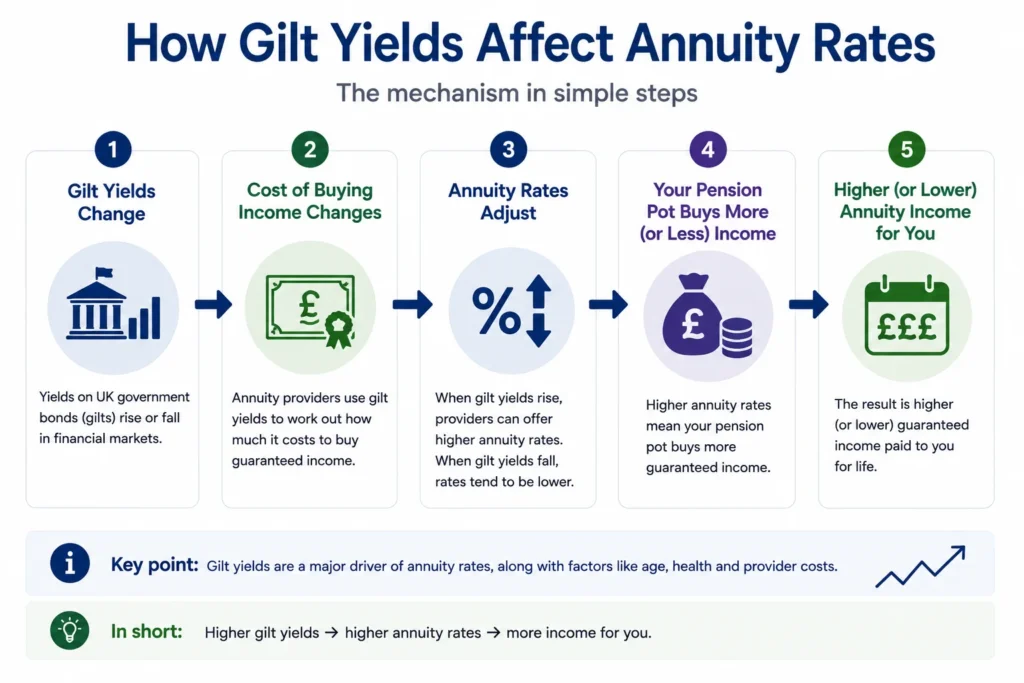
Here’s the genuine cause-and-effect chain behind annuity rates gilt yields, laid out plainly:
When gilt yields rise, the fixed income insurers earn from holding gilts increases. Since they’re now earning more from the underlying investment backing your annuity, they can afford to pass a meaningful share of that extra return on to you as a higher guaranteed income, while still comfortably meeting their own obligations and profit requirements.
When gilt yields fall, the opposite happens. Insurers earn less from the gilts backing new annuity purchases, so the guaranteed income they can offer for a given lump sum falls correspondingly, to keep their own numbers balanced.
This is precisely why annuity rates move up and down largely in step with gilt yields, sometimes within weeks of a meaningful shift in the bond market — because the underlying economics of what insurers can afford to promise you literally depends on what return they’re currently able to earn from the gilts backing that promise.
Why the Base Rate Isn’t the Real Driver
This is where a lot of confusion genuinely comes from, and it’s worth addressing directly. The Bank of England base rate and gilt yields are related — they both broadly reflect the cost and availability of money in the UK economy — but they’re not the same thing, and they don’t always move together, or by the same amount, or even in the same direction over shorter periods.
The base rate is a single, deliberately set policy tool, adjusted periodically by the Bank of England’s Monetary Policy Committee to manage inflation and economic activity. Gilt yields, by contrast, are set continuously by the market — by what investors are actually willing to pay for UK government debt at any given moment, based on their own expectations about future inflation, government borrowing needs, and broader economic conditions, often looking years or decades ahead rather than reacting to the current month’s policy decision.
This is exactly why annuity rates gilt yields can genuinely diverge from what base rate movements alone would suggest — the market’s long-term view, embedded in gilt pricing, can move quite differently from the Bank of England’s current short-term policy stance.
What Moves Gilt Yields Themselves
If gilt yields are the real driver behind annuity pricing, it’s worth understanding what moves gilt yields in turn. Government borrowing levels matter significantly — if the government needs to issue more debt to fund spending, it typically needs to offer investors a higher yield to attract sufficient demand for that debt. Inflation expectations matter enormously too, since a bond paying a fixed rate becomes less attractive to investors if they expect inflation to erode its real value over the bond’s lifetime, pushing yields higher to compensate. Global investor sentiment and demand for safe assets also plays a role, particularly during periods of broader economic uncertainty, when investors sometimes pile into or out of government bonds as a perceived safe haven.
None of these forces are things the Bank of England directly controls through the base rate alone — they’re market forces responding to a much wider set of economic signals, which is exactly why the annuity rates gilt yields relationship can behave in ways that surprise people expecting a simpler, more direct connection to base rate decisions.
How This Played Out Through 2025 and 2026
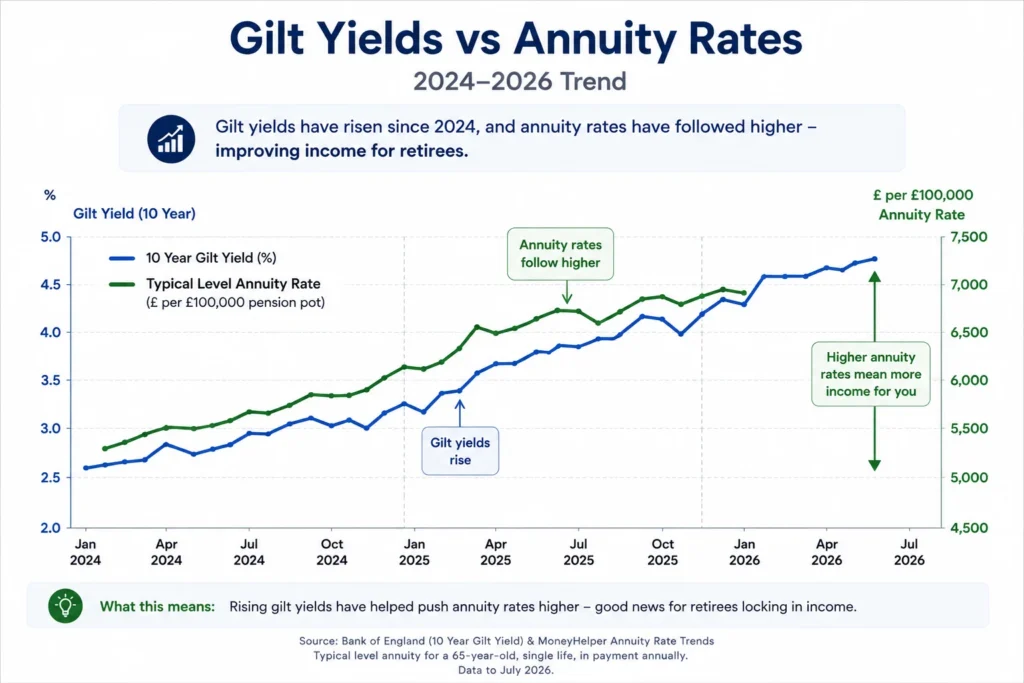
This isn’t just theoretical — it’s exactly what happened in the UK market recently, and our guide to UK annuity rates in 2026 covers the fuller story. Through 2025 and into 2026, the Bank of England cut the base rate multiple times, from 5.25% down to 3.75%. Under the “annuity rates simply follow the base rate” assumption, annuity income should have fallen meaningfully over that period. It didn’t. Gilt yields, driven by sustained government borrowing needs and persistent inflation expectations, actually rose over much of the same period, hitting their highest level since 2008 in March 2026 — and annuity rates rose right alongside them, entirely disconnected from the falling base rate.
This is the clearest possible real-world demonstration of why understanding the genuine mechanism behind annuity rates gilt yields matters far more than assuming a simple, direct base rate relationship that doesn’t actually reflect how insurers price these products.
What This Means for Your Own Annuity Timing
Given how central gilt yields are to your eventual annuity income, it’s worth checking current gilt yield trends, rather than base rate headlines alone, if you’re trying to gauge whether now is a reasonably good or poor time to buy. That said, as covered in our broader guide to current UK annuity rates, trying to precisely time the market based on short-term gilt movements is genuinely difficult, even for professional analysts — the more reliable approach is comparing your current available rate against long-run historical averages, and weighing that against your own personal circumstances and income needs, rather than attempting to predict the next gilt yield movement with any real precision.
A few things worth knowing:
- This explanation covers the general mechanism — individual insurer pricing also factors in their own costs, profit margins, and competitive positioning on top of the underlying gilt yield picture
- Gilt yields can move meaningfully within a single week, which is part of why annuity rate quotes are typically only valid for a limited period
- The relationship described here applies specifically to conventional annuity pricing — other retirement income products may respond to different underlying market factors
- Shopping around across multiple providers, using the open market option, remains valuable regardless of the current gilt yield environment, since individual provider pricing still varies meaningfully
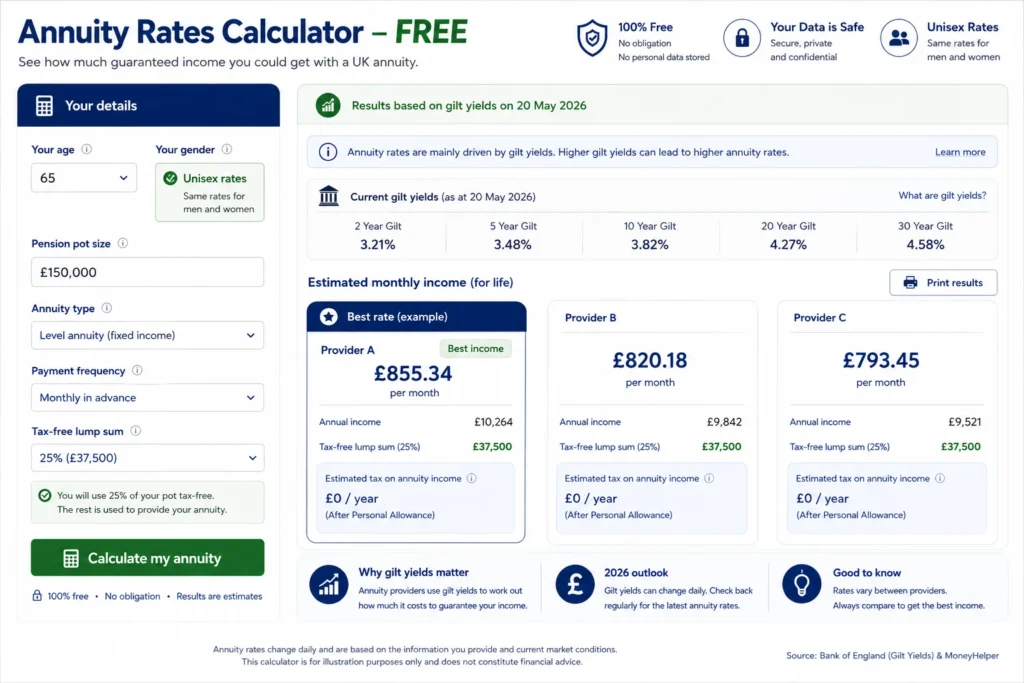
See a representative current annuity income estimate, reflecting today’s gilt yield environment, using our annuity rates calculator.
Frequently Asked Questions
Why do annuity rates follow gilt yields rather than the base rate?
Insurers invest the lump sums used to buy annuities primarily in government bonds (gilts) with maturities matching expected annuity payment periods, a practice called asset-liability matching. The return they earn from these gilts directly determines how much guaranteed income they can afford to offer, making gilt yields the more direct pricing driver than the Bank of England base rate.
What is the difference between gilt yields and the base rate?
The base rate is a single policy tool set periodically by the Bank of England’s Monetary Policy Committee. Gilt yields are set continuously by the bond market, reflecting investor expectations about inflation, government borrowing, and broader economic conditions, and don’t always move in step with the base rate.
Did annuity rates fall when the Bank of England cut the base rate in 2025 and 2026?
No, largely because gilt yields, the actual driver of annuity pricing, rose over much of the same period due to sustained government borrowing needs and inflation expectations, even as the base rate itself fell from 5.25% to 3.75%.
What causes gilt yields to rise or fall?
Government borrowing levels, inflation expectations, and global investor demand for safe assets all influence gilt yields. Higher government borrowing or higher inflation expectations typically push yields higher, while strong demand for safe assets can push them lower.
Should I try to time my annuity purchase based on gilt yield movements?
It’s genuinely difficult to time precisely, even for professional analysts. A more reliable approach is comparing current rates against long-run historical averages and weighing that against your own personal circumstances, rather than attempting to predict short-term gilt yield movements.
Does understanding gilt yields help me get a better annuity rate?
Not directly, since gilt yields affect the whole market rather than your individual quote. However, understanding the mechanism helps explain why rates change over time, and shopping around across multiple providers remains the most reliable way to maximise your own individual rate regardless of the broader gilt yield environment.
Official sources: check current gilt yield data and monetary policy decisions at the Bank of England, read general annuity guidance at MoneyHelper, and verify any adviser on the FCA register. Model your own annuity income with our annuity rates calculator, or browse every tool on the mortgage calculators homepage.