
Annuity Inflation Risk | How £7,000 Shrinks by Age 85
Here’s the genuinely uncomfortable truth about annuity inflation risk: the number on your statement never changes, but what it actually buys quietly shrinks, year after year, without you ever seeing a single payment reduced. A level annuity paying £7,000 a year at 65 still says £7,000 at 85 — but at just 3% average inflation, that £7,000 is only buying what roughly £3,862 would buy today. More than half the real value, gone, while the headline figure stayed exactly the same the entire time.
Here’s exactly how that erosion happens, year by year, and what genuinely can be done about it.
Site editor at MortgageToolsHub — annuity inflation risk figures cross-checked against Fidelity retirement planning research and published UK inflation data. Last checked July 2026.
On This Page
- What annuity inflation risk actually means
- A level income, tracked year by year
- Why this feels invisible until it isn’t
- A real-world example: the price of milk
- What happens at higher inflation
- Why the State Pension is different
- What you can genuinely do about it
- FAQ
What Annuity Inflation Risk Actually Means
A level annuity pays exactly the same cash amount every year, for the rest of your life, from the day you buy it. That fixed, unchanging figure feels reassuring — no calculations, no uncertainty, the same number arriving every payment. But annuity inflation risk is the specific danger hiding inside that apparent stability: while the cash amount never falls, the real purchasing power of that fixed income falls continuously, every single year that prices rise, which in practice means almost every year.
This isn’t a hypothetical risk or a worst-case scenario. It’s the mathematically certain outcome of holding a fixed income for a long period, in an economy where prices reliably rise over time, even during periods of relatively modest, well-controlled inflation.
A Level Income, Tracked Year by Year
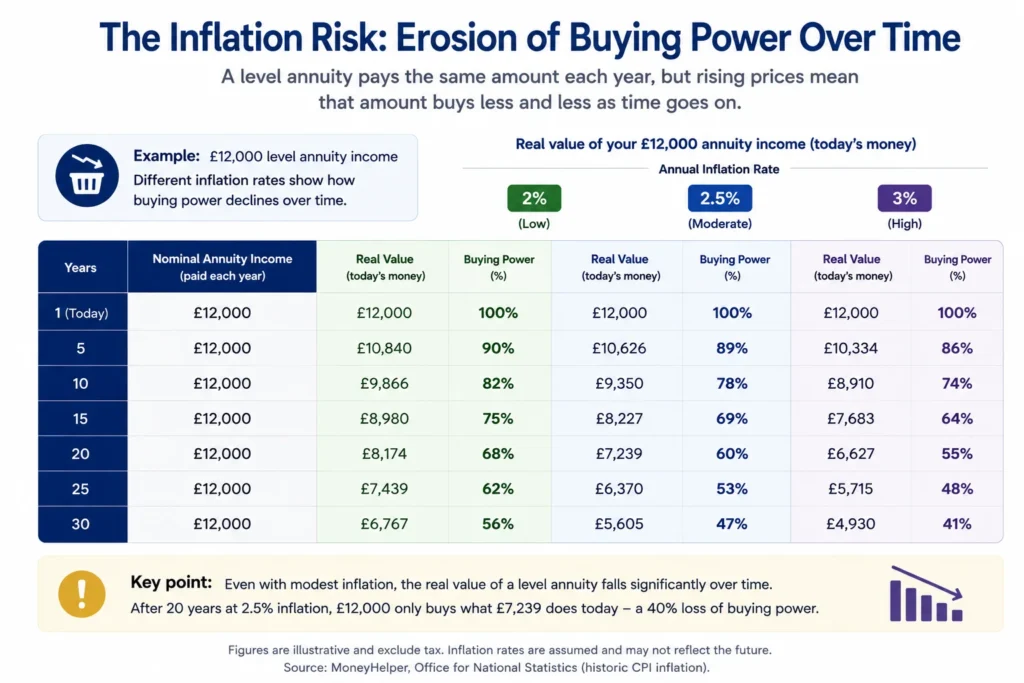
Here’s exactly what happens to a £7,000 annual level annuity income, in real, today’s-money terms, at a representative 3% average inflation rate — genuinely close to long-run UK averages over recent decades:
| Years after purchase | Age (bought at 65) | Real purchasing power |
|---|---|---|
| Start | 65 | £7,000 (100%) |
| 5 years | 70 | ~£6,020 (86%) |
| 10 years | 75 | ~£5,188 (74%) |
| 15 years | 80 | ~£4,480 (64%) |
| 20 years | 85 | ~£3,862 (55%) |
Notice the shape of that decline. It doesn’t feel dramatic in any single year — a modest, barely noticeable erosion from one year to the next. But annuity inflation risk compounds, exactly like interest does, just working in the opposite direction: each year’s erosion applies to an already-reduced real value from the year before, meaning the percentage loss actually accelerates the longer the period runs, even at a perfectly steady inflation rate.
Why This Feels Invisible Until It Isn’t
This is precisely why annuity inflation risk catches so many retirees off guard, despite being entirely predictable and well understood by financial planners. Nobody experiences a sudden, dramatic cut to their income — there’s no single moment where the loss becomes obvious. Instead, it’s a slow, steady, almost imperceptible tightening, year after year, that only becomes genuinely visible when you stop and compare what your income actually buys today against what it bought when you first retired.
By the time the erosion becomes undeniable — typically somewhere in your late seventies or eighties, after 15 to 20 years of a level income — the decision that caused it was made decades earlier, and there’s generally no way to reverse it. This is exactly why understanding annuity inflation risk before buying, not after two decades of watching it play out, matters so much.
A Real-World Example: The Price of Milk
Numbers on a spreadsheet can feel abstract, so here’s a genuinely concrete illustration financial planners often use. The average cost of a pint of milk in the UK was roughly 34.2p in 1999. By the end of 2023 — just 24 years later — it had very nearly doubled, to around 67.2p. Nothing dramatic happened in any single year to cause that; it was simply the steady, cumulative effect of ordinary, largely unremarkable inflation, compounding quietly year after year, exactly the same mechanism driving annuity inflation risk on a fixed pension income.
If your annuity income had stayed completely level over that same 24-year period, while milk (and everything else) roughly doubled in price, the practical reality is straightforward: you’d be buying meaningfully less with the same fixed income, for absolutely everything, not just milk specifically.
What Happens at Higher Inflation
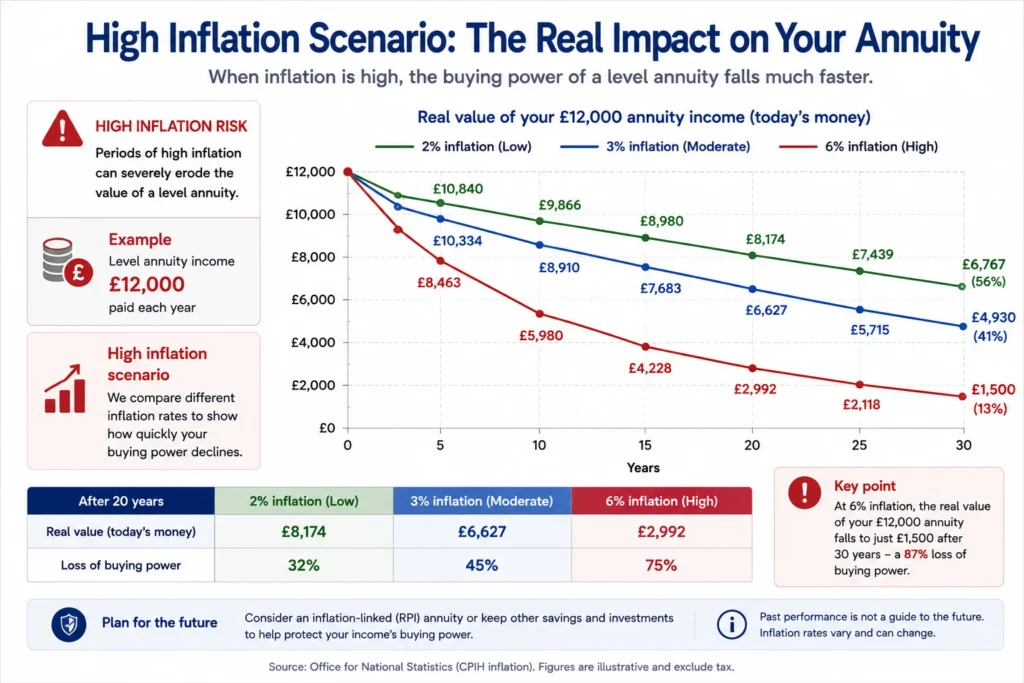
The 3% scenario above is a reasonable long-run assumption, but annuity inflation risk becomes considerably more severe during periods of higher inflation, which the UK has genuinely experienced within recent memory — inflation peaked at 11.1% in October 2022 before gradually easing back toward target.
At a sustained 6% average inflation rate — not impossible, given recent history — a fixed £10,000 income falls to less than a third of its original real value after just 20 years, worth roughly £3,118 in today’s terms. Fidelity’s retirement planning research notes that a 65-year-old man has roughly a 25% probability of living to 92 — and at that age, with inflation averaging even a moderate 4%, his fixed income would have fallen to around a third of its original real value. At a more benign 2% inflation rate, by contrast, the same income would still be worth more than half its original value even at that advanced age — illustrating just how much the specific inflation rate experienced over a retirement genuinely matters to the scale of this risk.
Why the State Pension Is Different
It’s worth understanding this contrast directly, because it highlights exactly what a level annuity is missing. The State Pension rises each year under the triple lock — increasing by whichever is highest of price inflation, average wage growth, or 2.5%. This structural protection means the State Pension’s real purchasing power is substantially better preserved over a long retirement than a level annuity’s fixed income, precisely because it’s specifically designed to keep pace with rising prices, rather than staying frozen at its original level.
This is exactly the protection an escalating annuity attempts to replicate for the rest of your pension income — covered in detail in our guide to level vs escalating annuities, including the specific break-even age at which an escalating annuity’s cumulative total actually overtakes a level annuity’s, given its lower starting income.
What You Can Genuinely Do About It
If annuity inflation risk genuinely concerns you, the most direct solution is choosing an escalating or RPI-linked annuity instead of a level one, accepting a lower starting income in exchange for protection that keeps pace with rising prices throughout your retirement. If you’ve already committed to a level annuity, or if a blend feels more appropriate to your circumstances, an income floor strategy — combining a smaller annuity covering essentials with flexible drawdown for the remainder — can provide some natural inflation protection through the invested portion of your pot, without requiring the entire pension to sacrifice starting income for inflation protection.
A few things worth knowing:
- These figures use representative long-run inflation assumptions — actual future inflation is inherently unpredictable and could run higher or lower than any historical average
- The erosion described here applies specifically to level annuities; escalating and RPI-linked annuities are structured differently, specifically to counter this risk
- Once purchased, an annuity’s structure (level, escalating, or RPI-linked) generally cannot be changed, making this decision genuinely permanent at the point of purchase
- Combining a level annuity with other inflation-protected income, such as the State Pension, can partially offset this risk across your total retirement income, even if the annuity itself remains fixed
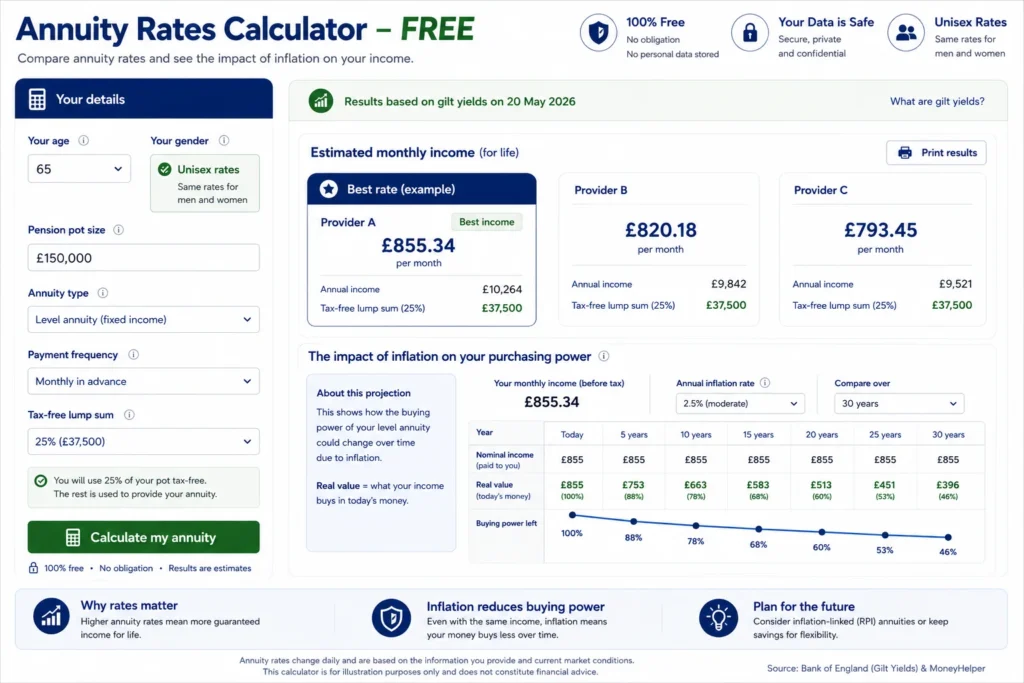
Model level versus escalating annuity income for your own circumstances using our annuity rates calculator, and see exactly how inflation risk compares between the two structures.
Frequently Asked Questions
What is annuity inflation risk?
It’s the risk that a level annuity’s fixed income loses real purchasing power over time as prices rise, even though the cash amount paid never changes. At 3% average inflation, a level annuity loses roughly 45% of its purchasing power over 20 years.
How much does a £7,000 level annuity actually buy after 20 years?
At a representative 3% average inflation rate, £7,000 a year in real purchasing power falls to roughly £3,862 in today’s money after 20 years, even though the actual payment amount stays exactly £7,000 throughout.
Does the State Pension have the same inflation risk as a level annuity?
No. The State Pension rises each year under the triple lock, increasing by the highest of inflation, wage growth, or 2.5%, giving it structural protection against inflation that a level annuity’s fixed income lacks entirely.
How can I protect my annuity income against inflation?
Choosing an escalating or RPI-linked annuity instead of a level one provides direct protection, in exchange for a lower starting income. Alternatively, combining a smaller annuity with flexible drawdown can offer some natural inflation protection through the invested portion of your pot.
Is annuity inflation risk worse during periods of high inflation?
Yes, significantly. At 6% average inflation, a fixed income falls to less than a third of its original real value after 20 years, compared to roughly 55% remaining at 3% inflation over the same period.
Can I switch from a level annuity to an escalating one later if inflation rises?
No. Once purchased, an annuity’s structure is generally permanent and cannot be changed, which is exactly why understanding annuity inflation risk before buying matters considerably more than trying to adjust for it afterwards.
Official sources: check current and historical UK inflation data at the Office for National Statistics, read general annuity guidance at MoneyHelper, and verify any adviser on the FCA register. Compare level and escalating options with our annuity rates calculator, or browse every tool on the mortgage calculators homepage.