
Annuity vs Drawdown | The Honest Answer for 2026
Annuity vs drawdown is the single biggest decision most people make at retirement, and here’s the number almost nobody puts side by side before deciding: an annuity at 65 pays roughly 7.9% of your pot every year, guaranteed for life. A genuinely safe drawdown withdrawal rate is roughly 3.9%. The annuity pays double the income — and it can’t run out, however long you live.
That doesn’t settle the argument on its own. But it should absolutely be the starting point of it, and it’s precisely the comparison most retirement guidance skips straight past.
Site editor at MortgageToolsHub — annuity and drawdown figures cross-checked against current UK annuity rates and Morningstar sustainable withdrawal research. Last checked July 2026.
On This Page
- The comparison almost nobody makes properly
- What each option actually is
- Why 7.9% and 3.9% aren’t really comparable numbers
- Sequence-of-returns risk — the thing drawdown doesn’t warn you about
- The 4% rule doesn’t apply to UK retirees
- The genuine advantages of drawdown
- The middle path: an income floor strategy
- The MPAA trap worth knowing before you touch drawdown
- FAQ
The Comparison Almost Nobody Makes Properly
Here’s why the annuity vs drawdown decision gets made badly so often: people compare an annuity’s 7.9% against a portfolio’s hoped-for investment return of 5% to 7%, and conclude drawdown wins because the numbers look similar or even better. It’s the wrong comparison entirely. The number that actually matters isn’t what your investments might return — it’s what you can safely spend from drawdown without running out, and that figure is considerably lower than most people assume.
What Each Option Actually Is
An annuity converts your pension pot into a guaranteed income for life, paid by an insurer, in exchange for handing over the lump sum. The income is fixed (or follows a chosen structure like escalation), arrives regardless of what happens to markets, and continues however long you live — even if that turns out to be well past 100.
Drawdown keeps your pension pot invested, letting you withdraw money as you choose, while the remainder stays exposed to investment markets, with the potential for growth — and equally, the potential for loss. There’s no guarantee your money lasts as long as you do, and the withdrawal amount you choose directly affects how long the pot is likely to survive.
Why 7.9% and 3.9% Aren’t Really Comparable Numbers
At current 2026 rates, a healthy 65-year-old buying a standard single-life, level annuity gets around 7.9% of their pot as guaranteed annual income — roughly £7,900 a year on a £100,000 pot. Meanwhile, the sustainable withdrawal rate from a drawdown pot — the amount you can take each year with a high probability of not running out over a 30-year retirement — sits closer to 3.5% to 4%. Morningstar’s 2025 research puts the figure specifically at 3.9% at 90% confidence.
On a £300,000 pot, that gap works out to roughly £23,700 a year from an annuity versus £11,700 a year from safe drawdown — the annuity paying more than double. So why does drawdown still outsell annuities four to one across the UK market? Because people run the wrong comparison, putting 7.9% next to an expected investment return of 5-7% and concluding they can beat the annuity, without accounting for the margin drawdown genuinely needs to survive bad years, fees, and the possibility of living to 96.
Sequence-of-Returns Risk — The Thing Drawdown Doesn’t Warn You About
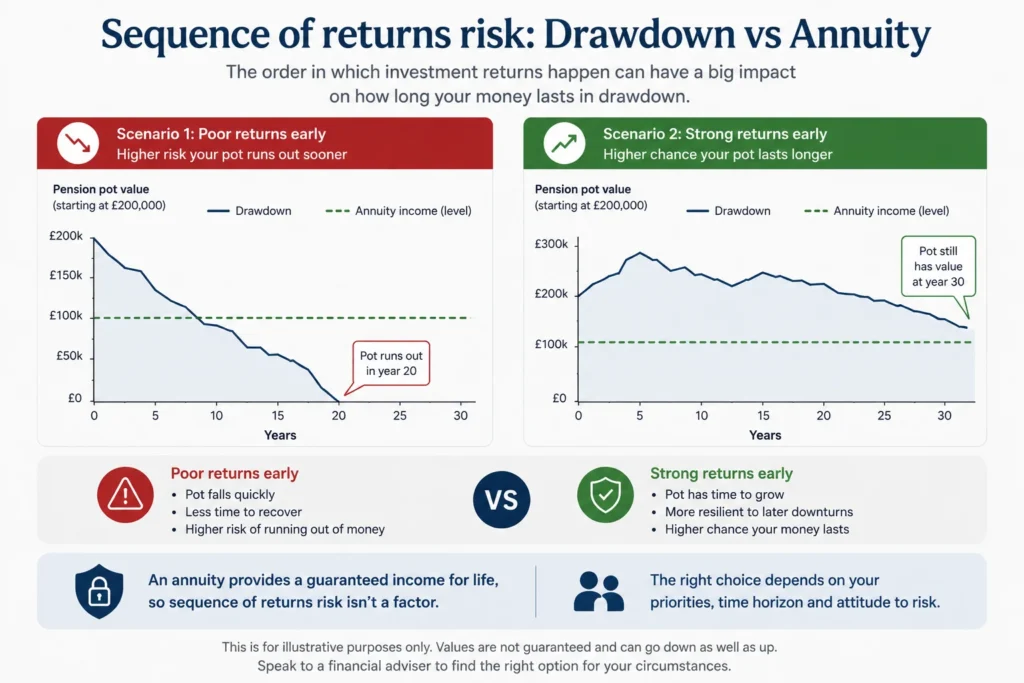
This is genuinely the most underappreciated risk in the annuity vs drawdown decision. Two retirees, identical pots, identical withdrawals, and — this is the critical part — the exact same average annual return over 30 years. One gets the bad market years first. The other gets them last. They do not end up in the same place. They can end up hundreds of thousands of pounds apart, and one of them may run out entirely, purely because of when the bad years happened to fall within their retirement, not how the market performed overall.
The mechanism is straightforward: when markets fall and you’re still taking a fixed withdrawal, that withdrawal represents a larger percentage of a shrunken pot, meaning you’re selling more units at a lower price. When markets eventually recover, you own fewer units to benefit from that recovery. This is precisely why the same average return can produce wildly different real-world outcomes depending purely on the order the returns arrived in — a risk an annuity simply doesn’t carry, since the insurer absorbs all of it.
The 4% Rule Doesn’t Apply to UK Retirees
William Bengen’s famous 4% rule came from US stock and bond data, analysed in the 1990s. It’s genuinely useful research — but it wasn’t built around UK retirees. UK real investment returns have historically been lower than US ones, UK inflation has been more volatile, and UK fund charges tend to run higher. Run the same analysis on British data and the safe withdrawal rate drops meaningfully: Morningstar’s 2025 UK-specific figure lands at 3.9%, and other UK-specific research puts it as low as 3.0% to 3.5%.
Worth sitting with what “90% confidence” actually means in that figure too: even at 3.9%, roughly one in ten retirees following that withdrawal rate still runs out of money before they die. That’s not a rounding error in a spreadsheet — that’s a real person, at 91, with an empty pot.
The Genuine Advantages of Drawdown
None of this means an annuity automatically wins the annuity vs drawdown decision — drawdown carries real, legitimate advantages that matter enormously to many people. Flexibility is the obvious one: you can vary withdrawals year to year based on your actual needs, rather than being locked into a fixed income forever. Inheritance is the other major factor — money remaining in drawdown at death can generally pass to your beneficiaries, whereas a standard annuity typically leaves nothing once you die (unless you’ve added a guarantee period or joint life protection).
If leaving money to family matters significantly to you, or if your income needs are likely to change substantially over retirement, these genuine advantages of drawdown deserve serious weight — the trade-off simply needs to be made with your eyes open, understanding what you’re giving up in guaranteed income to keep those options available.
The Middle Path: An Income Floor Strategy
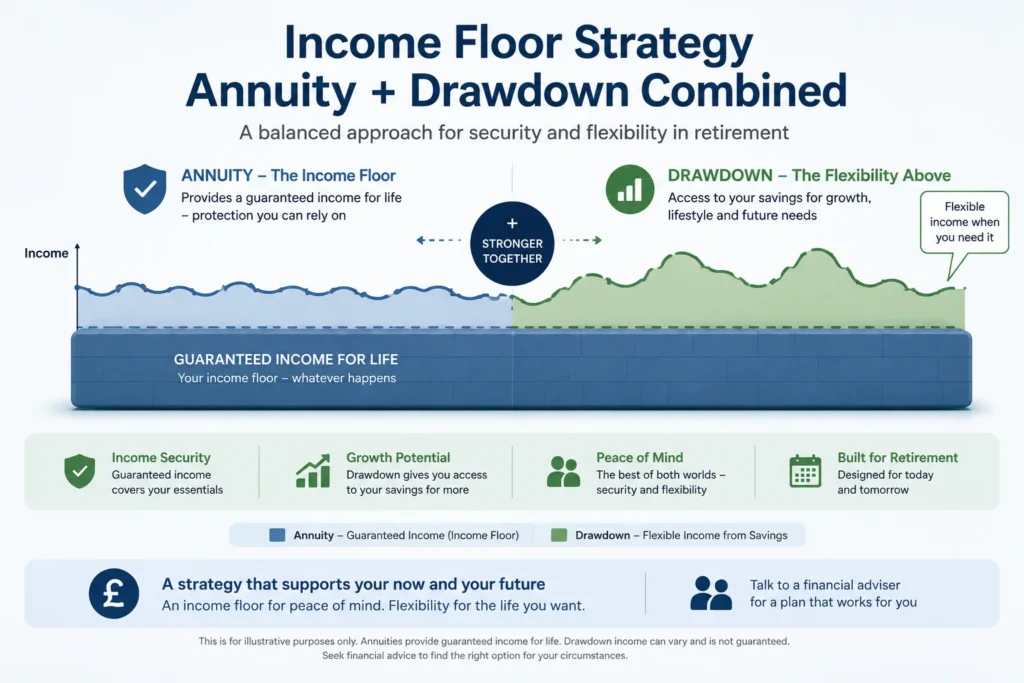
Rather than treating annuity vs drawdown as an all-or-nothing choice, many financial advisers now recommend a blended approach: annuitise enough to cover your essential, non-negotiable spending — housing costs, utilities, food, council tax — using your State Pension plus a modest annuity purchase, and keep the remainder of your pot in drawdown for flexibility and discretionary spending.
This strategy means a market downturn can never threaten your ability to pay essential bills, since that portion is guaranteed regardless of what happens to markets, while you retain genuine flexibility and inheritance potential on the rest of your pot. It’s arguably the single most useful, underused piece of retirement planning advice, precisely because it stops framing this as a binary choice between two competing products.
The MPAA Trap Worth Knowing Before You Touch Drawdown
Here’s a detail that catches people out with real financial consequences: the moment you take any taxable income from drawdown — even a single pound — your annual pension contribution allowance drops permanently from £60,000 to just £10,000 for the 2026/27 tax year. This is called the Money Purchase Annual Allowance (MPAA), and it matters enormously if you’re still working, or might return to work, and want to keep contributing meaningfully to a pension.
Taking only your 25% tax-free lump sum doesn’t trigger the MPAA. Taking even a small amount of taxable income above that does, and the change is irreversible. If there’s any chance you might want to keep contributing significantly to a pension in the future, this is worth understanding fully before touching drawdown income, regardless of which side of the annuity vs drawdown decision you ultimately lean toward.
A few things worth knowing:
- Annuity and drawdown figures here are representative of 2026 market conditions — your own numbers will depend on your specific pot, age, health, and provider
- Enhanced annuity rates, covered in our enhanced annuity guide, can significantly shift this comparison if you have a qualifying health condition
- Drawdown fees, fund charges, and platform costs all reduce your effective sustainable withdrawal rate below the headline figures discussed here
- Always take independent financial advice before making an irreversible decision of this scale, given how permanent an annuity purchase is once completed
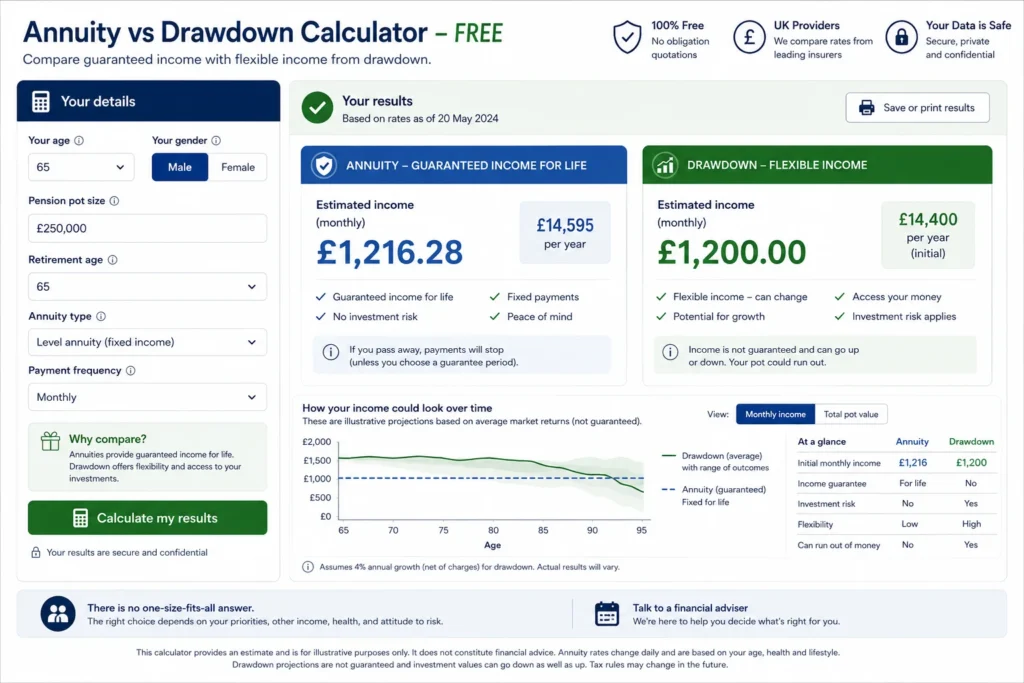
Compare your own annuity income against a drawdown scenario using our annuity rates calculator, or model the full income floor strategy with our pension annuity calculator.
Frequently Asked Questions
Is an annuity or drawdown better for retirement income?
Neither is universally better — an annuity pays roughly double the income of safe drawdown (7.9% vs 3.9% at current rates) and cannot run out, while drawdown offers flexibility and inheritance potential that a standard annuity doesn’t. Many people benefit from combining both rather than choosing one exclusively.
What is sequence-of-returns risk in drawdown?
It’s the risk that poor investment returns early in retirement do lasting damage to a drawdown pot, even if the long-run average return is fine, because withdrawals during a downturn sell a larger share of a shrunken pot. Two retirees with identical average returns in a different order can end up with vastly different outcomes.
Why is the 4% rule not reliable for UK retirees?
The 4% rule was based on US market data from the 1990s. UK-specific research, including Morningstar’s 2025 analysis, suggests a more conservative safe withdrawal rate of around 3.9%, or as low as 3.0-3.5% in some UK-focused studies, reflecting historically lower UK real returns and higher volatility.
What is an income floor strategy?
It’s a blended approach where you annuitise just enough to cover essential living costs, using your State Pension plus a modest annuity, while keeping the rest of your pot in drawdown for flexibility. This protects essential spending from market risk while preserving some flexibility and inheritance potential.
What is the MPAA and why does it matter?
The Money Purchase Annual Allowance drops your pension contribution allowance from £60,000 to £10,000 permanently once you take any taxable income from drawdown. This matters if you might want to continue contributing significantly to a pension while still working.
Does an annuity leave anything for my family when I die?
A standard single-life annuity with no additional features leaves nothing on death. Adding a guarantee period or joint life option, or choosing value protection, can provide some inheritance or continuation of income, though at the cost of a lower starting income.
Official sources: read general retirement income guidance at MoneyHelper, and verify any adviser on the FCA register. Compare your own numbers with our annuity rates calculator or pension annuity calculator, or browse every tool on the mortgage calculators homepage.