
Annuity Guarantee Period | 5 or 10 Years? The Smart Answer
Here’s the fear that quietly stops a lot of people from buying an annuity at all: what if I hand over my entire pension pot, and die eighteen months later? An annuity guarantee period exists precisely to answer that fear, and it’s one of the cheapest, most widely used protections in the entire annuity market — around 90% of 2026 buyers choose at least one form of death benefit protection, and a guarantee period is consistently the most popular starting point.
Here’s exactly how it works, what it costs, and how to choose between 5 years and 10.
Site editor at MortgageToolsHub — annuity guarantee period figures cross-checked against PensionHelper and UK provider published data. Last checked July 2026.
On This Page
- What an annuity guarantee period actually does
- 5 years or 10 — the real difference
- What it actually costs
- A real worked example
- Guarantee period vs value protection — they’re not the same thing
- Who a guarantee period genuinely suits
- How guarantee periods interact with joint life annuities
- FAQ
What an Annuity Guarantee Period Actually Does
A basic annuity, with no additional protection, works exactly as harshly as it sounds: the moment you die, payments stop immediately, regardless of whether that’s two years into a twenty-year retirement or one month after you signed the paperwork. Whatever remains of the capital simply stays with the insurer. For a lot of people, that’s a genuinely difficult risk to accept, particularly given how permanent an annuity purchase is.
An annuity guarantee period solves this specific worry. You choose a fixed period — most commonly 5 years or 10 years — and the insurer commits to paying the annuity income for at least that long, regardless of when you actually die. If you die within the guarantee period, the remaining payments continue to your nominated beneficiary for whatever’s left of that period. If you outlive the guarantee period entirely, nothing changes — the annuity simply continues paying you normally, exactly as it would without the guarantee, for the rest of your life.
5 Years or 10 — The Real Difference
The choice between a 5-year and 10-year annuity guarantee period comes down to how much protection you want against the specific scenario of dying unexpectedly early, weighed against the modest additional cost of the longer option.
A 5-year guarantee offers meaningful protection for a relatively small reduction in income, covering the period many people consider the highest-anxiety window immediately after retirement. A 10-year guarantee extends that protection considerably further, at a slightly larger, though still modest, cost to your starting income. Neither option affects your income at all if you live beyond the guarantee period — the entire cost is purely the insurance premium against dying early, not an ongoing charge for the rest of your life.
What It Actually Costs
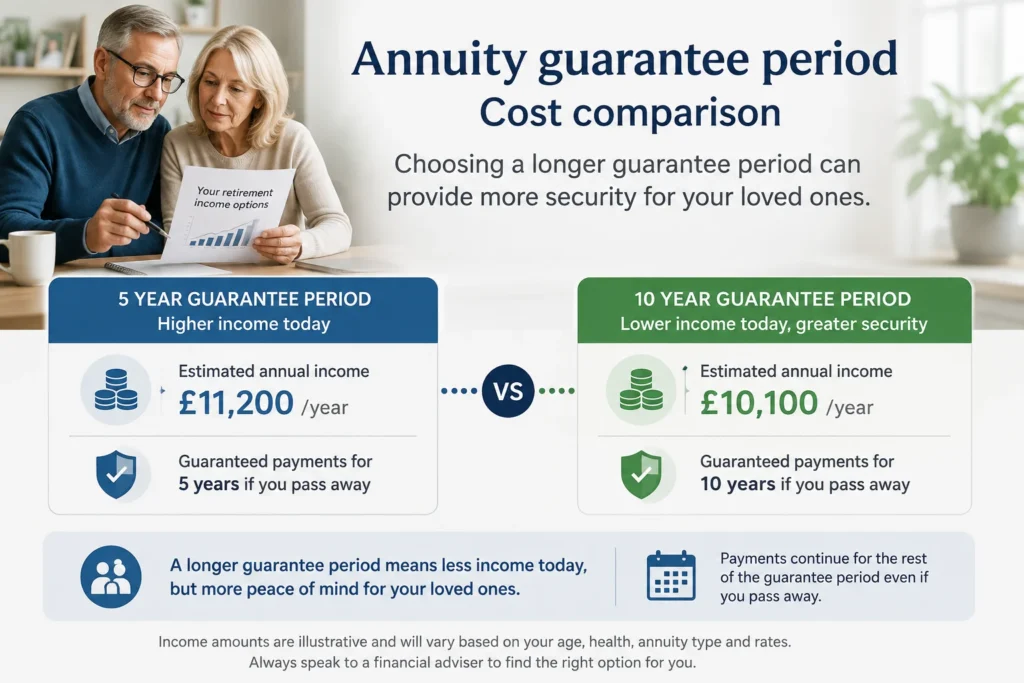
This is genuinely one of the most affordable protections available in the entire annuity market. Adding a guarantee period typically reduces your starting income by only 1% to 3% for a 10-year guarantee, with a 5-year guarantee costing even less. On a £100,000 pot generating roughly £7,800 a year without any guarantee, a 10-year guarantee period might reduce that to somewhere around £7,600-£7,700 — a genuinely small reduction for the peace of mind it provides.
Compare that modest cost against a joint life annuity, which typically reduces income by 5% to 15% depending on the survivor percentage chosen, and it becomes clear why a guarantee period is often the first protection people add, even before considering more substantial features. If you’re weighing up joint life protection alongside a guarantee period, our guide to joint life annuities covers that decision in more depth.
A Real Worked Example
Picture a £200,000 pot at 65, buying a level annuity. Without any guarantee period, the income might be roughly £13,500 a year, stopping entirely and immediately on death, however soon that happens. With a 10-year guarantee added, the income drops only slightly, to roughly £13,200 a year — a reduction of around 2% for the protection.
Now imagine the worst-case scenario the guarantee period is designed for: you die in year 3. Without the guarantee, payments would have stopped completely, and the insurer would have kept the remaining capital. With the 10-year guarantee in place, your nominated beneficiary receives the remaining 7 years of payments — roughly £92,400 in total, paid out specifically because you added this modest, relatively inexpensive protection at the outset.
That gap — between receiving nothing further and receiving £92,400 — for a starting cost of roughly £300 a year in reduced income, is precisely why so many buyers choose to add an annuity guarantee period almost automatically, treating it as a near-default feature rather than an optional extra.
Guarantee Period vs Value Protection — They’re Not the Same Thing
It’s worth being precise here, because these two features solve related but genuinely different problems, and they’re easy to confuse. An annuity guarantee period ensures payments continue for a fixed number of years, regardless of the total amount involved — if you die in year 1 of a 10-year guarantee, your beneficiary gets 9 more years of income, however that compares to what you originally paid for the annuity.
Value protection (sometimes called capital protection) works differently: it guarantees that if you die before receiving back the full amount you originally paid for the annuity, the shortfall is returned to your beneficiaries as a lump sum, regardless of how many years have passed. These two features can sometimes be combined, but they’re priced and structured separately, and it’s worth understanding which specific risk each one is actually protecting against before choosing between them, or adding both.
Who a Guarantee Period Genuinely Suits
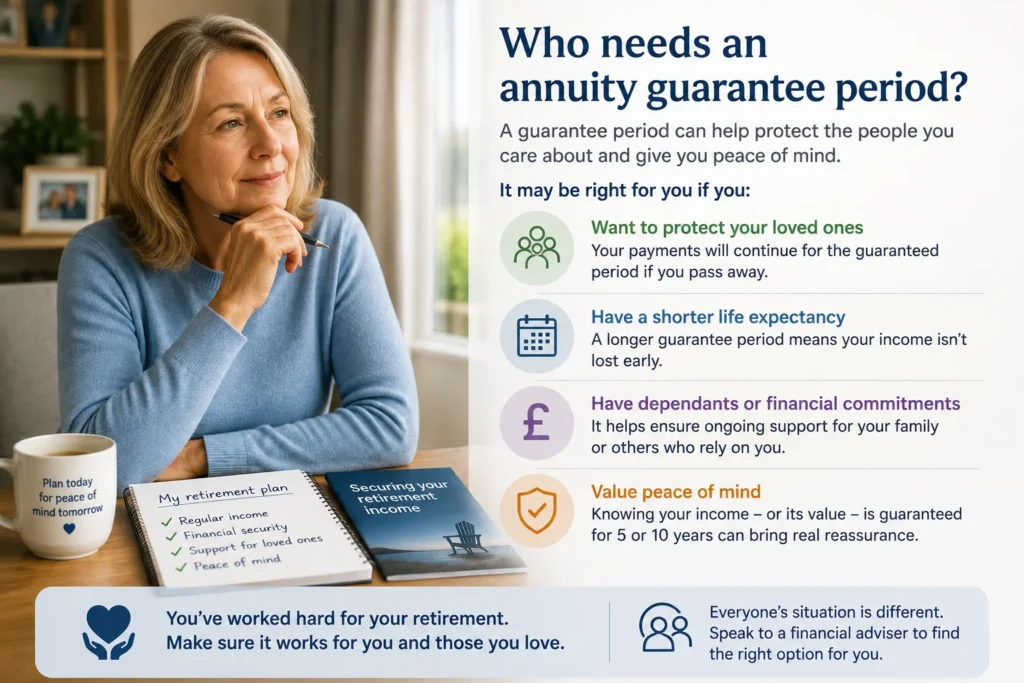
Given how modest the cost typically is, a guarantee period is worth serious consideration for almost anyone buying an annuity, but it matters most specifically for people without a joint life annuity in place. If you’ve already chosen a joint life option, your partner is protected regardless of when you die, which somewhat reduces the urgency of a guarantee period covering the same early-death scenario, though many people still add both for genuinely comprehensive protection.
It’s also particularly relevant if you have health concerns that give you less confidence in a long retirement, or if you simply want a nominated person other than a spouse — an adult child, a sibling, a chosen beneficiary — to receive something if you die shortly after purchase. Given the genuinely modest cost involved, there are very few situations where adding at least a 5-year guarantee period isn’t worth serious consideration.
How Guarantee Periods Interact With Joint Life Annuities
These two features can be combined, and understanding how they interact matters if you’re considering both. If you have a joint life annuity with a guarantee period, and you die within the guarantee period, your surviving partner typically receives the higher of either the full guaranteed payments or their ongoing joint life survivor percentage, rather than both stacking on top of each other. The exact mechanics vary by provider, so it’s worth confirming precisely how a specific quote combines these features before assuming you understand the total protection in place.
A few things worth knowing:
- Guarantee period costs vary by provider and the specific length chosen — the figures here are representative, not a personal quote
- Once purchased, the guarantee period cannot be added or changed later — this decision is locked in at the point of purchase, alongside every other feature of the annuity
- A guarantee period pays out regardless of your cause of death, unlike some life insurance policies that exclude certain circumstances
- Combining a guarantee period with enhanced annuity rates, if you qualify due to health conditions, is entirely possible and doesn’t affect eligibility for either feature
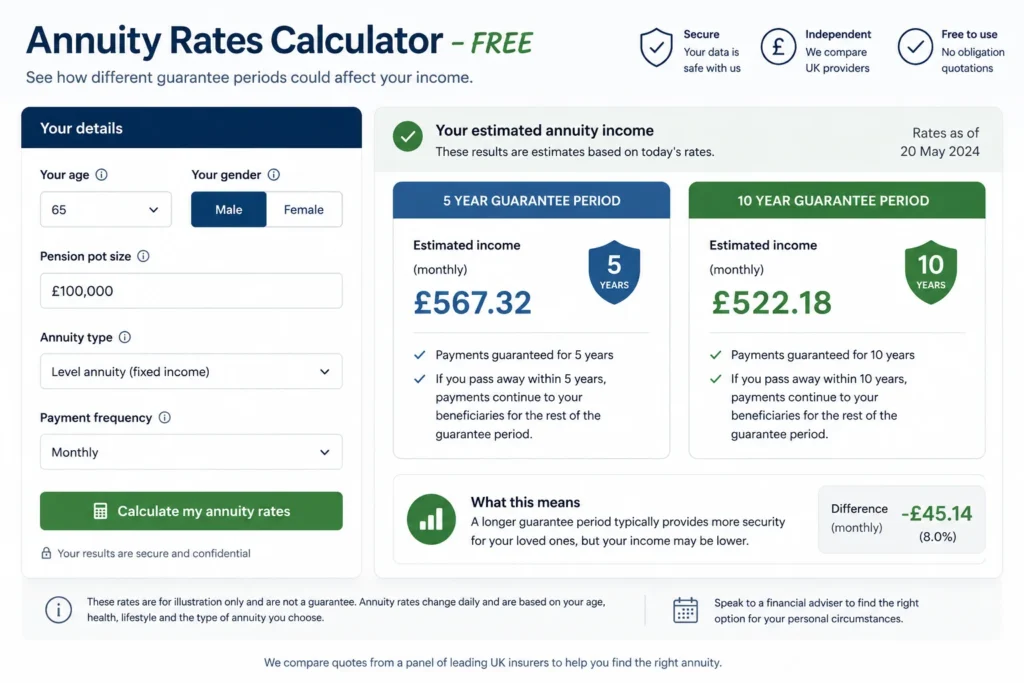
See how a 5-year or 10-year guarantee period affects your own annuity income using our annuity rates calculator.
Frequently Asked Questions
What is an annuity guarantee period?
An annuity guarantee period ensures your annuity income continues for a minimum number of years, typically 5 or 10, regardless of when you die. If you die within that period, remaining payments continue to your nominated beneficiary for whatever’s left of the guaranteed term.
How much does an annuity guarantee period cost?
Adding a guarantee period typically reduces your starting income by only 1% to 3% for a 10-year guarantee, with a 5-year guarantee costing even less. It’s one of the most affordable protections available in the annuity market.
What happens if I outlive my annuity guarantee period?
Nothing changes. Once the guarantee period ends, your annuity simply continues paying your normal income for the rest of your life, exactly as it would without the guarantee period in place.
Is a guarantee period the same as value protection?
No. A guarantee period ensures payments continue for a fixed number of years regardless of amount. Value protection guarantees that if you die before receiving back the full purchase price of your annuity, the shortfall is paid as a lump sum. These are different, separately priced features.
Should I choose a 5-year or 10-year guarantee period?
This depends on how much protection you want against dying early, weighed against the modest additional cost. A 10-year guarantee offers longer protection for a slightly larger, though still modest, reduction in your starting income compared to a 5-year option.
Do I need a guarantee period if I already have a joint life annuity?
Not necessarily as urgently, since your partner is already protected under a joint life annuity regardless of when you die. However, many people still add a guarantee period for additional protection, particularly if they want a beneficiary other than their spouse to also be covered.
Official sources: read general annuity guidance at MoneyHelper, and verify any provider or adviser on the FCA register. Model guarantee period options with our annuity rates calculator, or browse every tool on the mortgage calculators homepage.