
Enhanced Annuity | The Genuine Way to Boost Your Pension Income
An enhanced annuity is one of the few places in financial services where being unwell genuinely works in your favour. Declare high blood pressure, diabetes, or a history of smoking, and instead of being quoted a worse deal — the pattern almost every other insurance product follows — you can end up with a noticeably higher guaranteed income for the rest of your life. It sounds almost too good to be true the first time someone explains it, but the logic is entirely sound, and it’s genuinely one of the most underused ways to boost retirement income.
Here’s exactly what qualifies, how much it’s actually worth, and why so many people miss out simply by not asking.
Site editor at MortgageToolsHub — enhanced annuity uplift figures cross-checked against published UK provider data. Last checked July 2026.
On This Page
- Why an enhanced annuity pays more, not less
- What conditions actually qualify
- How much extra income enhanced annuities pay
- The lifestyle factors most people forget to mention
- Why you should never assume you don’t qualify
- How the underwriting process actually works
- FAQ
Why an Enhanced Annuity Pays More, Not Less
Every standard annuity rate is priced around average life expectancy. The insurer is making a promise: pay a lump sum now, receive a guaranteed income for however long you live. If your life expectancy is statistically shorter than average, due to a health condition or lifestyle factor, the insurer expects to be paying that income for fewer years — so they can afford to offer you more money per year, for the exact same lump sum, and still expect to come out roughly even over your lifetime.
This is precisely the mechanism behind an enhanced annuity: it isn’t charity, and it isn’t a loophole. It’s the insurer pricing your specific, individual risk more accurately than a generic, population-average standard rate ever could — and for millions of people, that more accurate pricing works out considerably in their favour.
What Conditions Actually Qualify
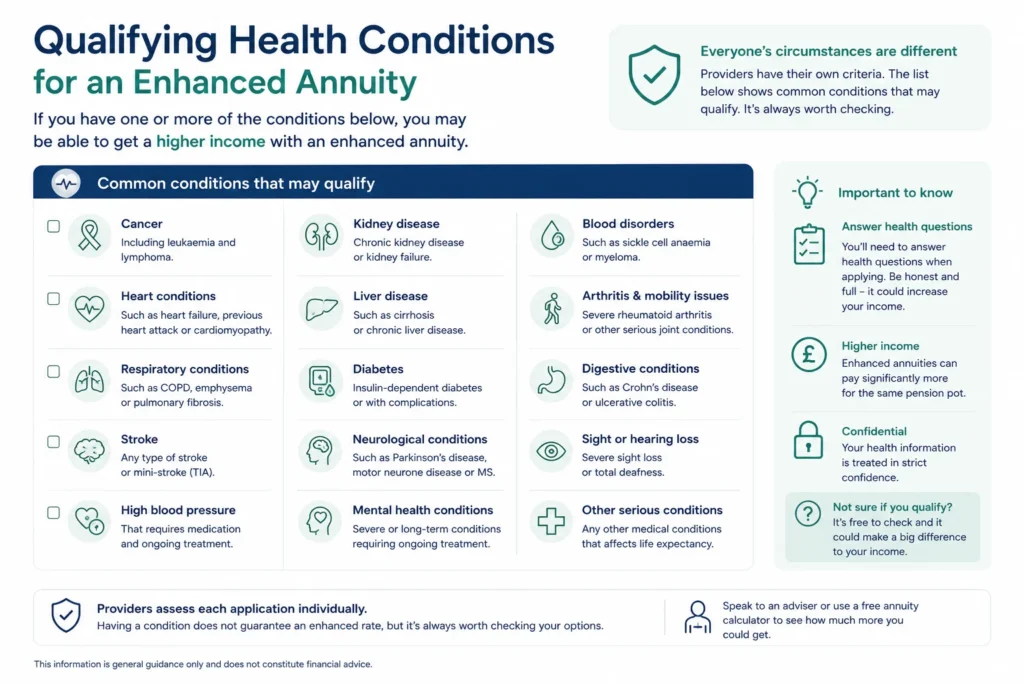
The list of qualifying conditions is genuinely broader than most people expect, and it’s worth reading through properly rather than assuming you don’t fit. Common conditions that can qualify for an enhanced annuity include:
- High blood pressure and high cholesterol — even when well-controlled with medication
- Diabetes, whether Type 1 or Type 2
- Heart conditions, including previous heart attacks or angina
- Cancer, current or previous, at various stages
- Kidney disease
- Chronic respiratory conditions, including COPD and severe asthma
- Stroke, previous history
- Multiple sclerosis and other neurological conditions
- Obesity, measured by BMI thresholds that vary by provider
This isn’t an exhaustive list, and providers each have their own underwriting criteria, meaning a condition that qualifies with one insurer might be assessed differently by another — precisely why comparing across the whole market, using your open market option, matters as much for enhanced annuities as it does for standard ones.
How Much Extra Income Enhanced Annuities Pay
The uplift varies enormously depending on the specific condition, its severity, and how many factors combine together. As a general guide, published market examples show a range from modest to substantial:
- Mild, well-managed conditions (such as controlled high blood pressure alone) — often around 6% to 10% more than a standard rate
- Moderate combined conditions (such as high blood pressure plus high cholesterol) — often 10% to 20% more
- Smoking, declared honestly — commonly 6% to 10% more, sometimes higher depending on how much and for how long
- Serious conditions significantly affecting life expectancy — sometimes classified as an “impaired life” annuity, with uplifts of 30% to 100% or more above standard rates, for conditions such as certain cancers, severe heart failure, or specific neurological diagnoses
On a £100,000 pot, even a modest 10% uplift on a standard 65-year-old rate of roughly £7,800 translates to an extra £780 a year, for the rest of your life. For more significant conditions, the difference can run into thousands of pounds annually — a genuinely material change to a retirement budget, from simply answering health questions honestly.
The Lifestyle Factors Most People Forget to Mention
Health conditions get most of the attention, but lifestyle factors matter too, and they’re the ones people most often forget to declare, either through oversight or a sense that they’re not “medical” enough to mention. Smoking history is the most significant — even a modest cigarette habit over a sustained period can shift your rate noticeably. Occupation can matter in some cases, particularly physically demanding or higher-risk roles. Alcohol consumption, above certain thresholds, is sometimes factored in by specific providers too.
The general rule worth remembering: if a factor genuinely affects your statistical life expectancy, it’s worth mentioning during the quote process, even if it doesn’t feel like a formal “condition.” The worst outcome of declaring something that turns out not to qualify is simply no change to your quote — there’s no downside to asking.
Why You Should Never Assume You Don’t Qualify
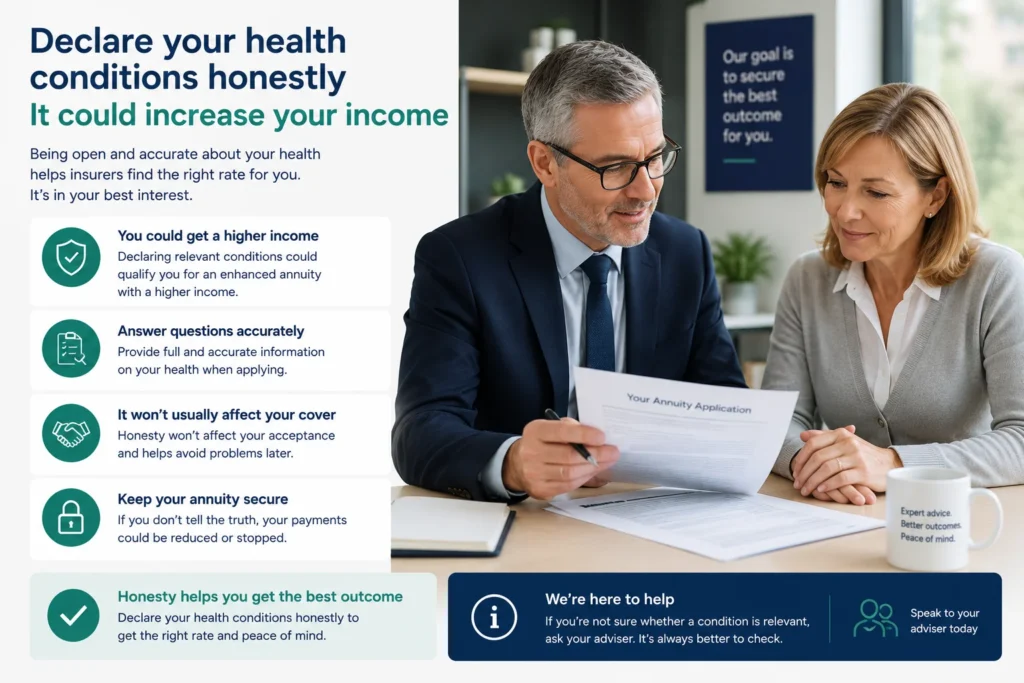
This is the single most common mistake people make with an enhanced annuity: assuming their condition is “too minor” to matter, and simply not mentioning it. Providers each have different thresholds and different specialisms — a condition that one insurer considers negligible might genuinely move the needle with another, particularly with providers who specialise specifically in medically underwritten annuities.
The practical advice here is straightforward: declare everything, honestly, to multiple providers, and let the underwriting process decide, rather than pre-judging your own eligibility. Combined with shopping around via the open market option, declaring health and lifestyle factors thoroughly is one of the two biggest levers available to boost your guaranteed retirement income — and unlike investment risk or market timing, it’s entirely within your control simply by being thorough and honest at the point of quoting.
How the Underwriting Process Actually Works
Getting an enhanced quote typically involves completing a health and lifestyle questionnaire with each provider you approach, covering existing conditions, medications, smoking and drinking habits, and sometimes your occupation. For more significant conditions, a provider may request further information from your GP or ask for recent medical records before finalising a quote — this is more common with larger enhancements, since the insurer needs genuine confidence in the underlying risk assessment before offering a materially higher rate.
This process adds a small amount of time compared to a standard annuity quote, but it’s rarely a significant delay, and the potential income increase makes it worth the extra paperwork for almost everyone with a genuine qualifying factor.
A few things worth knowing:
- Enhanced annuity uplifts vary considerably by provider, condition, and severity — the ranges here are representative, not a personal quote
- Some providers specialise specifically in medically underwritten annuities and may offer meaningfully better terms for certain conditions than a generalist provider
- Combining an enhanced quote with the open market option — comparing multiple providers rather than accepting the first offer — typically produces the best overall result
- Once purchased, an annuity is generally permanent, so accuracy in declaring health and lifestyle factors at the outset matters considerably
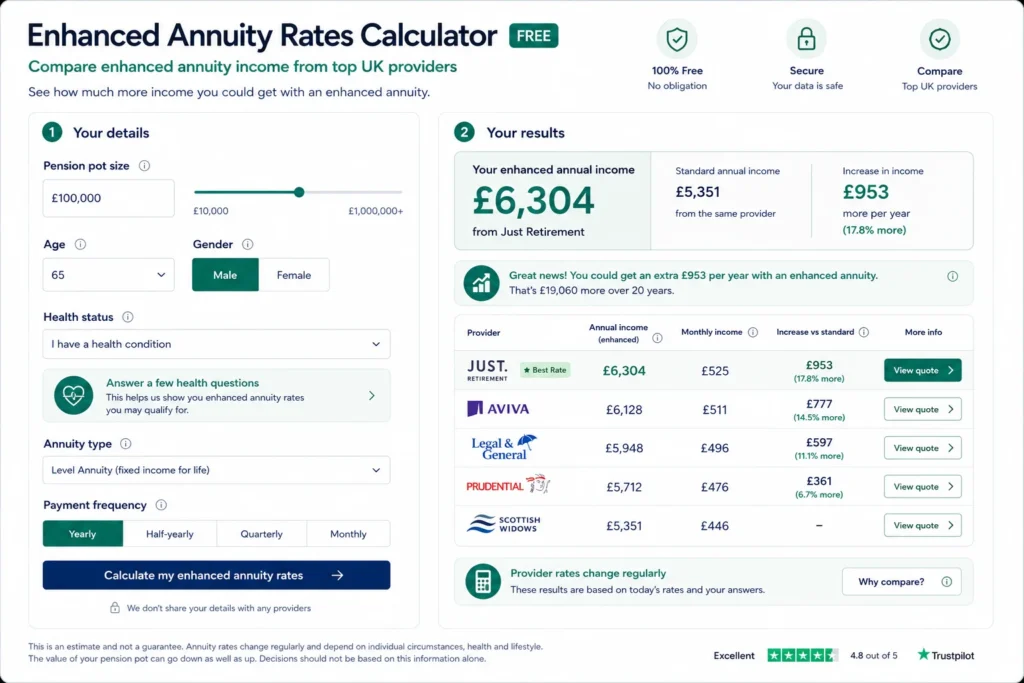
See a representative starting estimate for your age using our annuity rates calculator, then compare enhanced quotes from multiple providers before deciding — our guide to UK annuity rates in 2026 covers the wider market context worth understanding alongside your own personal quote.
Frequently Asked Questions
What is an enhanced annuity?
An enhanced annuity pays a higher guaranteed income than a standard annuity because you’ve declared a health condition or lifestyle factor that statistically reduces life expectancy, allowing the insurer to price your specific risk more generously than a population-average rate.
What health conditions qualify for an enhanced annuity?
A wide range, including high blood pressure, diabetes, heart conditions, cancer, kidney disease, chronic respiratory conditions, and stroke history, among others. Providers assess each condition individually, and criteria vary between insurers.
How much more income does an enhanced annuity pay?
This varies significantly, from around 6% to 10% more for mild or well-managed conditions, up to 30% to 100% or more for serious conditions significantly affecting life expectancy. The exact uplift depends on the specific condition, its severity, and the provider’s underwriting.
Does smoking qualify me for an enhanced annuity?
Yes, smoking history is a commonly recognised lifestyle factor that can increase your annuity income, typically by around 6% to 10%, depending on smoking history and the specific provider’s criteria.
Should I declare a minor health condition even if I’m not sure it counts?
Yes. There’s no downside to declaring a condition that turns out not to qualify — your quote simply stays the same. Not declaring something that could have qualified means potentially losing income for the rest of your life.
Do all annuity providers offer the same enhanced rates?
No. Providers assess conditions differently and some specialise specifically in medically underwritten annuities, meaning it’s worth comparing multiple providers, using the open market option, rather than accepting the first enhanced quote you receive.
Official sources: read general annuity guidance at MoneyHelper, and verify any provider or adviser on the FCA register. Get your starting estimate with our annuity rates calculator, or browse every tool on the mortgage calculators homepage.