
How Much Can I Borrow Commercial Mortgage? The Real Answer
How much can I borrow commercial mortgage lenders will actually approve isn’t a single number you can work out from your income alone, and this is precisely where most first-time commercial borrowers get their expectations wrong. Unlike a residential mortgage, where a simple income multiple gets you most of the way to an answer, commercial lending runs on three separate tests simultaneously — and your actual maximum is whichever one is most restrictive, not the most generous.
Here’s exactly how to work out your real number, not a rough guess.
Site editor at MortgageToolsHub — commercial mortgage borrowing figures cross-checked against current UK lender ICR, DSCR and LTV criteria. Last checked July 2026.
On This Page
- Why there’s no simple answer to how much you can borrow
- The three tests that actually decide your maximum
- Working through a real example
- What pushes your maximum up
- What pushes your maximum down
- Investment property vs owner-occupied — different maths entirely
- FAQ
Why There’s No Simple Answer to How Much You Can Borrow
If you’ve searched how much can I borrow commercial mortgage hoping for a quick multiple of your income or turnover, the honest answer is that commercial lending doesn’t work that way at all. Residential mortgages use a straightforward income multiple — roughly 4 to 4.5 times your salary. Commercial mortgages instead ask whether the property or the business itself generates enough income to safely cover the debt, tested through specific ratios that vary depending on exactly what you’re buying the property for.
The Three Tests That Actually Decide Your Maximum
Your actual borrowing maximum is always the lowest figure produced by these three separate checks — not the highest, and not an average.
Interest Coverage Ratio (ICR) applies if you’re buying an investment property with a tenant already in place. Your annual rental income is divided by the annual interest payment at a stressed rate, and lenders typically want this to reach 125% for limited companies, or 140-145% for personal name borrowers.
Debt Service Coverage Ratio (DSCR) applies if you’re buying premises for your own trading business to operate from. Your business’s EBITDA (or adjusted net profit) is divided by your total annual debt service, including capital repayment, not just interest. Most lenders want a minimum of 1.25x to 1.5x cover.
Loan-to-Value (LTV) applies regardless of which category you fall into, capping your loan at a percentage of the property’s value — typically 65% to 75% for standard commercial property, occasionally higher for owner-occupier premises or particularly strong professional practices.
Working Through a Real Example
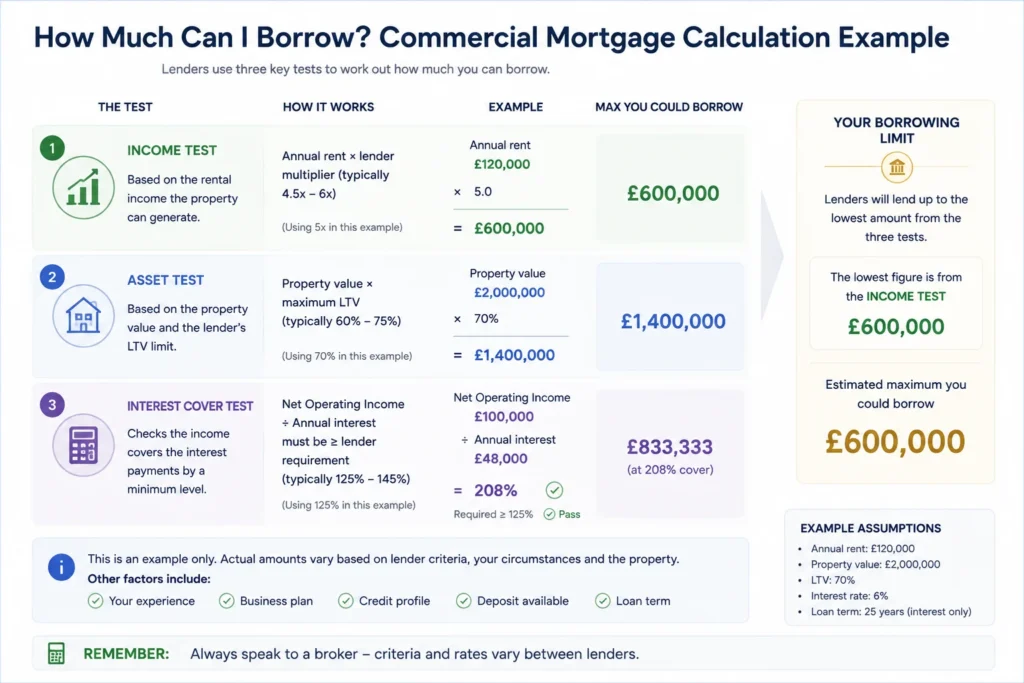
Say you want to buy a £350,000 investment property with a tenant paying £24,000 a year in rent, borrowing through a limited company.
Step one — check the LTV cap. At 70% LTV, the property alone would support a maximum loan of £245,000, requiring a £105,000 deposit.
Step two — check ICR at that loan size. With a stress rate of 7%, annual interest on £245,000 would be £17,150. Dividing your £24,000 rent by that gives an ICR of roughly 140% — comfortably above the 125% threshold for a limited company.
In this case, both tests pass at the full £245,000, so that’s genuinely your answer to how much can I borrow commercial mortgage for this specific property. Change the rent to £18,000 instead of £24,000, and the ICR at the same £245,000 loan drops to roughly 105%, below the 125% threshold — meaning your real maximum would be reduced until the ICR climbed back to 125%, regardless of what the LTV cap alone would have allowed.
What Pushes Your Maximum Up
A stronger, longer lease with a well-established tenant can occasionally soften ICR requirements slightly with specialist lenders, since the rental income is viewed as more secure. A larger deposit reduces your LTV, which doesn’t directly change ICR or DSCR but does reduce the overall loan amount you need to qualify for in the first place. And for owner-occupied applications, a strong, consistent trading history with growing profit tends to be viewed more favourably than a shorter or more volatile track record, potentially softening the DSCR requirement with some lenders.
What Pushes Your Maximum Down
Applying as an individual rather than a limited company, if you’re buying investment property — the ICR threshold jumps from 125% to 140-145%, meaningfully reducing your maximum loan for identical rental income. Using net rather than gross rent in the ICR calculation, if voids, management fees, or maintenance costs need deducting first — always confirm which figure your specific lender uses before assuming your headline rent qualifies in full. A shorter or declining trading history, for DSCR-assessed owner-occupied applications, typically pushes lenders toward requiring a higher coverage ratio, since there’s less evidence the business can sustain the payment through a downturn.
Investment Property vs Owner-Occupied — Different Maths Entirely
It’s worth being explicit that how much can I borrow commercial mortgage genuinely depends on which category your purchase falls into, since the two use entirely different tests. An investment property purchase is assessed almost entirely on the rental income the property itself generates — your personal finances barely enter the calculation. An owner-occupied purchase is assessed on your business’s own trading profit, meaning a struggling business, even with a valuable property in mind, may struggle to borrow as much as the property’s value alone would suggest.
Our full guide to how commercial mortgages are calculated covers both mechanisms in complete depth, including the exact stress-rate methodology lenders apply to both tests.
A few things worth knowing:
- ICR and DSCR thresholds vary by lender — the figures here are representative of the current UK market, not a guarantee from any specific lender
- The stress rate used in ICR and DSCR calculations is not your actual product rate — it’s typically 2-3 percentage points higher, to test affordability against future rate rises
- Legal and valuation costs on commercial mortgages typically run £3,000 to £12,000, considerably more than residential purchases
- Always get a lender’s specific criteria confirmed before assuming a general market figure applies to your exact circumstances
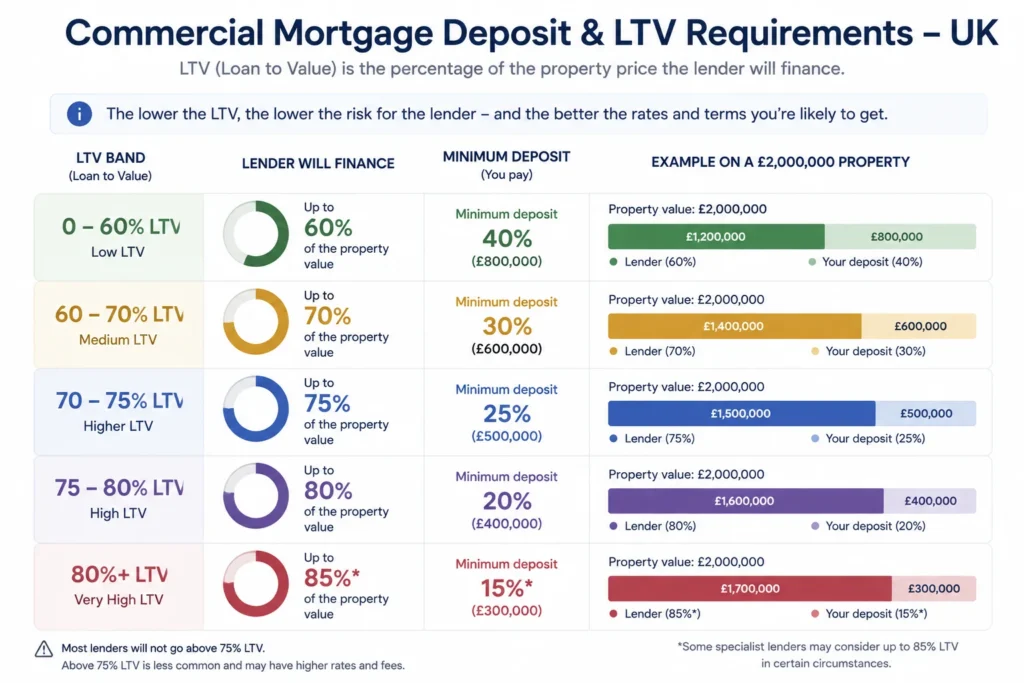
Understanding your deposit requirement alongside your borrowing maximum matters just as much — our guide to commercial mortgage deposits covers exactly how much you’ll need across different property types.
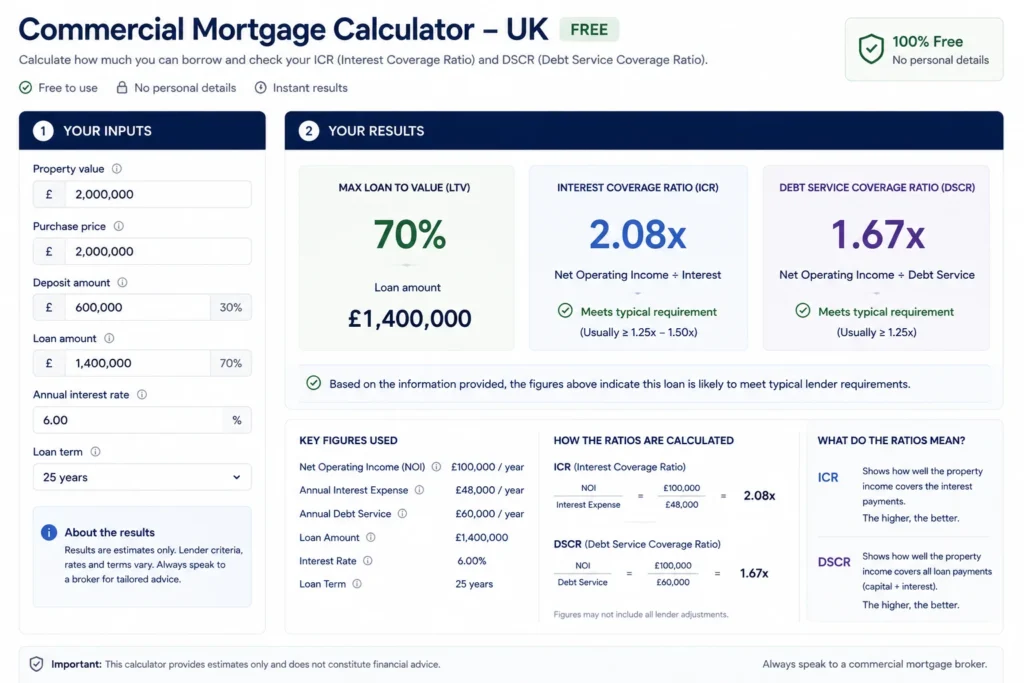
Work out your own borrowing maximum, testing ICR, DSCR and LTV together, using our commercial mortgage calculator.
Frequently Asked Questions
How much can I borrow on a commercial mortgage?
Your maximum is the lowest of three separate tests: Interest Coverage Ratio (for investment property, typically requiring 125-145% rent-to-interest cover), Debt Service Coverage Ratio (for owner-occupied premises, typically requiring 1.25x-1.5x profit-to-debt cover), and loan-to-value (typically capped at 65-75% of property value).
Does my personal income affect how much I can borrow on a commercial mortgage?
For investment property, generally no — the assessment focuses on rental income. For owner-occupied premises, your business’s trading profit (via DSCR) is what matters, rather than your personal salary specifically.
Why would a lender offer me less than the property’s LTV would allow?
If your rental income (ICR) or business profit (DSCR) doesn’t comfortably cover the debt at the stress-tested rate, the lender will reduce your maximum loan until the relevant ratio is satisfied, even if the property’s value alone would support a larger loan.
Does borrowing through a limited company increase how much I can borrow?
Often, yes, for investment property specifically. Limited company borrowers typically face a lower ICR threshold (around 125%) compared to personal name borrowers (140-145%), meaning the same rental income supports a larger loan through a limited company structure.
What is the stress rate used in commercial mortgage calculations?
Lenders apply a hypothetical, deliberately higher rate than your actual product rate — typically 2-3 percentage points above, often landing between 5.75% and 8% given current base rates — specifically to test whether the loan remains affordable if interest rates rise in the future.
Can I borrow more by using a longer mortgage term?
For DSCR-assessed owner-occupied purchases, yes, potentially, since a longer term reduces the annual capital repayment portion of your debt service. This doesn’t apply in the same way to ICR-assessed investment property, where the calculation focuses on interest only.
Official sources: check current Bank of England base rate decisions at the Bank of England, read general commercial finance guidance, and verify any lender or broker on the FCA register. Work out your maximum with our commercial mortgage calculator, or browse every tool on the mortgage calculators homepage.