
Pension Pot for 25k a Year | The Real Numbers Revealed 2026
Here’s a question worth genuinely sitting with before you answer it: what pension pot for 25k a year do you actually need? Most people assume there’s one clean number. There isn’t — and the gap between the two honest answers is genuinely startling. Via drawdown, you’d need somewhere in the region of £311,000 to £356,000. Via an annuity, the same £25,000 a year requires roughly £158,000 — less than half.
That’s not a typo, and it’s not one route being “better” than the other in some simple sense. Here’s exactly why the numbers diverge so dramatically, and what it means for your own retirement planning.
Site editor at MortgageToolsHub — pension pot for 25k a year figures cross-checked against Hargreaves Lansdown, PLSA and current UK State Pension data. Last checked July 2026.
On This Page
- The two very different answers to this question
- Working out the annuity route
- Working out the drawdown route
- Why the gap between them is so large
- Where £25,000 a year actually sits on the PLSA scale
- The hybrid route most people should actually consider
- What this means if you’re still saving
- FAQ
The Two Very Different Answers to This Question
The honest starting point for pension pot for 25k a year is recognising that “how big a pot do I need” genuinely depends on how you plan to turn that pot into income. An annuity guarantees the income for life, with no risk of running out, which lets you extract a considerably higher percentage of your pot each year without danger. Drawdown keeps your pot invested and flexible, but carries genuine longevity risk — the possibility of running out before you die — which means a much more conservative percentage is considered safe to withdraw.
This single difference explains almost the entire gap between the two pot sizes below.
Working Out the Annuity Route
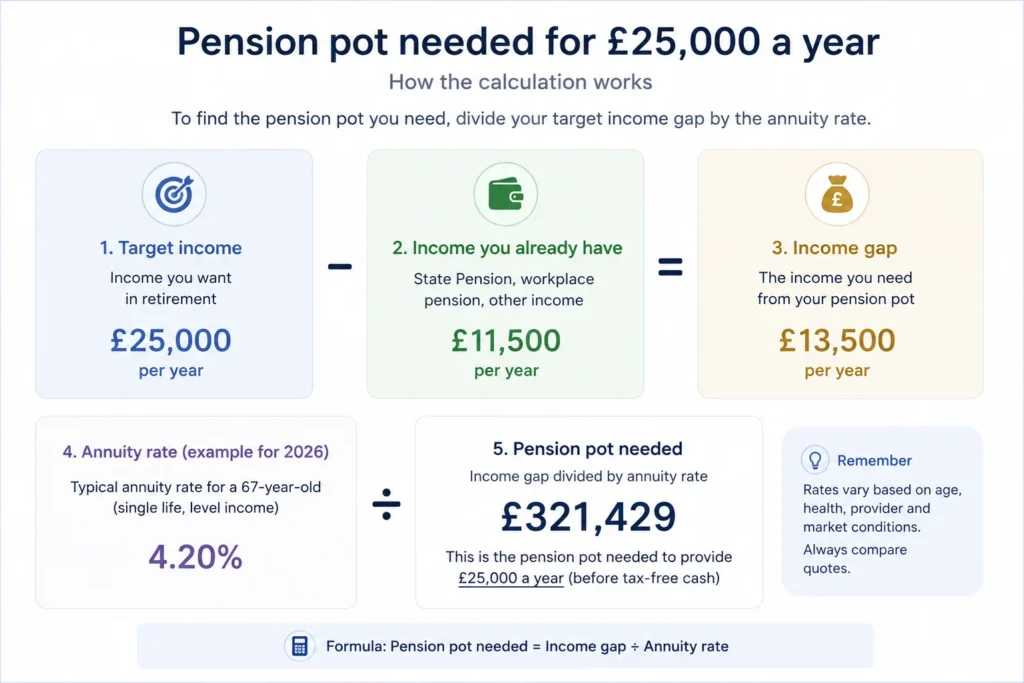
Start with your target: £25,000 a year. Subtract your existing guaranteed income — for the 2026/27 tax year, the full new State Pension is £12,547.60 annually. That leaves an annuity gap of roughly £12,452.
At current 2026 best-buy annuity rates for a healthy 65-year-old — around 7.89% for a level single-life annuity, based on published Hargreaves Lansdown data — you divide that gap by the rate: £12,452 ÷ 0.0789 works out to roughly £157,800, which we can round to £158,000.
That’s the pot size needed via the annuity route to hit £25,000 a year, combined with your State Pension, guaranteed for the rest of your life, however long that turns out to be.
Working Out the Drawdown Route
The same calculation via drawdown uses a considerably lower percentage, because there’s no guarantee absorbing the risk of a long life or a period of poor market returns. UK-specific safe withdrawal rate research — including Morningstar’s 2025 analysis — suggests somewhere between 3.5% and 4% is genuinely sustainable over a 30-year retirement, rather than the more optimistic figures sometimes quoted from older, US-based research.
Using the same £12,452 gap: at 4%, you’d need roughly £311,300. At the more conservative 3.5%, you’d need closer to £355,800. Either way, that’s meaningfully more than double the annuity route’s £158,000 — for the exact same £25,000 a year target income.
Why the Gap Between Them Is So Large
This is the core insight worth genuinely understanding, not just accepting. The annuity rate (roughly 7.9%) reflects what an insurer can afford to pay knowing they only need to fund payments for your actual lifespan — and crucially, across their entire pool of annuity customers, some die earlier and some die later, and the insurer’s pricing balances out across that whole pool.
The safe drawdown rate (roughly 3.5-4%) has to be conservative enough to survive even an unusually long life, potentially 30+ years, without any pooling mechanism to spread that risk. You’re planning for your own worst-case longevity scenario individually, rather than benefiting from the insurer’s ability to average across thousands of customers. This margin — the gap between “average expected outcome” and “worst reasonable individual outcome” — is precisely what accounts for the difference between a 7.9% annuity rate and a 3.5-4% safe drawdown rate, and by extension, the difference between a £158,000 pot and a £311,000+ pot for identical income.
Where £25,000 a Year Actually Sits on the PLSA Scale
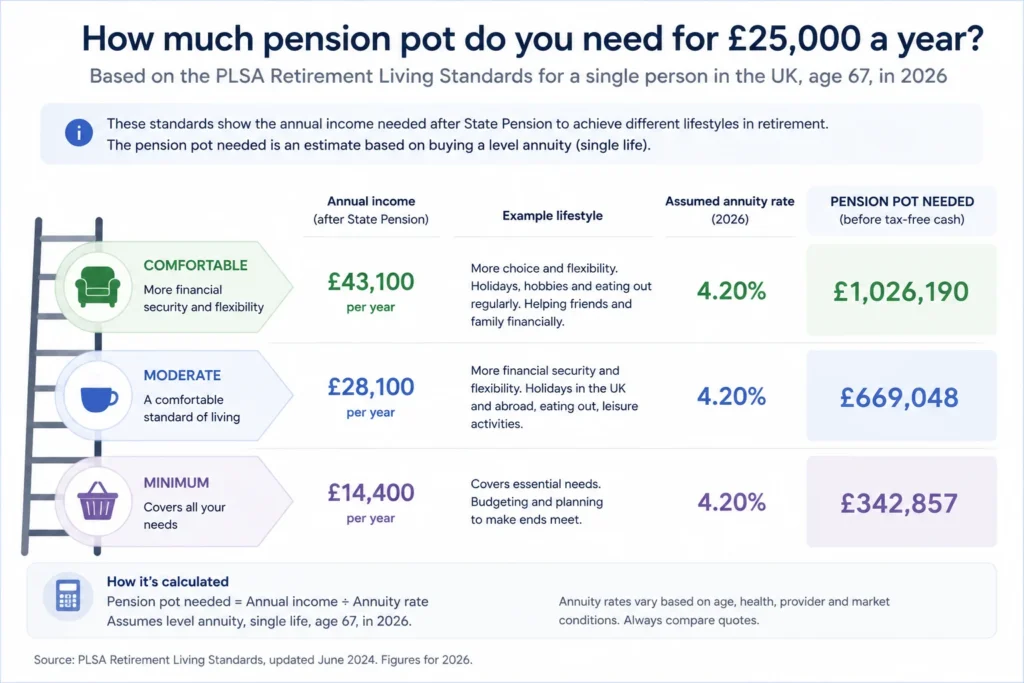
It’s worth having context for what £25,000 a year actually represents as a lifestyle target. The Pensions and Lifetime Savings Association (PLSA) publishes widely-used retirement living standards for a single person: £13,400 for “Minimum,” £31,300 for “Moderate,” and £43,900 for “Comfortable” (2025/26 figures).
A pension pot for 25k a year sits comfortably above the Minimum standard but noticeably below Moderate — a genuinely solid, above-basic retirement income, without stretching to the more generous lifestyle the Moderate standard implies (which typically includes things like a European holiday most years and more discretionary spending on hobbies and socialising).
The Hybrid Route Most People Should Actually Consider
Rather than choosing purely one route or the other, our guide to a partial annuity strategy covers exactly this kind of blended approach in depth — annuitising just enough to cover your essential spending, while keeping the remainder in drawdown for flexibility and potential inheritance. Applied to a £25,000 a year target, this might mean a smaller pot than the full £158,000 annuity route, annuitised specifically to cover essentials, with a genuinely smaller drawdown pot covering the discretionary remainder, rather than needing the full amount via either single approach.
This hybrid thinking is also precisely why our broader annuity vs drawdown guide exists — the two routes aren’t really competitors so much as tools that solve different parts of the same retirement income problem.
What This Means If You’re Still Saving
If you’re not yet at retirement and working out how much to aim for, these figures give you two genuinely useful anchor points. If you’re leaning toward a drawdown-heavy retirement, valuing flexibility and inheritance highly, aim toward the £311,000-£356,000 end of the range. If you’re comfortable with the certainty an annuity provides and don’t need to preserve capital for inheritance, the £158,000 figure is a more realistic target for the same £25,000 outcome — though most people, in practice, land somewhere between the two via a blended approach as their retirement approaches and their actual priorities become clearer.
A few things worth knowing:
- These figures are illustrative, based on 2026 market rates and current State Pension figures — your own numbers will vary based on your actual State Pension entitlement, age at retirement, and prevailing rates when you actually retire
- Enhanced annuity rates, covered in our enhanced annuity guide, can reduce the pot needed via the annuity route further still if you qualify for a health-related uplift
- These calculations assume income before tax — your actual take-home figure will depend on your full tax position, covered in our guide to how annuity income is taxed
- A partial State Pension, due to gaps in your National Insurance record, would increase the pot needed via either route, since less of your £25,000 target is already covered by guaranteed State Pension income
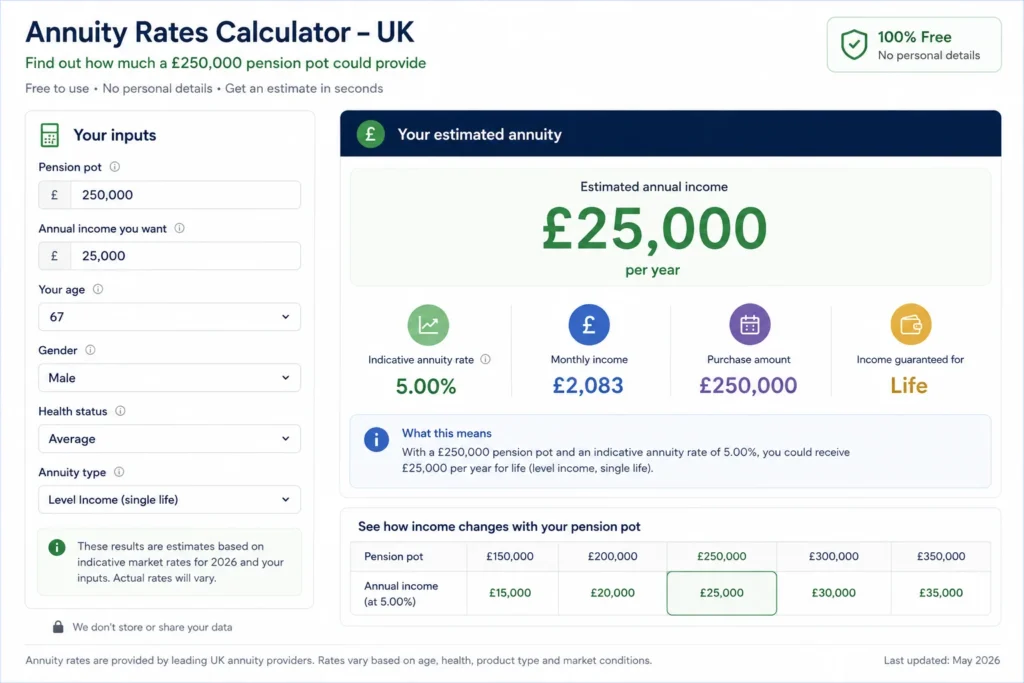
Work out your own personal figures using our annuity rates calculator, which models your actual age, health, and target income rather than the generic averages used in this guide.
Frequently Asked Questions
What pension pot do I need for £25,000 a year via drawdown?
Roughly £311,000 to £356,000, depending on whether you use a 4% or the more conservative 3.5% UK-specific safe withdrawal rate, after accounting for the full new State Pension covering part of your target income.
What pension pot do I need for £25,000 a year via an annuity?
Roughly £158,000, based on current 2026 best-buy annuity rates of around 7.89% for a healthy 65-year-old, combined with the full new State Pension covering the remainder of your target.
Why does the annuity route need such a smaller pot for the same income?
Because an annuity rate reflects average life expectancy pooled across all the insurer’s customers, while a safe drawdown rate has to be conservative enough to survive an individually unusually long life, with no pooling to spread that longevity risk.
Is £25,000 a year a good retirement income in the UK?
It sits comfortably above the PLSA “Minimum” retirement standard of £13,400 but below the “Moderate” standard of £31,300, representing a solid, above-basic retirement lifestyle without the more generous discretionary spending the Moderate standard implies.
Should I choose the annuity or drawdown route for £25,000 a year?
This depends on your priorities. If certainty and simplicity matter most, the smaller annuity pot may be attractive. If flexibility and inheritance potential matter more, the larger drawdown pot preserves those options. Many people benefit from a hybrid approach combining both.
Do these figures include tax?
No, these are gross, pre-tax figures. Your actual take-home income will depend on your full tax position, including how the State Pension interacts with your Personal Allowance and any other income you have.
Official sources: check PLSA retirement living standards at retirementlivingstandards.org.uk, current State Pension rates at GOV.UK, read general retirement guidance at MoneyHelper, and verify any adviser on the FCA register. Calculate your own numbers with our annuity rates calculator, or browse every tool on the mortgage calculators homepage.