
Product Transfer vs Remortgage | The Costly Mistake to Avoid
Product transfer vs remortgage is a decision roughly 1.6 million UK homeowners will quietly make in 2026, and most of them won’t actually realise they’re making it. Here’s how it usually plays out: your fixed deal is a few months from ending, a perfectly polite letter arrives from your existing lender offering you their new range of rates, and switching onto one takes about ten minutes online. No paperwork, no credit check, no hassle. UK Finance is forecasting product transfers to grow by 13% this year, and it’s easy to see why — it genuinely is the path of least resistance.
The problem is that “easiest” and “cheapest” aren’t the same thing, and the gap between them can quietly cost you real money over the life of a deal.
Site editor at MortgageToolsHub — product transfer vs remortgage figures cross-checked against current UK lender rate data. Last checked July 2026.
On This Page
- What each option actually involves
- Why the “easy” letter isn’t always the cheapest one
- Product transfer vs remortgage: the real cost comparison
- When a product transfer genuinely is the right call
- The early repayment charge trap
- What happens if you do nothing at all
- A simple way to decide
- FAQ
What Each Option Actually Involves
A product transfer means staying with your existing lender and simply switching onto one of their current deals. In most cases there’s no new affordability assessment, no valuation, and no legal work — your lender already has your mortgage, so they’re just repricing it. It can often be completed within days, sometimes entirely online.
A remortgage, in the fuller sense of the term, means moving to a genuinely different lender. This involves a full application, a fresh credit check, a property valuation, and legal work, typically taking somewhere between four and eight weeks from start to finish. What you get in exchange for that extra effort is access to the whole mortgage market, not just whatever your existing lender happens to be offering you today.
This is the entire crux of the product transfer vs remortgage decision: convenience and speed on one side, competition and choice on the other.
Why the “Easy” Letter Isn’t Always the Cheapest One
Here’s the part lenders don’t put in bold on the letter: the rate they’re offering existing customers in a product transfer is rarely their most competitive rate on the market. New-customer deals, deals available through brokers, and deals from entirely different lenders are frequently priced better than what you’re quietly nudged toward when your fix is ending.
This isn’t a conspiracy — it’s simply commercial reality. Retaining an existing customer costs a lender very little compared to acquiring a new one, so there’s limited pressure to compete as hard for your business through the product transfer letter as they would to win you from a rival lender. Taking the offered deal without comparing it against the wider market is precisely the moment product transfer vs remortgage stops being a genuine choice and becomes accepting whatever’s in front of you.
Product Transfer vs Remortgage: The Real Cost Comparison
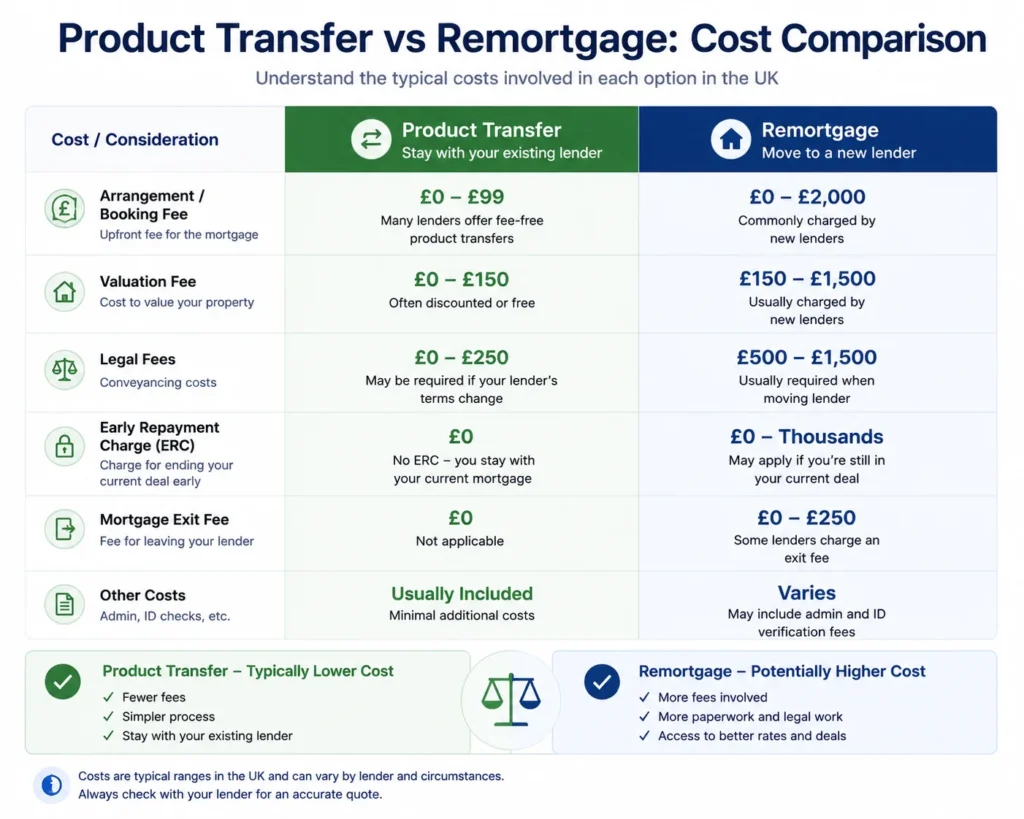
| Product transfer | Remortgage | |
|---|---|---|
| Speed | Days | 4-8 weeks |
| Credit check | Usually none | Yes, full check |
| Valuation | No | Yes (often free) |
| Legal fees | None | Often covered by new lender |
| Arrangement fee | Sometimes waived | £0 – £2,000 |
| Access to whole market | No — only your current lender | Yes |
| Best for | Simplicity, or if circumstances have worsened | Best available rate, extra borrowing |
The genuinely important row here is “access to whole market.” A product transfer only ever compares one lender’s offer — the one already sitting in front of you. A remortgage, even with its extra paperwork, opens the comparison up to every lender genuinely competing for your business, and that competition is precisely what tends to produce the better rate.
When a Product Transfer Genuinely Is the Right Call
This isn’t a one-sided argument — there are real, legitimate reasons to take a product transfer over a full remortgage, and they’re worth taking seriously rather than assuming remortgaging always wins.
Your circumstances have got worse since your original mortgage. A new affordability assessment on a remortgage might mean a lower approved amount, or even a decline, if your income has dropped or your credit history has taken a hit. A product transfer typically skips that reassessment entirely, which can genuinely be the only realistic route if your situation has changed.
Your mortgage balance is small, or the rate gap is marginal. If the difference between your lender’s retention offer and the best available remortgage rate is tiny, the fees and hassle of a full remortgage might not be worth it for the modest saving involved.
You’re not looking to borrow anything extra and just want the path of least friction. If your existing lender’s offer is genuinely competitive once you’ve actually checked it against the market — not assumed it — there’s nothing wrong with taking the simpler route.
The Early Repayment Charge Trap
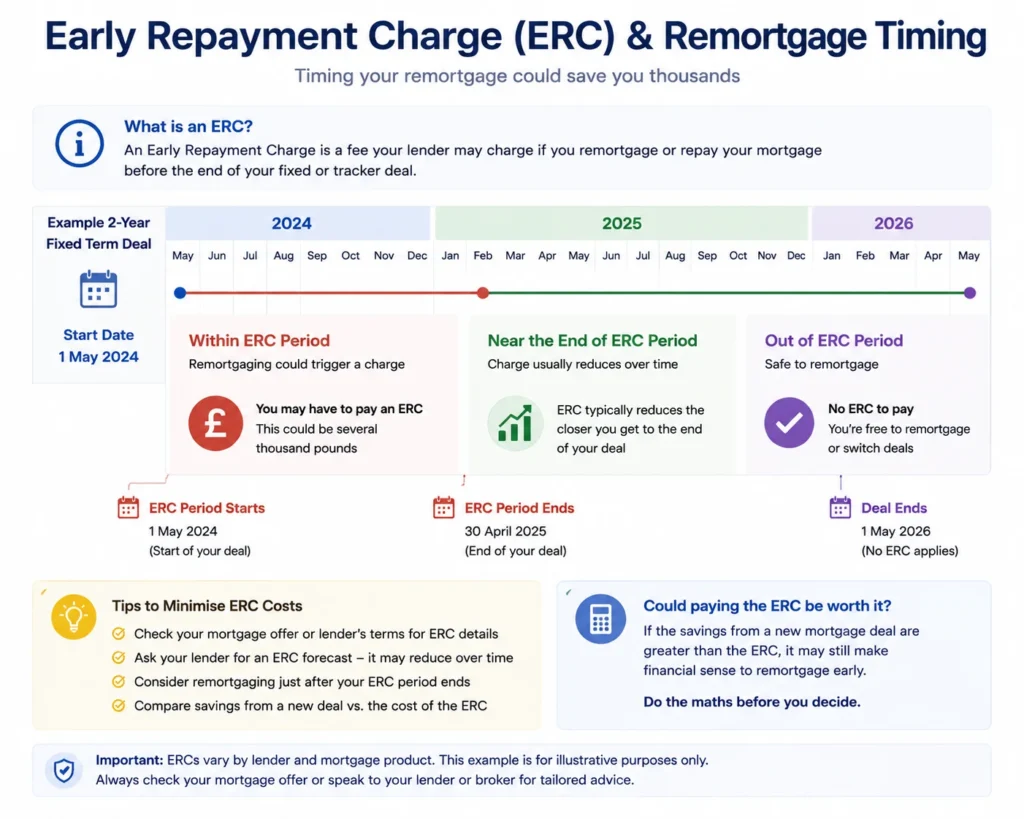
This is where the product transfer vs remortgage decision genuinely gets expensive if handled at the wrong time. If you switch — to either a new deal with your current lender or a different lender — before your existing fixed deal has actually ended, you’ll typically trigger an early repayment charge (ERC), usually somewhere between 1% and 5% of your outstanding balance.
On a £200,000 mortgage, even a modest 1% ERC is £2,000. A 5% charge is £10,000. On larger mortgages — say £550,000, common in higher-value areas — a 3% ERC comes to £16,500. That’s easily enough to wipe out years of savings from a genuinely better rate, which is exactly why timing matters as much as the product transfer vs remortgage choice itself.
The fix: most lenders let you lock in a new rate up to six months before your current deal ends, without triggering the ERC, whether that new rate comes via a product transfer or a full remortgage with a different lender. Starting the process 3 to 6 months ahead of your deal expiring gives you enough time to compare properly and complete the switch exactly as your old deal ends — no ERC, no gap on the expensive Standard Variable Rate either.
What Happens If You Do Nothing at All
If your fixed deal simply expires with no action taken, you’re automatically moved onto your lender’s Standard Variable Rate (SVR) — currently averaging somewhere around 6.5% to 7.15% across major UK lenders, considerably above the best available fixed rates, which have been sitting closer to 4% to 4.5% through much of 2026. On a £200,000 mortgage, the gap between sitting on the SVR and taking a competitive fixed rate can add roughly £490 a month or more to your payments.
There’s genuinely no scenario where doing nothing beats either a product transfer or a remortgage — it’s simply the most expensive of the three options, every time.
A Simple Way to Decide
Get your existing lender’s product transfer offer in writing first — most will provide this a few months before your deal ends. Then compare it properly against the wider market, either yourself or through a broker, factoring in any arrangement fees on either side and any ERC if you’re switching mid-deal. If a genuine remortgage saves you meaningfully more even after accounting for fees and hassle, it’s very likely worth the extra paperwork. If the gap is marginal, or your circumstances have changed in a way that might affect a new affordability check, the simpler product transfer route is a perfectly sound choice.
A few things worth knowing:
- Rates and fees quoted here are representative of the UK market in mid-2026 and will vary by lender and your specific circumstances
- ERCs typically decrease the further you are into your fixed deal, so check your exact remaining charge before assuming a full remortgage isn’t worth it
- Some lenders waive ERCs in specific circumstances, such as moving home or death of a partner — always check your actual deal documents
- If you want to borrow more, not just switch rate, a product transfer combined with additional borrowing is sometimes possible, so it’s worth asking rather than assuming a full remortgage is the only route to extra funds
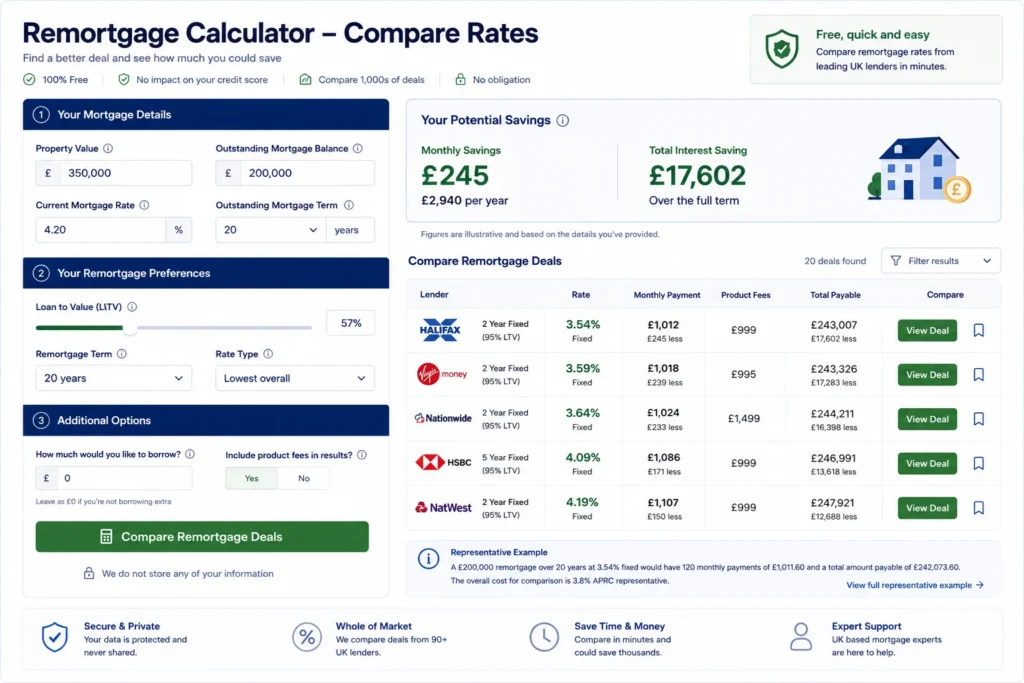
Compare your current deal against the wider market properly using our remortgage calculator, or see the full picture including product transfer, full remortgage and doing nothing side by side with our switch mortgage calculator.
Frequently Asked Questions
What is the difference between a product transfer and a remortgage?
A product transfer means switching to a new deal with your existing lender, usually without a new affordability check, valuation, or legal work. A remortgage means moving to a different lender entirely, involving a full application and credit check, but giving you access to the whole market rather than just one lender’s offer.
Is a product transfer always cheaper than a remortgage?
Not necessarily. A product transfer avoids valuation and legal fees, but the rate offered is rarely a lender’s most competitive deal, since it only reflects one lender rather than the whole market. Comparing both properly, including all fees, is the only reliable way to know which is genuinely cheaper for your situation.
When should I start comparing product transfer vs remortgage options?
Most lenders let you lock in a new rate up to six months before your current deal ends without triggering an early repayment charge. Starting the comparison process 3 to 6 months ahead gives enough time to switch exactly as your old deal expires.
Will I definitely need a new affordability check for a remortgage?
Yes, in almost all cases, since you’re applying to a new lender. A product transfer typically avoids this, which is one of its main advantages if your income or circumstances have changed since your original mortgage.
What happens if my fixed deal ends and I do nothing?
You’ll automatically move onto your lender’s Standard Variable Rate, which is significantly higher than available fixed rates — currently averaging around 6.5% to 7.15% across major UK lenders, compared to competitive fixed deals around 4% to 4.5%.
Can I switch lenders and borrow more at the same time?
Yes, this is a standard part of a full remortgage, letting you release additional equity from your home as a lump sum. Some lenders also allow additional borrowing alongside a product transfer, so it’s worth asking rather than assuming you must fully remortgage to borrow more.
Official sources: read general remortgaging guidance at MoneyHelper, check current market data from UK Finance, and verify any lender or broker on the FCA register. Compare your options with our remortgage calculator, or browse every tool on the mortgage calculators homepage.