
Annuity Rates Men Women | The Surprising 2012 Law Change
Annuity rates men women used to be a genuinely different conversation than it is today. Before December 2012, a man and a woman, identical ages, identical pension pots, identical health, would receive different annuity quotes — the woman’s income noticeably lower, purely because she was statistically expected to live longer. Then, almost overnight, an EU court ruling changed the entire market. Today, gender simply doesn’t feature in the calculation at all.
Here’s the surprising history behind that change, what actually happened to rates when it took effect, and what genuinely still determines your annuity income today.
Site editor at MortgageToolsHub — annuity rates men women pricing history cross-checked against EU Gender Directive documentation and industry provider data. Last checked July 2026.
On This Page
- Are annuity rates the same for men and women today?
- What annuity rates men women pricing looked like before 2012
- The 2012 EU Gender Directive that changed everything
- What actually happened to rates when it took effect
- Why life expectancy differences haven’t disappeared
- What genuinely does affect your annuity rate today
- Does this rule still apply after Brexit?
- FAQ
Are Annuity Rates the Same for Men and Women Today?
Yes, unequivocally. Since 21 December 2012, it has been unlawful for UK insurers to offer different annuity rates men women based on gender alone. A man and a woman of identical age, with an identical pension pot and identical health circumstances, are legally entitled to receive the exact same annuity quote from a given provider. Gender simply isn’t a factor insurers are permitted to use in their pricing calculations anymore, regardless of how it might have influenced rates in the past.
What Annuity Rates Men Women Pricing Looked Like Before 2012
For decades before this change, gender was one of the standard factors insurers built directly into annuity pricing, alongside age and health. The logic was straightforward actuarial reasoning: women statistically live longer than men — historically around 82 years average life expectancy for women, compared to roughly 78 years for men in the UK. Since an annuity is a promise to pay income for however long someone lives, insurers priced that longer expected payment period into women’s rates, meaning women received a lower annual income than men for an identical pension pot, simply because the insurer expected to be paying that income for more years on average.
This felt, to a growing number of people, genuinely unfair — two people who had saved and contributed identically throughout their working lives receiving different retirement incomes purely based on gender, even though other parts of the UK pension system, including the State Pension, didn’t work this way at all.
The 2012 EU Gender Directive That Changed Everything
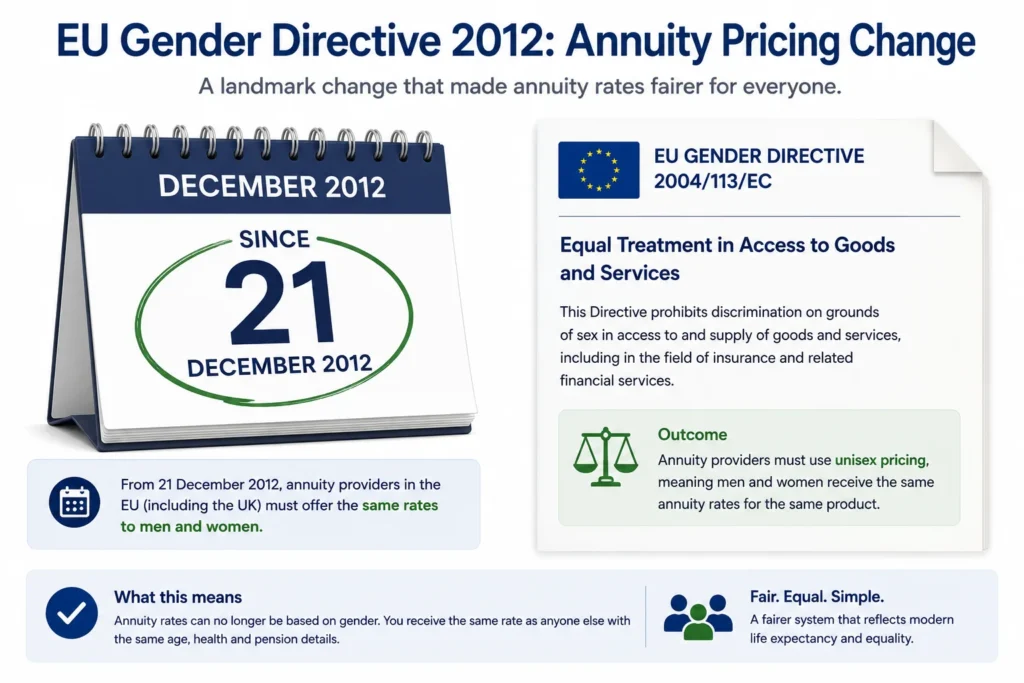
The change came from the European Court of Justice, which ruled that using gender to determine insurance pricing — including annuity rates men women differently — amounted to unlawful sex discrimination. The ruling closed a previous exemption that had allowed gender-based pricing to continue, and set a firm implementation date: 21 December 2012, sometimes referred to in the industry at the time as “G-Day.”
From that date onward, insurers across the EU, including the UK (which was still an EU member at the time), were required to move to unisex pricing for all new annuity contracts. This wasn’t a gradual phase-in — providers had to have fully transitioned their pricing models by the deadline, affecting every new annuity purchased through the Open Market Option from that point forward.
What Actually Happened to Rates When It Took Effect
This is where the real-world transition gets genuinely interesting, because the effect wasn’t simply “average the two rates together” in every case — it depended heavily on each individual provider’s existing customer base. Prudential, one of the first providers to move to unisex pricing ahead of the deadline, offers a well-documented example: for a 65-year-old, female annuity rates increased by roughly 6.5%, while male rates saw only a modest 1.5% reduction. At 60, the effect was even more pronounced — women saw rates rise by roughly 4.5%, while men experienced a fall of around 2.5%.
Across the wider market, some analysis at the time suggested men could see falls of up to 13% depending on the specific provider, particularly where a provider’s existing book of business skewed more heavily toward male customers, meaning their unisex rate calculation weighted more toward what had previously been the (higher) male rate, but ended up nearer a genuine midpoint once fully unisex. Aviva later noted that the change had a “far more profound and long lasting effect on the market” than the temporary spike in male annuity purchases that occurred in the run-up to the deadline, as some men tried to lock in pre-directive rates before they disappeared.
Why Life Expectancy Differences Haven’t Disappeared
It’s worth being precise about what actually changed here, because the underlying biological and statistical reality didn’t vanish just because the law changed. Women, on average, genuinely do still live longer than men in the UK. What changed is that insurers are no longer permitted to price that difference into individual annuity quotes based on gender specifically.
Instead, this difference is now absorbed across the insurer’s entire book of business — a form of cross-subsidisation where, in aggregate, male policyholders (who statistically claim for a shorter period on average) effectively help fund the somewhat longer average payment periods for female policyholders, without either group being individually priced differently at the point of purchase. This is precisely the mechanism the earlier gender-specific system avoided, and precisely the trade-off the 2012 change accepted in the name of equal treatment.
What Genuinely Does Affect Your Annuity Rate Today
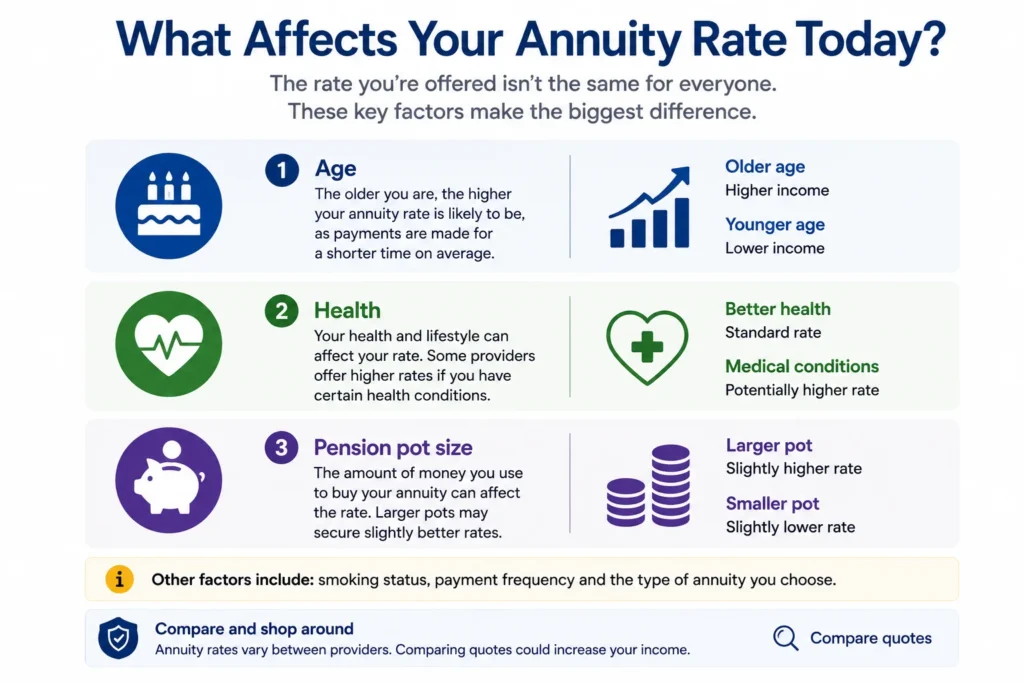
With gender removed from the equation, the factors that genuinely drive your individual annuity rate today are the ones covered throughout this series: your age at purchase (older buyers get higher rates, since the insurer expects a shorter payment period), your health and lifestyle (which can qualify you for an enhanced annuity paying meaningfully more), the size of your pension pot, and the specific features you choose — single life or joint life, level or escalating, whether you add a guarantee period.
Notably, health-based pricing under enhanced annuities remains entirely permitted, even though gender-based pricing isn’t — the legal distinction rests on the fact that health conditions are individually assessed and disclosed, rather than being a blanket demographic characteristic applied to an entire group regardless of individual circumstances.
Does This Rule Still Apply After Brexit?
Yes. The unisex pricing requirement, while originating from an EU court ruling, was implemented into UK law and has remained in force since the UK’s departure from the EU. The underlying principle — that insurance pricing, including annuity rates men women, cannot discriminate based on gender — continues to apply to every UK annuity purchase today, regardless of the UK’s post-Brexit relationship with EU law more broadly. If you’re comparing quotes across the whole market today, using your open market option, you can expect every provider to be quoting on an identical, gender-neutral basis.
A few things worth knowing:
- Unisex pricing applies to individual annuity purchases through the retail market and Open Market Option — this guide doesn’t cover every historical pension product or workplace scheme variation
- Life expectancy statistics referenced here are historical averages used to illustrate the pre-2012 pricing rationale, not current precise figures
- Health and lifestyle factors remain entirely legitimate pricing considerations, distinct from the now-prohibited use of gender alone
- Always compare live quotes across multiple providers, since individual insurer pricing still varies meaningfully even under unisex rules
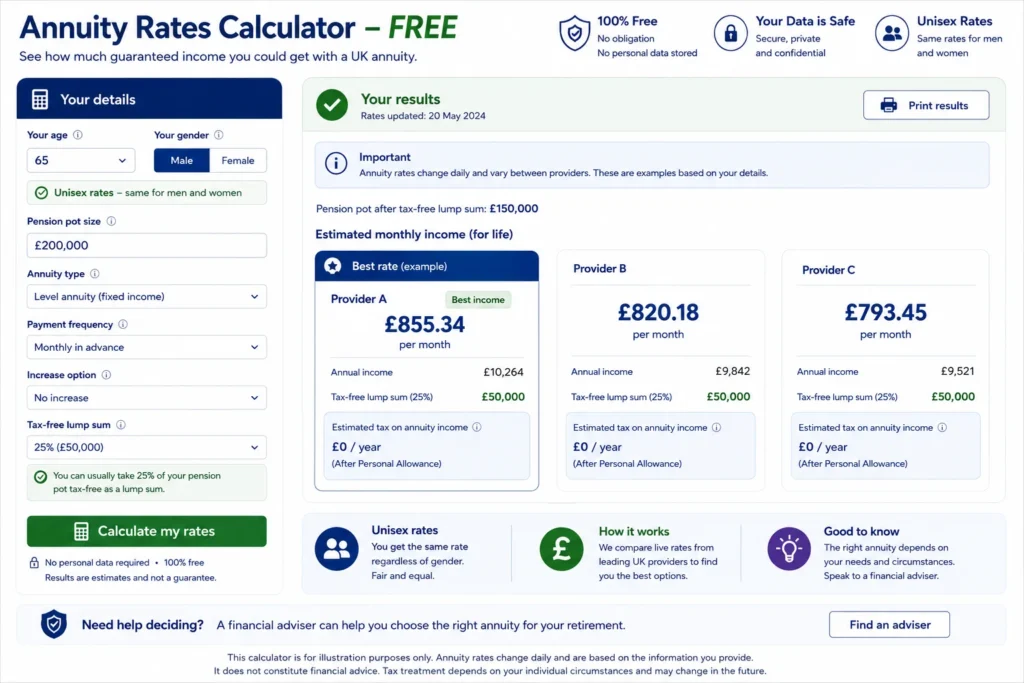
See your own representative annuity income, calculated on the same unisex basis every UK provider uses today, with our annuity rates calculator.
Frequently Asked Questions
Are annuity rates the same for men and women in the UK?
Yes, since 21 December 2012, it has been unlawful for UK insurers to offer different annuity rates based on gender. Men and women of identical age, pot size, and health receive the same quote from a given provider.
Why did annuity rates used to differ between men and women?
Before 2012, insurers priced annuities partly based on gender, since women statistically live longer than men on average, meaning the insurer expected to pay income for more years. This meant women historically received lower annual income than men for an identical pension pot.
What changed when unisex pricing was introduced?
Female annuity rates generally increased and male rates generally decreased slightly, though the exact change varied by provider and by each insurer’s existing customer base. One documented example showed a 65-year-old woman’s rate rising roughly 6.5%, with a corresponding 1.5% fall for men.
Does this unisex pricing rule still apply after Brexit?
Yes. The requirement remains in force in UK law and applies to every annuity purchased through the UK retail market today, regardless of the UK’s departure from the EU.
Can insurers still use health conditions to price annuities differently?
Yes. Health and lifestyle factors, individually assessed and disclosed through enhanced annuity underwriting, remain a legitimate pricing consideration, distinct from the now-prohibited practice of pricing based on gender as a blanket demographic factor.
Does life expectancy still differ between men and women even with unisex pricing?
Yes, the underlying statistical difference in average life expectancy hasn’t changed. What changed is that insurers can no longer price that specific difference into individual quotes based on gender, with the cost effectively absorbed across their entire customer base instead.
Official sources: read general annuity guidance at MoneyHelper, and verify any provider or adviser on the FCA register. Get your own unisex-priced estimate with our annuity rates calculator, or browse every tool on the mortgage calculators homepage.