
Joint Life Annuity | The Essential Way to Protect Your Spouse 2026
A joint life annuity answers a question most people don’t want to think about, but genuinely need to: what happens to your partner’s income the day after you die? With a standard single-life annuity, the honest answer is stark — the income simply stops, entirely, the moment you pass away, however recently the payments started. A joint life annuity exists specifically to prevent that cliff edge, continuing a chosen percentage of the income to your spouse or partner for the rest of their life too.
Here’s exactly how much it costs to protect them, and how to think about choosing the right percentage for your situation.
Site editor at MortgageToolsHub — joint life annuity figures cross-checked against Retirement Line, PensionHelper and Hargreaves Lansdown published data. Last checked July 2026.
On This Page
- What a joint life annuity actually does
- The three percentage options, explained
- What it actually costs — real 2026 numbers
- Why the age gap between you and your partner matters
- How to choose the right survivor percentage
- Joint life annuity vs a guarantee period — they’re not the same
- Who genuinely needs a joint life annuity
- FAQ
What a Joint Life Annuity Actually Does
A joint life annuity pays a guaranteed income while either you or your named partner is alive. While you’re both living, the income continues exactly as it would with a standard single-life annuity. When the first of you dies, rather than stopping completely, a chosen percentage of that income continues to the survivor, for the remainder of their life too.
This is fundamentally an insurance decision, not an investment one. You’re trading a slightly lower income while you’re both alive for the certainty that your partner won’t face a sudden, total loss of that income at the worst possible moment. For married couples and civil partners in particular, this trade-off is one of the most consequential — and most frequently under-considered — decisions in the entire annuity purchase process.
The Three Percentage Options, Explained
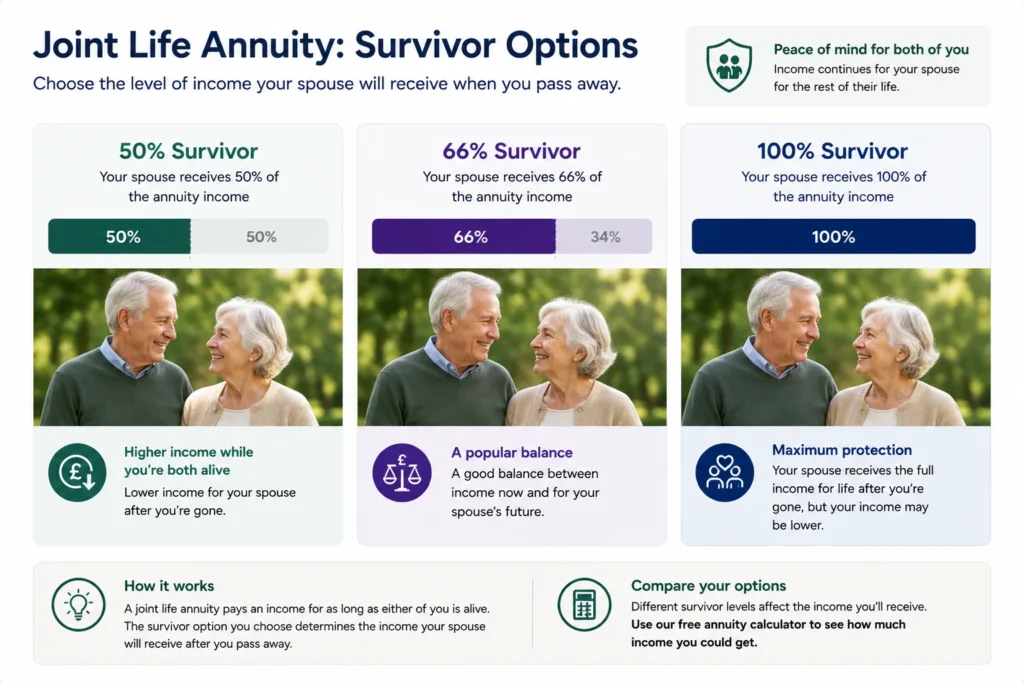
When setting up a joint life annuity, you choose what percentage of your income continues to your partner after you die. The standard options across the UK market are:
50% survivor benefit — the most commonly chosen option, and often the most cost-effective starting point. Your partner receives half of what you were originally receiving. This works well if their own living costs would genuinely fall once you’re no longer part of the household, or if they have meaningful income of their own from a separate pension or savings.
66% survivor benefit — a middle-ground option some providers offer, balancing a smaller reduction in your joint income now against more generous protection for your partner later.
100% survivor benefit — the maximum protection available. Your partner continues receiving exactly the same income you were both living on, with absolutely no drop at all. This costs the most in reduced starting income but leaves genuinely no gap for your partner to cover from savings or other sources.
What It Actually Costs — Real 2026 Numbers
Here’s where the actual trade-off becomes concrete. Based on published August 2026 provider data, for a healthy 65-year-old with a £100,000 pot:
| Annuity type | Approximate annual income |
|---|---|
| Single life (no survivor benefit) | ~£8,000-£8,360 |
| Joint life, 50% to survivor | ~£7,500-£7,770 |
| Joint life, 100% to survivor | ~£7,000-£7,190 |
The gap between single life and a full 100% joint life annuity typically works out to roughly £800 to £1,300 a year on a £100,000 pot — a real, ongoing reduction in your joint income while you’re both alive, in exchange for your partner never facing a sudden drop to nothing if you die first. Some broader industry analysis puts the overall reduction for choosing joint life over single life at roughly 5% to 15% of the single-life rate, depending on the specific survivor percentage and the age gap between partners.
Why the Age Gap Between You and Your Partner Matters
This is a detail that catches people out, and it’s worth understanding before you get a quote. The age of your partner, not just your own age, directly affects the pricing of a joint life annuity. If your partner is meaningfully younger than you, the insurer is potentially committing to pay the survivor benefit for considerably longer than if you were the same age — since the younger partner is statistically likely to outlive you by more years than an equal-age partner would.
This means the same joint life annuity, at the same survivor percentage, can cost genuinely more (in terms of reduced starting income) for a couple with a large age gap than for a couple of similar ages. If your partner is significantly younger, it’s worth specifically comparing quotes across multiple providers, since pricing approaches to age gaps can vary meaningfully between insurers.
How to Choose the Right Survivor Percentage
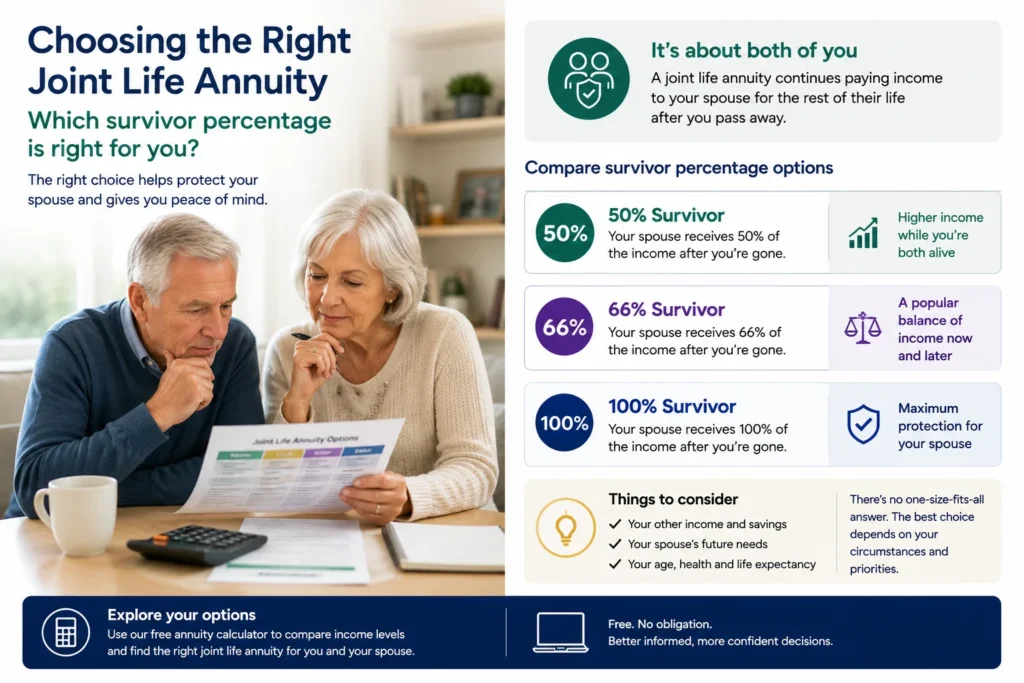
The right percentage genuinely depends on your partner’s own financial position, not a generic rule of thumb. Start by working out what your partner’s essential monthly costs would realistically be if you were no longer contributing to the household — this is rarely simply half of your current joint spending, since many costs (housing, utilities, council tax) don’t halve just because one person is no longer there.
Next, add up your partner’s own guaranteed income sources: their State Pension, any personal pension they hold separately, and any other reliable income. Compare that total against their essential costs. If a 50% survivor benefit from your joint life annuity, combined with their own income, comfortably covers their essential costs, a 50% option may genuinely be sufficient, and the higher starting income while you’re both alive is worth having. If there’s a meaningful gap even after accounting for their own income, a 66% or 100% option closes that gap, at the cost of a lower joint income now.
Joint Life Annuity vs a Guarantee Period — They’re Not the Same
This is a genuinely common point of confusion worth clearing up directly. A joint life annuity protects your partner specifically, continuing income to them for the rest of their life. A guarantee period, by contrast, is a separate feature protecting against the risk of dying very soon after buying the annuity at all — typically 5 or 10 years, ensuring payments continue to a beneficiary (who could be a spouse, but doesn’t have to be) for at least that guaranteed period, even if you die within months of purchase.
These two features can be combined, and often are, but they solve different problems. A guarantee period protects against dying unexpectedly early, regardless of whether you have a partner. A joint life annuity protects your partner specifically, for as long as they live, regardless of how long that turns out to be. Couples often want both: a joint life annuity for genuine long-term partner protection, with a guarantee period added as extra reassurance against the specific, if statistically unlikely, scenario of dying very shortly after purchase.
Who Genuinely Needs a Joint Life Annuity
Married couples and civil partners where one partner would face a genuine income shortfall without the other’s pension are the clearest case for a joint life annuity — which, in practice, describes a large share of couples entering retirement together. It’s less critical if your partner has substantial, entirely independent pension provision of their own that would comfortably cover their needs regardless of what happens to your annuity income.
It’s also worth considering even for couples who aren’t married or in a civil partnership, since a joint life annuity can be set up naming any dependant, not exclusively a spouse — worth raising directly with your provider or adviser if your situation doesn’t fit the traditional married-couple structure.
A few things worth knowing:
- These figures are representative of August 2026 published market rates — your own quote will depend on both your and your partner’s ages, health, and the specific provider
- Health enhancements, covered in our guide to enhanced annuities, can apply to joint life annuities too, based on either partner’s declared health conditions
- Once set up, the survivor percentage on a joint life annuity generally cannot be changed later, making the decision at the point of purchase genuinely permanent
- Always compare joint life quotes across multiple providers using the open market option, since pricing on survivor benefits and age gaps varies meaningfully between insurers
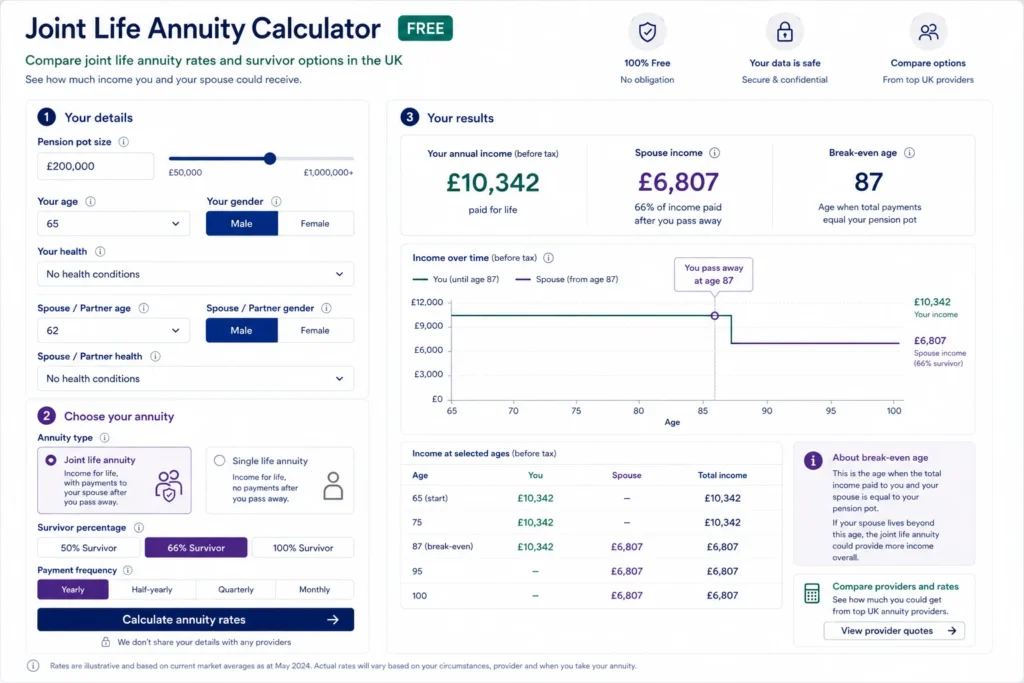
Compare single life and joint life options for your own ages and pot size using our annuity rates calculator, which models different survivor percentages side by side.
Frequently Asked Questions
What is a joint life annuity?
A joint life annuity pays a guaranteed income while either you or your named partner is alive. When the first of you dies, a chosen percentage of the income — typically 50%, 66%, or 100% — continues to the survivor for the rest of their life.
How much does a joint life annuity cost compared to single life?
Based on 2026 provider data, a 100% joint life annuity typically costs roughly £800 to £1,300 a year less in starting income than an equivalent single-life annuity on a £100,000 pot, or roughly 5% to 15% of the single-life rate overall, depending on the survivor percentage and age gap.
What percentage should I choose for my joint life annuity?
This depends on your partner’s own income and essential costs. If their own pension and State Pension would comfortably cover their needs alongside a 50% survivor benefit, that option may be sufficient. If there’s a meaningful gap, a higher percentage, up to 100%, closes it, at the cost of lower income now.
Does the age gap between me and my partner affect the cost?
Yes. If your partner is meaningfully younger than you, the insurer expects to pay the survivor benefit for longer, which can increase the cost, in terms of reduced starting income, compared to a couple of similar ages.
Is a joint life annuity the same as a guarantee period?
No, these are different features. A joint life annuity protects your partner for the rest of their life. A guarantee period, typically 5 or 10 years, protects against dying very soon after purchase, ensuring payments continue to a beneficiary for at least that period regardless of when you die.
Can I name someone other than my spouse on a joint life annuity?
In many cases, yes. Joint life annuities can often be set up naming any genuine dependant, not exclusively a legally married spouse or civil partner, though this should be confirmed directly with your chosen provider.
Official sources: read general annuity guidance at MoneyHelper, and verify any provider or adviser on the FCA register. Compare single and joint life options with our annuity rates calculator, or browse every tool on the mortgage calculators homepage.