
Level or Escalating Annuity? The Smart Break-Even Age in 2026
Level or escalating annuity — it’s the single decision that shapes your entire retirement income, and most people make it based on nothing more than which number looks bigger on day one. A level annuity starts noticeably higher. An escalating one starts lower but climbs every year. The genuinely useful question isn’t “which pays more today” — it’s “at what age does the escalating annuity actually overtake the level one,” because that break-even point is the number that should be driving your level or escalating annuity decision, not the headline figure on your first quote.
Here’s the real answer, with actual 2026 figures, why the answer might not be what you’d assume, and how to work out which side of this decision genuinely fits your own circumstances.
Site editor at MortgageToolsHub — level and escalating annuity figures cross-checked against Canada Life, Retirement Line and Aviva published data. Last checked July 2026.
On This Page
- What level and escalating annuities actually pay
- The break-even age, with real numbers
- Why the level annuity usually wins for most people
- What inflation does to a level income over time
- Fixed percentage escalation vs RPI-linked — the real difference
- When escalating genuinely makes sense
- How your other income sources should shape the decision
- A blended approach worth considering
- How to actually decide for your own situation
- FAQ
What Level and Escalating Annuities Actually Pay
A level annuity pays exactly the same amount every year, for life, from the day you buy it. A £7,800 annual income stays £7,800, whether that’s this year or twenty years from now. There’s a certain psychological comfort in that fixed, unchanging number — it’s the same every single payment, with no calculation, no review, nothing to think about beyond simply receiving it.
An escalating annuity starts at a noticeably lower figure, then increases every year — either by a fixed percentage, commonly 3% or 5%, or linked directly to the Retail Price Index (RPI). The trade is explicit and upfront: you accept less money now in exchange for a rising income later.
The gap at the start is substantial, and it’s worth seeing in real pounds before anything else. For a healthy 65-year-old with a £100,000 pot, a level annuity might pay around £7,800 a year in 2026, while a 3% escalating equivalent starts around 25-30% lower, roughly £5,700-£6,200, and an RPI-linked version starts even lower still, sometimes 30-40% below the level figure, around £4,700-£5,600. That’s a difference of well over £1,500 to £3,000 a year, right from the first payment, purely from choosing escalating over level.
The Break-Even Age, With Real Numbers
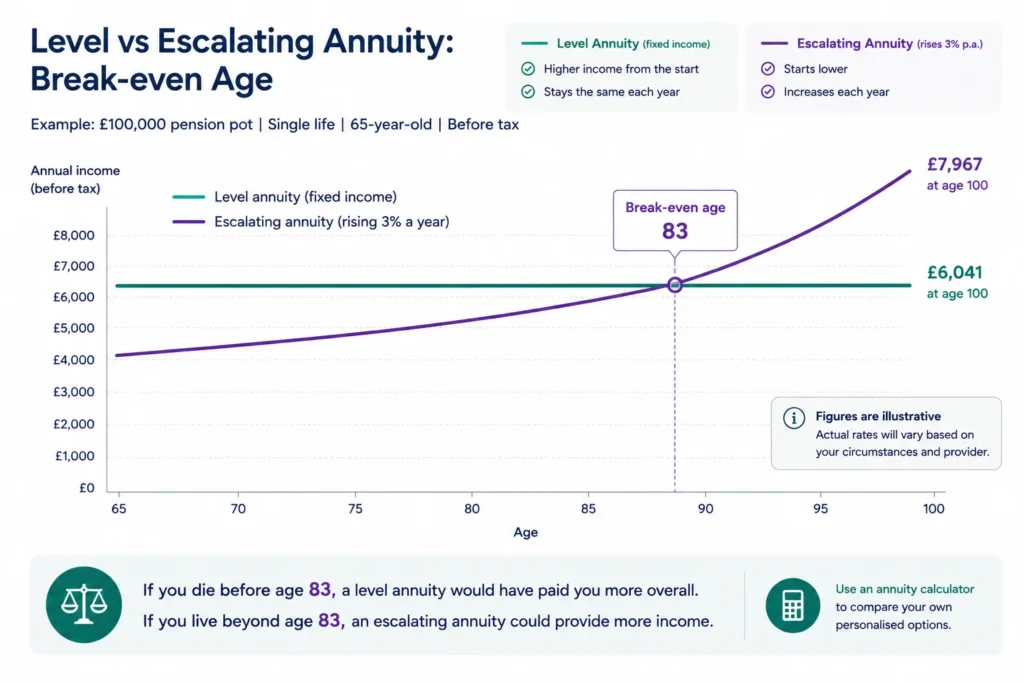
This is the number that actually matters in the level or escalating annuity decision, and it’s worth being honest that different providers and analysts land on slightly different figures depending on the exact assumptions used. Here’s the range across published industry data for 2026:
| Annuity type | Typical break-even (years after purchase) | Break-even age for a 65-year-old |
|---|---|---|
| 3% fixed escalation | 14-22 years | Roughly 79-87 |
| RPI-linked | 15-22 years | Roughly 80-91 |
| 5% fixed escalation | 20-22 years | Roughly 85-87 |
One specific, well-documented example from Canada Life illustrates the level or escalating annuity trade-off clearly: a 65-year-old with a £100,000 pot receiving a £7,175 level income reaches a cumulative total of £157,856 by age 87. A 3% escalating annuity on the same pot doesn’t overtake that cumulative total until roughly the same age, 87. An RPI-linked version, starting even lower at around £4,279, doesn’t break even until closer to age 91.
The honest answer to level or escalating annuity is that the escalating option only genuinely “wins” financially if you live meaningfully past that break-even age, and by a comfortable enough margin to make up for years of lower income beforehand. It’s not a guarantee of better value — it’s a bet on your own longevity, priced into the annuity’s structure.
Why the Level Annuity Usually Wins for Most People
This is worth stating plainly, because it goes against what feels intuitively “safer” about an escalating income. Break-even ages in the mid-to-late eighties, or into the nineties for RPI-linked options, sit above average UK life expectancy for someone retiring at 65, particularly once you factor in that not everyone in reasonable health at 65 lives to see their late eighties.
Nick Flynn, retirement income director at Canada Life, put it directly: for most people, once you’ve decided to buy an annuity at all, “choosing the certainty of a level income is likely to be the best economic decision they will make.” This isn’t a universal rule — it depends heavily on your own health, family longevity, and other income sources — but it’s a genuinely useful starting assumption to challenge rather than simply accept the escalating option because it “feels” more prudent against inflation.
Statistically, when you weigh the level or escalating annuity decision purely on expected total lifetime income across a representative population of 65-year-olds, level tends to come out ahead for a genuine majority, simply because more people fall short of the break-even age than exceed it comfortably. This doesn’t mean level is right for you specifically — only that it’s the higher-probability winner across the population as a whole.
What Inflation Does to a Level Income Over Time
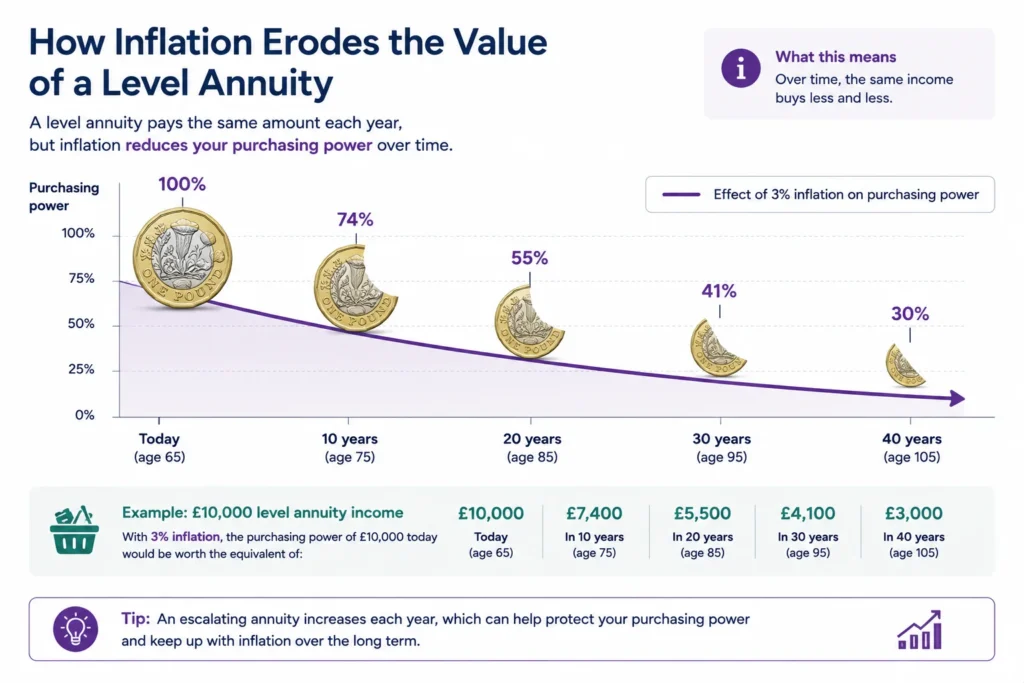
It’s worth being equally honest about the other side of this trade-off. At 3% average inflation, a level annuity’s real purchasing power falls by roughly 26% over 10 years and 45% over 20 years. A £7,800 income that felt entirely comfortable at 65 buys noticeably less by 85, even though the number on the statement hasn’t moved at all.
This is precisely the risk an escalating annuity is designed to protect against — and for someone with genuinely strong family longevity, no other inflation-linked income (such as a defined benefit pension), and reasonable confidence they’ll live well past the break-even age, that protection can be worth the lower starting income. The decision genuinely comes down to weighing a known, certain trade-off today (lower income now) against uncertain, but potentially significant protection later (income that keeps pace with rising prices).
Put another way: a level annuity guarantees you the biggest number on day one and the smallest real number, in today’s terms, on your last day. An escalating annuity guarantees the opposite — the smallest number on day one and, if you live long enough, the biggest real number toward the end. Neither guarantees you the “best” outcome, because neither knows how long you’ll actually be receiving payments.
Fixed Percentage Escalation vs RPI-Linked — The Real Difference
Within the escalating side of the level or escalating annuity decision, there’s a further choice worth understanding properly: a fixed percentage escalation (typically 3% or 5% a year, guaranteed regardless of actual inflation) versus an RPI-linked annuity, which tracks the Retail Price Index directly.
A fixed 3% escalation is predictable — you know exactly what your income will be in any given future year, calculated in advance. It performs well if actual inflation runs below 3%, since your income effectively outpaces real price rises. But if inflation runs meaningfully above 3%, as it has in several recent years, a fixed 3% escalation quietly falls behind, leaving you with genuine, if slower, erosion of purchasing power, just at a gentler rate than a fully level annuity.
RPI-linked annuities track actual inflation directly, offering the most complete protection against rising prices, but at the cost of the lowest starting income of all the options, and genuine year-to-year unpredictability in exactly what you’ll receive, since it depends on how RPI itself moves. For someone genuinely prioritising inflation protection above all else in their level or escalating annuity decision, RPI-linked is the most thorough option — but it’s also the one requiring the longest patience before it pays off relative to a level annuity.
When Escalating Genuinely Makes Sense
A few specific situations tilt the level or escalating annuity decision toward escalating rather than level. If you have a strong family history of longevity — parents or grandparents who lived well into their nineties — the odds of personally beating the break-even age improve meaningfully, and the maths shifts in favour of accepting a lower starting income for genuine long-term protection.
If your other retirement income has no inflation protection at all, relying entirely on a level annuity plus a State Pension (which does have some inflation protection built in via the triple lock) may leave you more exposed to rising costs in your later years than you’d want, particularly if the annuity forms a large share of your total retirement income.
Buying at a younger age also shifts things somewhat, since a younger purchaser has more years ahead for the escalating structure to compound and eventually overtake the level equivalent, even accounting for the lower starting years. And if you’re in excellent health with no family history of major illness, the statistical odds of a longer-than-average life expectancy, and therefore of genuinely benefiting from escalation, improve correspondingly.
How Your Other Income Sources Should Shape the Decision
The level or escalating annuity choice shouldn’t really be made in isolation from the rest of your retirement income picture. If you have a defined benefit (final salary) pension that already includes inflation-linked increases, your overall retirement income already has meaningful built-in protection against rising prices, which arguably makes a level annuity for the remainder of your pot a more reasonable, lower-cost complement, rather than needing every income source to independently protect against inflation.
Conversely, if your annuity represents the majority of your guaranteed retirement income, with only the State Pension alongside it, the case for at least some escalation protection strengthens, since you have less inflation-linked income elsewhere to fall back on if a fully level income’s purchasing power erodes significantly over a long retirement.
A Blended Approach Worth Considering
Rather than treating this as a binary choice, some people split their pension pot: a portion into a level annuity covering essential, non-negotiable costs, and the remainder into other retirement income options that offer more flexibility or inflation protection — a genuine middle ground worth discussing with an adviser rather than committing an entire pot to one approach or the other. Our guide to annuity vs drawdown covers a related version of this same blended thinking, weighing guaranteed income against flexibility more broadly, which pairs naturally with the level or escalating annuity question once you’re thinking about combining approaches rather than picking a single product for your entire pot.
How to Actually Decide for Your Own Situation
Bringing this together into a practical decision process: start by being honest about your own health and family longevity, since that’s the single biggest factor in whether you’ll personally reach the break-even age discussed throughout this guide. Then review your other retirement income sources — if a defined benefit pension or other inflation-linked income already covers your essential costs, a level annuity for the remainder becomes a more reasonable choice. Finally, get quotes for both level and escalating options from multiple providers using the open market option, since the exact break-even age varies meaningfully by provider and by the specific escalation rate on offer, not just by the generic industry averages discussed in this guide.
A few things worth knowing:
- Break-even ages vary by provider, rate, and the specific escalation percentage chosen — the figures here are representative, not a personal calculation
- These figures assume you live to the break-even age and beyond; if you don’t, the level annuity was the better financial decision regardless of inflation
- Enhanced annuities, covered in our guide to enhanced annuity income, can change these calculations if you have a qualifying health condition, since your own life expectancy assumption shifts
- Always compare live quotes across multiple providers using the open market option, since escalating annuity rates in particular can vary meaningfully between insurers
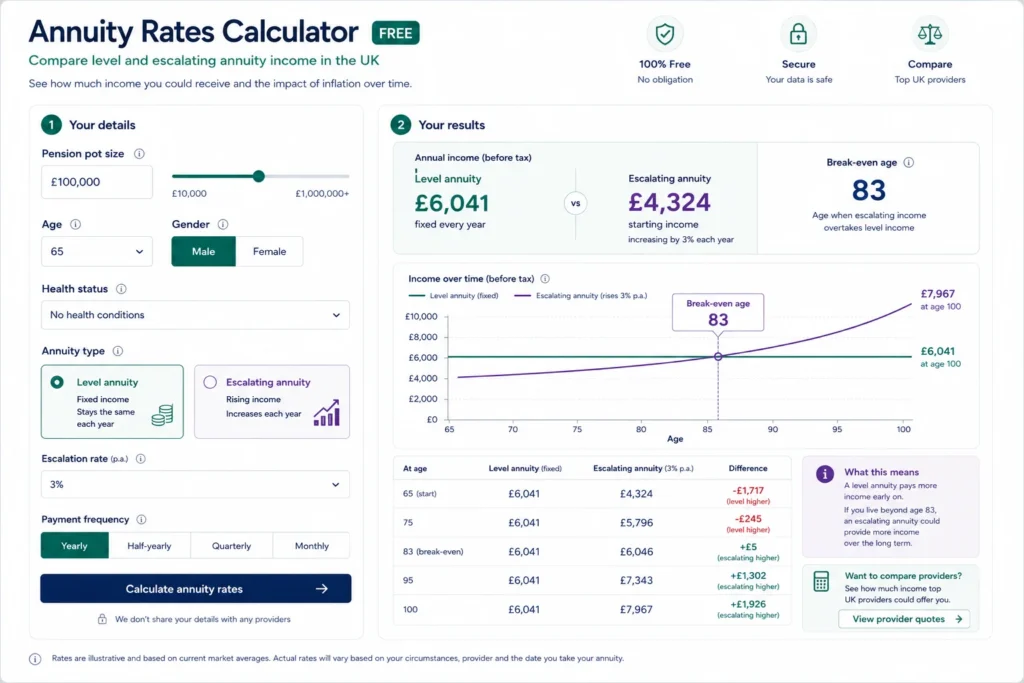
Compare level, escalating and RPI-linked options for your own age and pot size using our annuity rates calculator, which models all three side by side, so the level or escalating annuity decision is based on your actual numbers rather than an industry average.
Frequently Asked Questions
What is the break-even age between a level and escalating annuity?
For a 3% fixed escalating annuity, the break-even is typically 14 to 22 years after purchase, roughly age 79 to 87 for a 65-year-old. RPI-linked annuities have a longer break-even, often 15 to 22 years, roughly age 80 to 91.
Is a level or escalating annuity better?
For most people, a level annuity is considered the better economic decision, since the break-even age for escalating options often sits above average UK life expectancy. However, escalating annuities offer genuine inflation protection that becomes valuable if you live well past the break-even point.
How much does inflation erode a level annuity’s value?
At an average inflation rate of 3%, a level annuity’s real purchasing power falls by roughly 26% over 10 years and 45% over 20 years, even though the actual annual payment amount never changes.
How much lower is the starting income on an escalating annuity?
A 3% fixed escalating annuity typically starts around 25-30% lower than an equivalent level annuity. An RPI-linked annuity starts even lower, often 30-40% below the level figure.
Should I choose escalating if my family has a history of living into their nineties?
It’s a reasonable factor to weigh. If you have genuine confidence in living well past the typical break-even age of 79-91 depending on the escalation type, the inflation protection an escalating annuity provides becomes more likely to be worth the lower starting income.
Can I split my pension pot between a level and escalating annuity?
Yes, some people choose to allocate different portions of their pot to different annuity types, or combine an annuity with other retirement income options, to balance guaranteed income against inflation protection rather than committing entirely to one approach.
Does a defined benefit pension change the level or escalating annuity decision?
Yes, if you already have inflation-linked income from a defined benefit pension, your overall retirement income has some built-in protection against rising prices, which can make a level annuity for the remainder of your pension pot a reasonable, lower-cost complement rather than needing every income source independently protected.
Official sources: read general annuity guidance at MoneyHelper, check current inflation data at the Office for National Statistics, and verify any adviser on the FCA register. Compare level and escalating options with our annuity rates calculator, or browse every tool on the mortgage calculators homepage.