
Partial Annuity Strategy | The Smart Way to Cover Essentials
A partial annuity strategy solves a problem most people don’t realise they’re facing until it’s already too late to fix easily: the false choice between “annuity” and “drawdown” as if you have to pick exactly one. You don’t. Regulated advisers consistently recommend this hybrid approach for pot sizes roughly between £150,000 and £500,000 — annuitise just enough to cover your essential bills for life, then keep the rest genuinely flexible.
Here’s exactly how to work out your own numbers, with real 2026 figures.
Site editor at MortgageToolsHub — partial annuity strategy figures cross-checked against Hargreaves Lansdown, PLSA and FCA published retirement data. Last checked July 2026.
On This Page
- What a partial annuity strategy actually does
- Step one: work out your essential spending
- Step two: find your annuity gap
- Step three: annuitise just that gap
- A real worked example, three pot sizes
- Why this changes the psychology of a market crash
- Get enhanced quotes before anything else
- FAQ
What a Partial Annuity Strategy Actually Does
Rather than treating “annuity vs drawdown” as an all-or-nothing choice, a partial annuity strategy splits your pension pot into two distinct jobs. A slice of your pot — combined with your State Pension — is used to buy an annuity sized specifically to cover your essential, non-negotiable spending: housing costs, food, utilities, council tax, basic transport. The remainder stays in drawdown, invested and genuinely flexible, funding everything discretionary — travel, gifts, home improvements, the things you’d happily cut back on in a difficult year but wouldn’t want guaranteed against market risk.
This isn’t a compromise or a hedge against indecision. It’s precisely what most regulated financial advisers actually recommend once a pot reaches a meaningful size, because it solves the single biggest weakness of pure drawdown — the risk of running out — without giving up all the flexibility and inheritance potential that makes drawdown attractive in the first place.
Step One: Work Out Your Essential Spending
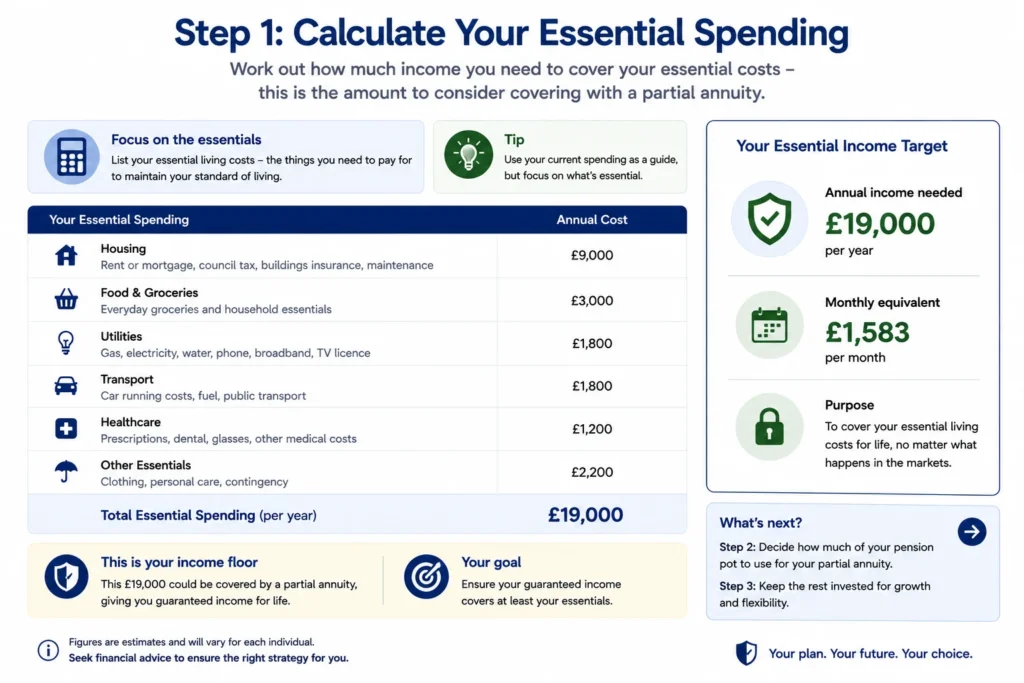
Before any annuity maths makes sense, you need a genuinely honest number for your essential annual spending — not your current total spending, but specifically the amount you absolutely need every year regardless of what else is happening in your life or in markets. This typically includes housing costs (mortgage, rent, or maintenance if owned outright), utilities, council tax, groceries, basic transport, and insurance.
The Pensions and Lifetime Savings Association (PLSA) publishes widely-used retirement living standards each year that many people find a genuinely useful benchmark here. Their “Minimum” standard for 2026 sits around £13,400 annually for a single person — a reasonable starting reference point for essential-only spending, though your own genuine figure may differ meaningfully based on your specific circumstances, location, and existing commitments like an outstanding mortgage.
Step Two: Find Your Annuity Gap
Once you have your honest essential spending figure, subtract your guaranteed income already in place — primarily your State Pension, and any defined benefit pension you may hold — from that number. What’s left is your annuity gap: the amount of additional guaranteed income you genuinely need to secure through a partial annuity purchase.
For the 2026/27 tax year, the full new State Pension sits at roughly £12,547 a year. If your essential spending is, say, £20,000 a year, and your State Pension covers £12,547 of it, your annuity gap is £7,453 — the specific amount of additional guaranteed annual income you need your partial annuity strategy to produce.
Step Three: Annuitise Just That Gap
[IMAGE 3 — Alt text: “partial annuity strategy calculating pot size needed”. Suggestion: simple calculation graphic showing the gap being converted to a lump sum needed]
With your annuity gap figured out, divide it by the current annuity rate available at your age to work out how much of your pot you actually need to annuitise. At current 2026 rates, a healthy 65-year-old buying a level single-life annuity can expect roughly £7,892 per £100,000 — meaning a £7,453 annuity gap would require annuitising somewhere in the region of £94,000 of your pot.
The remainder stays entirely in drawdown, genuinely flexible, and available for discretionary spending, larger irregular costs, and — since 6 April 2027 changes to how unused pension funds are treated for inheritance tax — worth discussing with an adviser regarding your specific estate planning goals alongside the income planning covered here.
A Real Worked Example, Three Pot Sizes
Here’s how this plays out at different pot sizes, based on published 2026 industry modelling:
| Pot size | Typical partial annuity strategy | Result |
|---|---|---|
| £250,000 | Annuitise £100,000-£150,000 | Covers roughly £8,000-£10,000 of essential bills for life; remaining £100,000-£150,000 stays flexible in drawdown |
| £500,000 (single) | Annuitise a slice covering the gap above State Pension | Remaining pot drawn at a sustainable rate for discretionary spending, with meaningful inheritance potential preserved |
| £500,000 (couple, £250k each) | Joint-life, RPI-linked annuity on £200,000 combined | Produces roughly £10,100 a year, rising with inflation, paid as long as either partner is alive; remaining £175,000 stays in drawdown |
Notice that in every scenario, the partial annuity strategy doesn’t attempt to guarantee your entire desired income — only the essential portion. The discretionary spending, the genuinely optional part of your retirement budget, remains funded by drawdown, where flexibility and potential growth matter more than absolute certainty.
Why This Changes the Psychology of a Market Crash
This is genuinely the most underappreciated benefit of a partial annuity strategy, and it’s more behavioural than mathematical. If your entire retirement income depends on your invested drawdown pot, a serious market fall forces an impossible choice: sell investments at depressed prices to cover your bills, or cut spending on things you genuinely cannot cut — your mortgage, your food, your heating.
With essential bills already covered by guaranteed income from your partial annuity strategy plus your State Pension, a market fall becomes irritating rather than existential. You simply don’t touch your drawdown pot during the downturn, because you don’t have to — your essential needs are already met regardless of what markets are doing that particular year. This single structural change removes exactly the behaviour that most damages a drawdown pot over the long run: being forced to sell low, purely because bills need paying and there’s no other guaranteed income to fall back on.
Get Enhanced Quotes Before Anything Else
Before committing to any figures, it’s genuinely worth checking whether you qualify for an enhanced annuity. FCA data shows nearly half of all UK annuity sales in 2024/25 were enhanced rates, reflecting health or lifestyle factors that qualified for meaningfully higher income than standard rates — sometimes 13% to 20% higher or more. If you qualify, your annuity gap can be covered by annuitising a genuinely smaller portion of your pot, leaving considerably more in flexible drawdown for the same essential coverage. Our full guide to enhanced annuities covers exactly what conditions qualify and by how much.
Similarly, it’s worth deciding whether a level or escalating annuity better suits your partial annuity strategy — since essential spending, particularly housing and utilities, genuinely does rise with inflation over a long retirement, an inflation-linked structure for this specific portion of your income can be worth the lower starting figure. Our guide to level vs escalating annuities covers this trade-off in depth.
A few things worth knowing:
- These figures use representative 2026 market rates — your own annuity gap and required pot allocation will depend on your specific circumstances, age, and health
- Shopping around across multiple providers, using the open market option, remains essential even for a partial annuity purchase, since rates can vary 10-20% between providers
- A partial annuity strategy doesn’t eliminate all risk from your retirement plan — the drawdown portion remains genuinely exposed to market movements and longevity risk
- Always discuss a partial annuity strategy with a qualified, regulated financial adviser before committing, given the significant, largely permanent nature of any annuity purchase
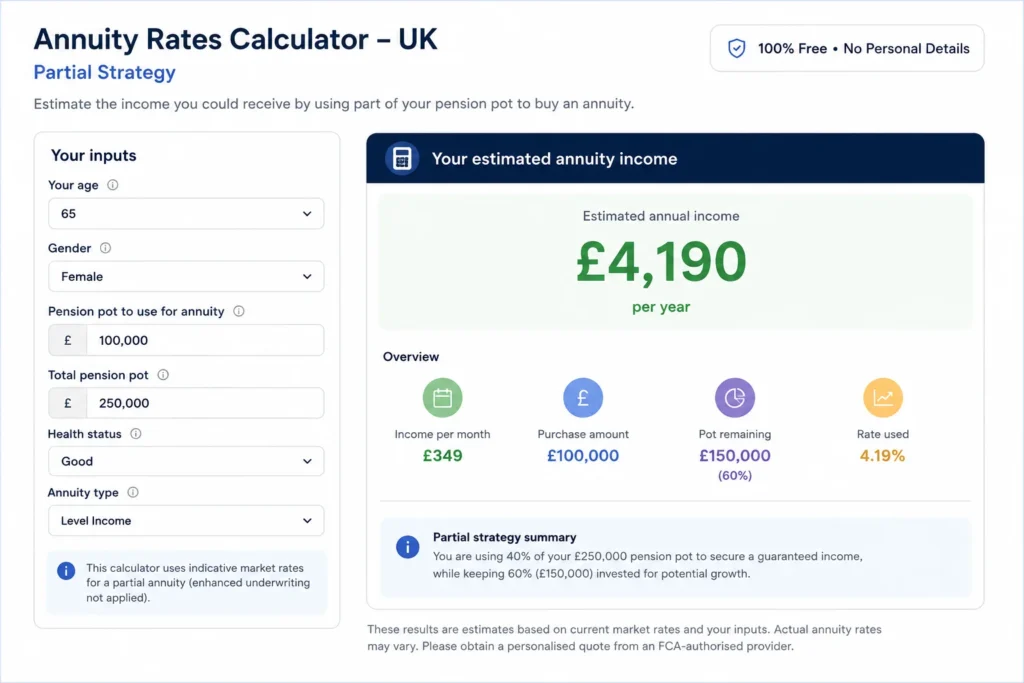
Work out your own annuity gap and required pot allocation using our annuity rates calculator, or compare the full annuity vs drawdown trade-off in our annuity vs drawdown guide.
Frequently Asked Questions
What is a partial annuity strategy?
It’s a hybrid retirement income approach where you annuitise only enough of your pension pot to cover essential spending, combined with your State Pension, while keeping the remainder in flexible drawdown for discretionary spending and inheritance potential.
How much of my pot should I annuitise?
This depends on your essential spending minus your existing guaranteed income (mainly the State Pension). Divide that gap by the current annuity rate for your age to calculate the pot amount needed. Regulated advisers commonly recommend this hybrid approach for pot sizes between £150,000 and £500,000.
What counts as essential spending in a partial annuity strategy?
Typically housing costs, utilities, council tax, food, basic transport, and insurance — the non-negotiable costs you’d need to cover regardless of market conditions. The PLSA’s “Minimum” retirement standard, around £13,400 a year for a single person in 2026, is a commonly used benchmark.
Does a partial annuity strategy protect against market crashes?
Indirectly, yes. While it doesn’t prevent your drawdown portion from losing value in a downturn, it means your essential bills remain covered by guaranteed income regardless of market performance, removing the pressure to sell investments at depressed prices purely to meet basic living costs.
Should I get an enhanced annuity quote for a partial annuity strategy?
Yes, it’s genuinely worth checking. Nearly half of UK annuity sales in 2024/25 were at enhanced rates, and qualifying for one means you can cover the same essential income gap by annuitising a smaller portion of your pot, leaving more in flexible drawdown.
Can I combine a partial annuity strategy with an escalating annuity?
Yes. Since essential spending genuinely tends to rise with inflation over a long retirement, some people choose an escalating or RPI-linked structure specifically for the annuitised portion, accepting a lower starting income in exchange for that inflation protection on their guaranteed floor.
Official sources: check PLSA retirement living standards at retirementlivingstandards.org.uk, read general annuity and drawdown guidance at MoneyHelper, and verify any adviser on the FCA register. Calculate your own annuity gap with our annuity rates calculator, or browse every tool on the mortgage calculators homepage.