
How Much Annuity Will £100,000 Buy? Best 2026 Numbers.
How much annuity will £100,000 buy? It’s the single most common question anyone with a £100,000 pension pot asks once retirement gets close — and the honest answer depends on more than your age alone. The pot size is only the starting point. The type of annuity, whether you add a guarantee period, your health, and whether you actually shop around all move the final number by hundreds, sometimes thousands, of pounds a year.
Here’s exactly what £100,000 realistically buys in 2026, broken down by age and structure, so you can see where your own numbers are likely to land before you get a real quote.
Written and checked by Tayyab Yaqoob, Site Editor at MortgageToolsHub — annuity income ranges checked against current UK market best-buy rate data. Last updated September 2026.
On This Page
- How much annuity will £100,000 buy — the short answer
- What actually determines the number
- Level vs escalating annuities
- Guarantee periods explained
- Joint life vs single life
- Enhanced annuities and your health
- Three worked examples, by age
- Why shopping around matters
- Why rates move: gilt yields
- Tax on your annuity income
- The 25% tax-free lump sum first
- Annuity vs drawdown, briefly
- Inflation risk over a long retirement
- Common mistakes to avoid
- How to actually get quotes
- FAQ
How Much Annuity Will £100,000 Buy? The Short Answer
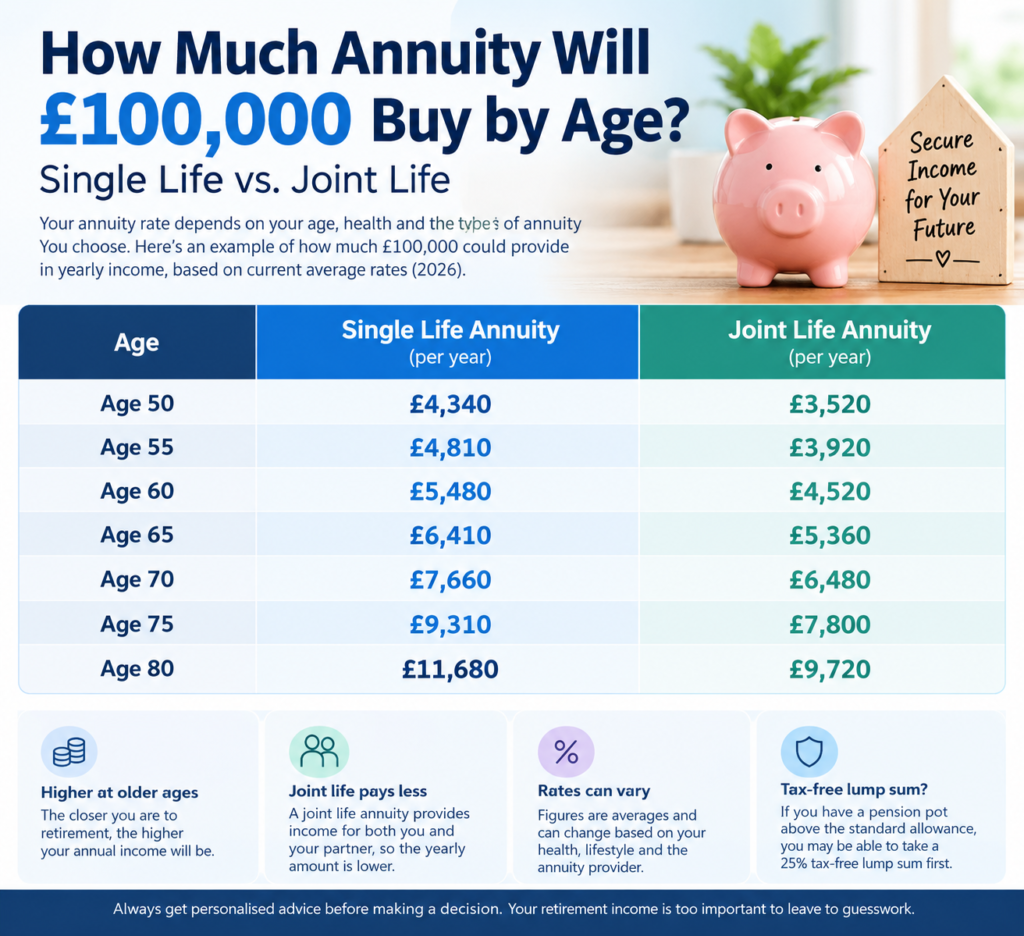
As a rough guide, £100,000 buying a single life, level annuity with no guarantee period is currently producing somewhere in the region of £6,500 a year at age 55, rising to around £9,500-£9,600 a year by age 75. The income is meaningfully higher the older you are when you buy, simply because the insurer expects to pay it out for fewer years on average.
| Age | Single Life, Level, No Guarantee | Single Life, Level, 5-Year Guarantee | Joint Life 50%, Level |
|---|---|---|---|
| 55 | ~£6,500/yr | ~£6,450/yr | ~£6,150/yr |
| 60 | ~£6,850/yr | ~£6,800/yr | ~£6,550/yr |
| 65 | ~£7,700/yr | ~£7,650/yr | ~£7,150/yr |
| 70 | ~£8,450/yr | ~£8,350/yr | ~£7,800/yr |
| 75 | ~£9,650/yr | ~£9,400/yr | ~£8,700/yr |
These figures move week to week with gilt yields, so treat them as a current snapshot rather than a fixed number — our annuity rates calculator runs today’s ranges against your own age and pot size directly.
What Actually Determines The Number
Four things move how much annuity £100,000 buys, and understanding each one is what turns a rough table into a real decision:
- Your age at purchase — older buyers get more income per pound, since payments are expected for fewer years
- The annuity type — level, escalating, or inflation-linked, each priced completely differently
- Whether you add a guarantee period or joint life cover — both reduce the starting income slightly in exchange for protection
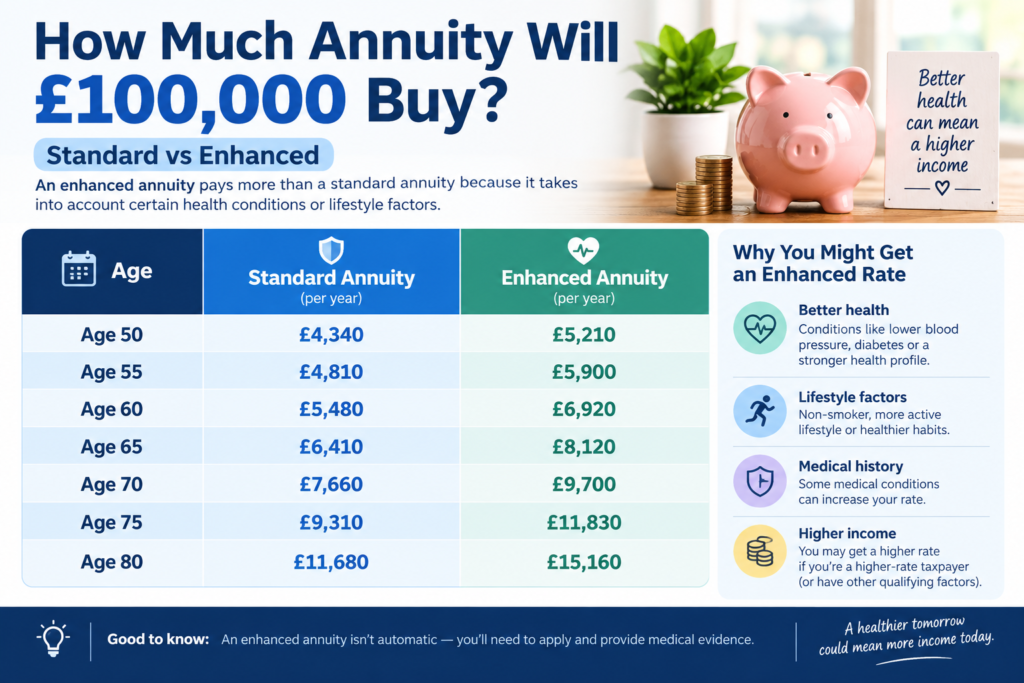
- Your health and lifestyle — declaring conditions can qualify you for an enhanced annuity paying meaningfully more
It’s worth adding that annuity rates have also been broadly the same for men and women since a 2012 EU gender directive change — an older assumption that still trips people up when they compare quotes against outdated expectations.
Level vs Escalating Annuities
A level annuity pays the same amount every year for life, which is why it produces the highest starting income of the structures compared here. An annuity that rises with inflation (RPI-linked) or by a fixed 3% a year starts noticeably lower — often 30-40% lower in year one — because the insurer is pricing in decades of future increases from day one. There’s a genuine break-even age where the escalating option overtakes the level one in total income; our level vs escalating annuity guide works through exactly where that crossover typically falls.
Guarantee Periods Explained
Adding a 5-year guarantee, which pays out to your estate if you die shortly after buying, typically shaves only a small amount off the annual income — often just 1-3%. That’s a modest price for real peace of mind if you’re at all concerned about an early death cutting the payments short before your family sees any benefit from the pot you built up.
Joint Life vs Single Life
A joint life annuity paying 50% to a surviving spouse produces a noticeably lower starting income than single life, since the insurer is now pricing in two lives instead of one. It’s the trade-off between a higher number now and continued income for your partner later — and it’s worth treating a single life annuity as a decision that also affects your spouse, not just yourself, before ruling out joint life to chase a bigger headline figure.
Enhanced Annuities and Your Health
One of the most under-used levers in this entire decision is health disclosure. Declaring conditions such as diabetes, high blood pressure, high cholesterol, or a history of smoking can qualify you for an enhanced (or “impaired life”) annuity, which can increase your income by a meaningful margin over a standard rate — sometimes considerably more, depending on the condition and severity. Insurers price these individually, so it’s always worth disclosing fully rather than assuming a minor condition won’t matter.
Three Worked Examples, By Age
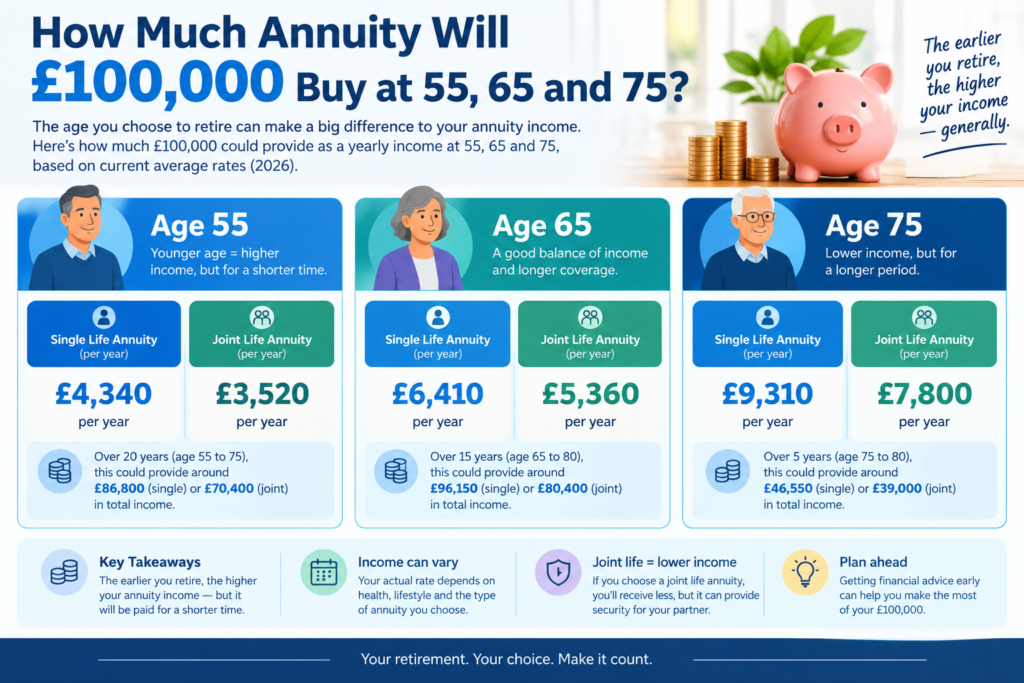
At 55, single, £100,000 pot. A single life, level annuity with no guarantee produces roughly £6,500 a year. Adding a 5-year guarantee barely moves that. Choosing RPI-linked instead drops the starting income to somewhere around £4,000-£4,100 a year — a steep discount this early, since the insurer is pricing in potentially 30+ years of rising payments.
At 65, single, £100,000 pot. This is the age most quotes are built around. A single life, level, no-guarantee annuity sits around £7,700 a year. The same structure with a 5-year guarantee comes in barely lower, around £7,650 a year. Switching to RPI-linked with a guarantee drops the figure to roughly £5,300-£5,400 a year, though it then rises every year for the rest of your life.
At 75, single, £100,000 pot. Income is meaningfully higher this late — a level annuity with no guarantee can reach around £9,600 a year, since the insurer’s expected payout period is shorter. This is also the age where enhanced annuities, if health conditions apply, tend to produce their biggest uplifts relative to a standard rate.
Across all three ages, the pattern holds: the highest number on paper is always the level, no-guarantee, single life structure — and the right choice usually isn’t the highest number, it’s whichever trade-off matches your own health, family situation, and appetite for inflation risk.
Why Shopping Around Matters
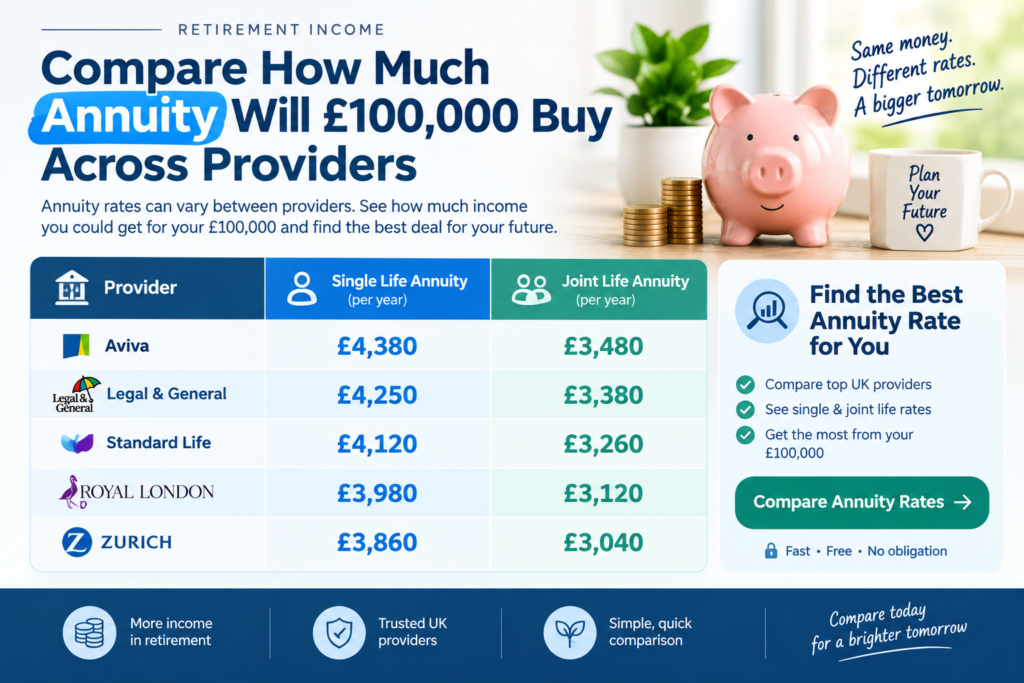
One of the most overlooked facts about buying an annuity is that you are not obliged to buy from your existing pension provider. This is called the open market option, and using it to compare quotes across the whole market — rather than accepting the first offer that lands — can meaningfully increase the income you lock in for life, since providers price identical pots differently for the same age and health profile. Our guide to the open market option covers exactly how much shopping around has been shown to add.
Why Rates Move: Gilt Yields
Annuity rates track UK government bond (gilt) yields closely, since insurers largely invest annuity premiums in gilts to fund the guaranteed payments they’ve promised. When gilt yields rise, annuity income tends to rise with them; when yields fall, so does the income £100,000 will buy. This is exactly why annuity rates have moved so much over the past few years, and our guide to annuity rates and gilt yields explains the mechanism in full.
Tax On Your Annuity Income
Annuity income is taxable as normal income, alongside your State Pension and any other income you have in retirement — it isn’t a separate, lower-taxed category. Depending on your total income, this can mean some or all of your annuity payments are taxed at your marginal rate. Our guide to how annuity income is taxed walks through exactly how the Personal Allowance stacks against the State Pension and annuity income together.
The 25% Tax-Free Lump Sum First
Before you buy an annuity, most people are entitled to take up to 25% of their pension pot as a tax-free lump sum, up to the current allowance. Taking that lump sum first reduces the amount left to buy an annuity with, so a £100,000 pot might really mean £75,000 going into the annuity calculation once the lump sum is taken — worth factoring in before comparing the raw numbers above against your own pot. Our guide to the 25% tax-free lump sum covers the current allowance in detail.
Annuity vs Drawdown, Briefly
An annuity isn’t the only way to turn a pension pot into income — drawdown leaves the pot invested and lets you withdraw flexibly, with no guaranteed income but the potential for growth and more control. Many people end up using a mix of both: an annuity to cover essential costs, and drawdown for everything else. Our annuity vs drawdown comparison and partial annuity strategy guide both go into this trade-off properly.
Inflation Risk Over A Long Retirement
A level annuity’s biggest weakness only shows up over time: because the payment never rises, inflation quietly erodes its real value every single year. £7,700 a year might feel comfortable at 65, but its real spending power can be considerably lower by 85 after two decades of even modest inflation. Our guide to annuity inflation risk shows exactly how much a level annuity typically loses by that age.
Common Mistakes To Avoid
- Accepting your existing provider’s quote without shopping around — the open market option exists precisely to prevent this
- Under-declaring health conditions — even minor ones can qualify for an enhanced rate, so full disclosure is worth it
- Choosing single life without discussing it with a spouse — a joint life option protects them, at the cost of a lower starting income
- Ignoring inflation entirely — a level annuity that looks generous today can lose real value badly by your mid-80s
- Forgetting the 25% tax-free lump sum comes off the pot first — the annuity calculation applies to what’s left, not the full pot
How To Actually Get Quotes
- Gather your pension details — provider, pot value, and any existing guarantees
- Get quotes from multiple providers, not just your current one, using the open market option
- Disclose health and lifestyle information fully to any provider offering enhanced rates
- Compare structures side by side — level vs escalating, single vs joint, with and without a guarantee — using identical pot sizes
- Consider free guidance from Pension Wise before committing, since an annuity purchase generally can’t be reversed once accepted
Frequently Asked Questions
How much annuity will £100,000 buy at 65? Currently in the region of £7,500-£7,700 a year for a single life, level annuity with no guarantee — though the exact figure depends on the provider, your health, and market conditions at the time you buy.
How much annuity will £100,000 buy if I want it to rise with inflation? Considerably less to start with — often 30-40% lower in year one compared with a level annuity — since the insurer prices in decades of future increases from the outset.
Does £100,000 buy more annuity income the older I am? Yes — income rises meaningfully with age, since the insurer expects to make fewer years of payments on average the later you start.
Is a bigger pension pot always better for annuity income? The income scales roughly in proportion to your pot size, so a larger pot buys proportionally more income, though the structure you choose still moves the final number significantly.
Does my health affect how much annuity income £100,000 buys? Yes — declaring health conditions or lifestyle factors can qualify you for an enhanced annuity, which can increase your income meaningfully compared with a standard rate.
Should I take annuity quotes from more than one provider? Yes — using the open market option to compare quotes across providers, rather than accepting your existing pension provider’s offer automatically, is one of the simplest ways to increase your income for exactly the same pot size.
Is annuity income taxed the same as other income? Yes — annuity income is taxed as normal income alongside your State Pension and any other income, at your usual marginal rate.
Can I take a tax-free lump sum before buying an annuity? Most people can take up to 25% of their pot tax-free first, up to the current allowance — which reduces the amount actually going into the annuity purchase.
Next Step
The numbers above are a starting point, not a quote — your actual income depends on the provider, your health, and rates on the day you buy. Run your own numbers through our Annuity Rates Calculator to see a current estimate for your age and pot size, and weigh it against drawdown as an alternative before deciding.
Sources: figures reflect current UK best-buy annuity rate ranges reported across the market in early-to-mid 2026 and will move with gilt yields. Cross-check current rates and guidance at MoneyHelper’s annuity guidance, verify any provider on the FCA register, and consider Pension Wise, the government’s free guidance service, if you’re over 50.