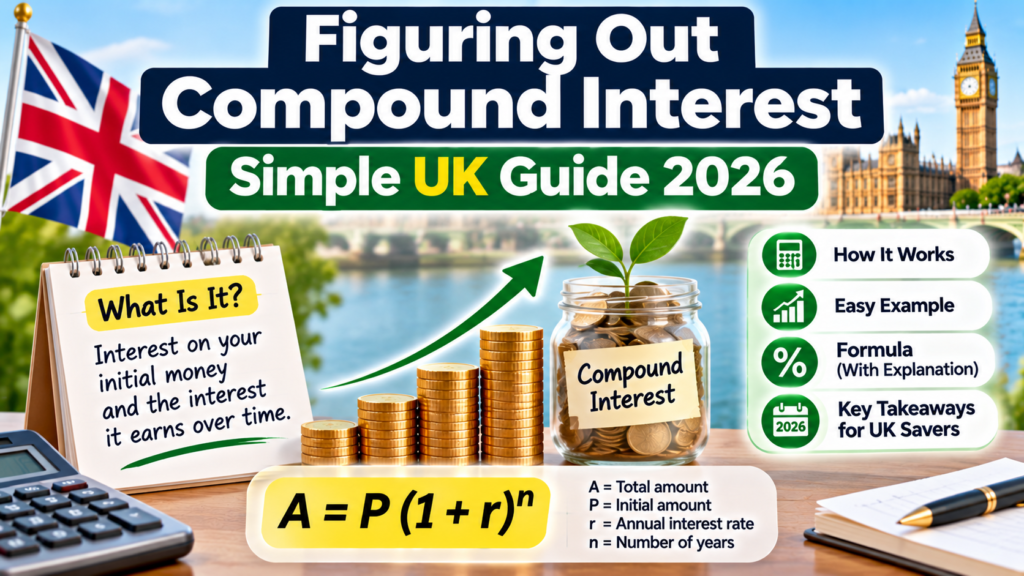
Albert Einstein is often said to have called compound interest the eighth wonder of the world. He probably never said it. But the idea behind it is real, and once you see how it works, you’ll look at savings, debt and pensions differently.
Here’s the plain version. With simple interest, you earn interest only on the money you started with. With compound interest, you earn interest on the interest too. Put £10,000 in at 5% a year and leave it for 30 years. Simple interest gives you £25,000. Compound interest gives you £43,219. Same money, same rate, same time. Figuring out compound interest is mostly about understanding that gap.

What is compound interest?
Compound interest means each period’s interest is added to your balance, and the next period’s interest is worked out on the bigger total. So your money grows a little faster each time.
Here’s a simple example. You put £5,000 in a savings account paying 4% a year, and you leave everything in:
| Year | Balance at start | Interest earned (4%) | Balance at end |
|---|---|---|---|
| 1 | £5,000.00 | £200.00 | £5,200.00 |
| 2 | £5,200.00 | £208.00 | £5,408.00 |
| 3 | £5,408.00 | £216.32 | £5,624.32 |
Notice the interest isn’t the same each year. It was £200 in year one and £216.32 in year three. That small difference is compounding at work. Over three years it’s tiny. Over thirty, it’s huge.
The compound interest formula, in plain English
If you like seeing the sum written down, here it is:
Final amount = P × (1 + r ÷ n) ^ (n × t)
- P is the money you start with.
- r is the yearly interest rate, as a decimal (5% is 0.05).
- n is how many times a year the interest is added.
- t is the number of years.
For interest added once a year, it simplifies to P × (1 + r) ^ t. So £10,000 at 5% for 10 years is £10,000 × 1.05 ^ 10, which comes to £16,289. You don’t need to do this by hand though. Our Savings Interest Calculator does it for you, including monthly top-ups and a year-by-year breakdown, and it runs in your browser without storing what you type.
Figuring out compound interest vs simple interest
The difference looks small at first, then it explodes. Here’s £10,000 at 5%, with nothing added:
| After | Simple interest | Compound interest | Extra from compounding |
|---|---|---|---|
| 10 years | £15,000 | £16,289 | £1,289 |
| 20 years | £20,000 | £26,533 | £6,533 |
| 30 years | £25,000 | £43,219 | £18,219 |

Look at the last column. After 10 years, compounding adds £1,289. After 30 years, it adds £18,219, over 14 times as much. The effect doesn’t grow in a straight line, it curves upward. That’s why time matters more than almost anything else.
Does it matter how often interest is added?
A little. The more often interest is added, the faster the balance grows, because each addition starts earning too. Here’s £10,000 at 5% a year over 10 years:
| Interest added | Balance after 10 years |
|---|---|
| Once a year | £16,289 |
| Monthly | £16,470 |
| Daily | £16,487 |
Going from yearly to monthly adds about £181. Going from monthly to daily adds just £17 more. So how often matters, but far less than the rate itself or how long you leave it.
This is why UK savings accounts quote an AER (annual equivalent rate). The AER already includes the effect of compounding, so it lets you compare accounts fairly. A 5% rate paid monthly works out as roughly 5.12% AER. When you’re comparing accounts, compare the AER, not the headline rate.
Compound interest with regular saving
Most of us don’t save one lump sum. We add a bit every month. That’s where compounding really shows what it can do. Here’s £200 a month at 5%, with interest added monthly and nothing taken out:
| After | You paid in | Interest earned | Total pot |
|---|---|---|---|
| 10 years | £24,000 | £7,056 | £31,056 |
| 20 years | £48,000 | £34,207 | £82,207 |
| 30 years | £72,000 | £94,452 | £166,452 |
| 40 years | £96,000 | £209,204 | £305,204 |

Between years 20 and 30, the interest alone (£60,245) is more than you paid in over those ten years (£24,000). And compare 30 years with 40. Ten extra years adds £138,752 to the pot, even though you only paid in £24,000 more. That’s the cost of waiting.
If you want to test your own monthly amount and rate, the Savings Interest Calculator shows the same split between what you paid in and what you earned.
The Rule of 72: a quick way to estimate
You can work out roughly how long it takes to double your money without a calculator. Divide 72 by the interest rate. At 4%, 72 ÷ 4 = 18 years. At 8%, it’s 9 years.
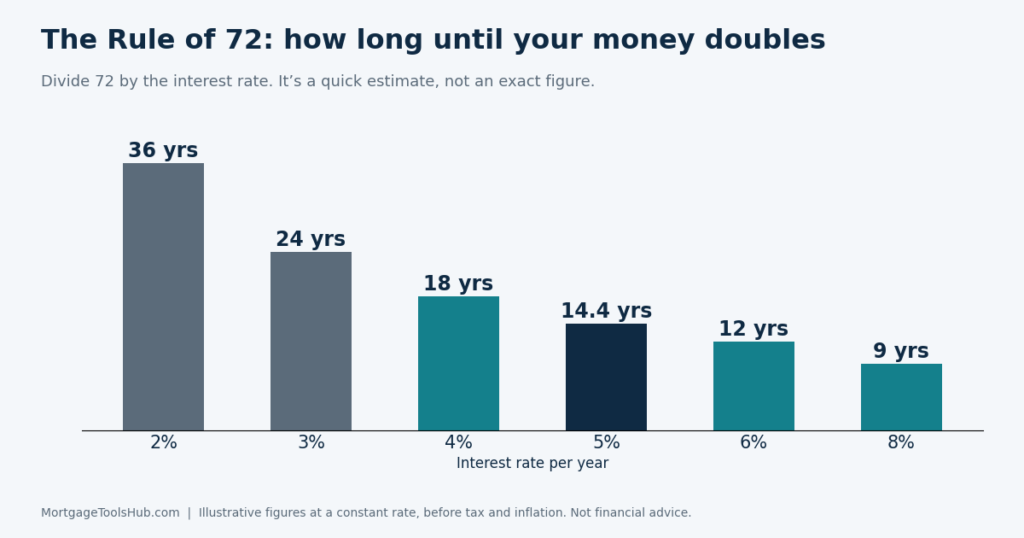
It’s an estimate, but a good one at the rates most of us deal with. It also works for debt, in the wrong direction: at 24% interest, a balance you don’t pay down doubles in about 3 years.
Where do UK savings rates stand?
Rates move, so treat these as a snapshot. The Bank of England’s Bank Rate has been 3.75% since December 2025, and the Bank was due to review it again on 5 November 2026. Savings providers don’t just copy it. According to comparison tables in early November 2026, the best easy access accounts paid roughly 4.5% to 5% AER and the best one-year fixed bonds roughly 5.1% to 5.4%, though some top rates come with bonuses that fall away after a few months. You can see current figures on the Moneyfacts savings page and the Bank’s Bank Rate page.
Whatever rate you pick, the maths stays the same. £10,000 at 4.5% AER compounds to about £15,530 in 10 years. At 5% it’s £16,289. That’s £759 more from a rate that’s only half a percentage point higher, which is why shopping around is worth the effort.
What inflation does to compound interest
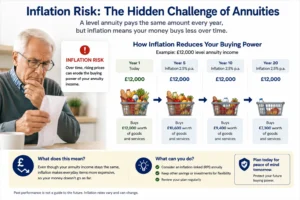
Compound interest grows your pounds. Inflation shrinks what those pounds can buy. The number that really matters is your growth after inflation.
Say your £10,000 grows at 5% for 20 years to £26,533. If prices rise by 3% a year over that time, that £26,533 only has the buying power of about £14,700 in today’s money. You’re better off, but not by as much as the headline suggests. If your savings rate is lower than inflation, compounding can’t stop your money losing buying power.
Tax on compound interest in the UK
Interest on cash savings can be taxed, but most people pay little or none. You get a Personal Savings Allowance: £1,000 of interest a year tax-free for basic-rate taxpayers, £500 for higher-rate and nothing for additional-rate. Some people with low other income also get a starting rate for savings.
Interest above your allowance is taxed. Here’s what that means on £50,000 at 4.5%, which earns £2,250 a year:
| Taxpayer | Allowance | Taxable interest | Tax in 2026/27 | Tax from April 2027 |
|---|---|---|---|---|
| Basic rate | £1,000 | £1,250 | £250 (at 20%) | £275 (at 22%) |
| Higher rate | £500 | £1,750 | £700 (at 40%) | £735 (at 42%) |
That table shows a real change. According to GOV.UK’s technical note, from 6 April 2027 the tax rates on savings income rise by two percentage points, to 22%, 42% and 47%. The allowances stay the same. The same note confirms that from 6 April 2027 the annual cash ISA limit will be £12,000, within the overall £20,000 ISA limit, with savers over 65 still able to put £20,000 into a cash ISA.
Interest inside an ISA is tax-free, so it compounds without any tax drag. If you want to see how that shelter helps over time, try our ISA Calculator. And for long-term growth inside a pension, the SIPP Calculator models regular contributions at different growth rates.
When compound interest works against you
The same maths that grows savings grows debt. If interest is added to a balance you owe and you don’t pay it off, you end up paying interest on interest.
- Credit cards. As an illustration, £2,000 left unpaid at 22% APR, compounding yearly, would grow to about £5,405 in five years. Real cards compound monthly and you’d normally make payments, but the direction is the same.
- Mortgages. Interest is charged on what you still owe, so overpaying early cuts the balance interest is calculated on. Our Loan Overpayment Calculator shows how much interest you could save.
- Equity release. Most lifetime mortgages roll the interest up, so the debt compounds. At 6.5%, a £100,000 loan grows to roughly £188,000 after 10 years and £352,000 after 20. Our Equity Release Calculator and Lifetime Mortgage Calculator show how the debt grows against your home’s value.
The takeaway is simple. When you’re saving, compounding is on your side, so start early and leave it alone. When you’re borrowing, it works against you, so pay down high-rate debt first.
Common mistakes when figuring out compound interest
- Comparing headline rates instead of AER. The AER is the fair comparison.
- Forgetting inflation. A 3% rate in a 3% inflation world doesn’t grow your buying power.
- Ignoring tax. Check whether your interest will use up your Personal Savings Allowance, and think about an ISA.
- Chasing a bonus rate. Some top rates drop after a few months, so check what the account pays after the bonus ends.
- Waiting to start. The first years feel slow, and that’s exactly when many people give up. Most of the growth comes later.
- Assuming rates stay put. Variable rates change. Treat a projection as an estimate.
Try it with your own numbers
The best way to get a feel for this is to play with your own figures. Open the Savings Interest Calculator, put in a starting amount, a monthly top-up and a rate, and compare compound with simple interest year by year. It runs privately in your browser, so nothing you type is stored or sent anywhere.
Frequently asked questions
What is compound interest in simple terms?
It’s interest earned on your original money and on the interest you’ve already earned. Your balance grows faster each period.
How do I work out compound interest?
Multiply your balance by (1 + the yearly rate) for each year. £5,000 at 4% for 3 years is £5,000 × 1.04 × 1.04 × 1.04 = £5,624.32. A calculator makes it quicker, especially with monthly deposits.
What is the difference between simple and compound interest?
Simple interest is calculated only on the original amount. Compound interest is calculated on the original amount plus the interest already added. On £10,000 at 5% for 30 years, that’s £25,000 versus £43,219.
What is the compound interest formula?
Final amount = P × (1 + r ÷ n) ^ (n × t), where P is the starting amount, r is the yearly rate, n is the number of times interest is added each year and t is the number of years.
What is the Rule of 72?
A shortcut for estimating how long money takes to double. Divide 72 by the interest rate. At 6%, it takes about 12 years.
Is compound interest taxed in the UK?
Interest on cash savings counts as income. Most people have a Personal Savings Allowance (£1,000 for basic-rate, £500 for higher-rate taxpayers), and interest inside an ISA is tax-free. Rates on savings income above the allowance rise to 22%, 42% and 47% from April 2027.
Does compounding daily beat compounding monthly?
Slightly, but the difference is small. On £10,000 at 5% over 10 years, daily compounding gives about £17 more than monthly. Compare accounts by AER.
Can compound interest make me lose money?
Not on savings. But if inflation is higher than your interest rate, your money buys less over time. And on debt, compounding makes what you owe grow.
Next step
Figuring out compound interest comes down to three things: a good rate, regular saving and plenty of time. Run your own numbers through the Savings Interest Calculator, check whether an ISA makes sense for you, and use free, impartial guidance from MoneyHelper if you’d like help deciding.
This article is for general information and isn’t tax or regulated financial advice. MortgageToolsHub isn’t FCA authorised. All examples are our own simple calculations that assume a constant rate, no withdrawals and, unless stated, no tax or inflation. Savings rates and Bank Rate change often; the figures quoted were reported in early November 2026. Tax rules and allowances, including the changes from April 2027, may change and depend on your circumstances. Check any provider on the FCA Register and speak to a regulated adviser before making financial decisions.