

How Are Mortgage Payments Calculated in the UK? (2026 Guide)
Understanding your mortgage payment is about more than knowing how much you borrow. The interest rate, mortgage term, deposit and repayment type all affect what you pay each month — and how much the loan costs over its lifetime.
If you are buying a home or reviewing an existing mortgage, knowing how mortgage payments are calculated can help you compare deals and plan your budget more confidently.
In this guide, we explain how lenders calculate monthly mortgage repayments in the UK, show the formula in simple terms, and work through a practical example using pounds.
What Makes Up a Monthly Mortgage Payment?
A mortgage is a loan secured against a property. When you take out a mortgage, you agree to repay the borrowed amount, known as the capital, together with interest charged by the lender.
For a standard repayment mortgage, your monthly payment normally contains two parts:
- Capital: The amount that reduces the money you originally borrowed.
- Interest: The charge your lender applies for lending you the money.
At the beginning of the mortgage, a larger share of your payment usually goes towards interest. As the outstanding balance falls, the interest charged each month becomes smaller, allowing more of your payment to reduce the capital.
Your mortgage payment may also be affected by product fees or other costs, depending on how your lender structures the mortgage. These are not always included in a basic monthly repayment calculation.

How Are Mortgage Payments Calculated?
For a repayment mortgage, lenders use an amortisation calculation to work out a regular payment that covers both interest and capital over the agreed mortgage term.
The calculation mainly depends on three figures:
- Mortgage amount: How much you borrow after deducting your deposit.
- Interest rate: The rate charged by the lender.
- Mortgage term: How long you have agreed to repay the loan.
The calculation spreads the loan and its interest costs across the scheduled monthly payments. Assuming the interest rate stays unchanged and payments are made as agreed, the mortgage should be repaid by the end of the term.
A useful point to understand is that the monthly payment is not simply the original loan divided by the number of months. Interest must also be included.
The Mortgage Repayment Formula Explained
The standard formula for calculating a monthly repayment mortgage payment is:
M = P × [r(1 + r)ⁿ] ÷ [(1 + r)ⁿ − 1]
Where:
- M = Monthly mortgage payment
- P = Mortgage principal, or amount borrowed
- r = Monthly interest rate expressed as a decimal
- n = Total number of monthly payments
To use the formula:
- Convert the annual interest rate into a monthly rate by dividing it by 12.
- Convert the mortgage term into months by multiplying the number of years by 12.
- Enter the loan amount, monthly rate and total number of payments into the formula.
For example, a 4.5% annual interest rate becomes 0.00375 when divided by 12. A 25-year mortgage has 300 monthly payments.
The formula may look complicated, but a mortgage calculator can perform the calculation instantly.
Worked Example: Calculating a UK Mortgage Payment
Let’s look at a straightforward example to see how the figures work together.
Imagine you are buying a property and need to borrow £200,000. Your lender offers an interest rate of 4.5%, and you choose a 25-year repayment mortgage.
| Mortgage detail | Example figure |
|---|---|
| Amount borrowed | £200,000 |
| Annual interest rate | 4.5% |
| Mortgage term | 25 years |
| Number of monthly payments | 300 |
| Estimated monthly repayment | £1,111.66 |
Using the standard repayment formula, your estimated monthly payment would be approximately £1,111.66.
Over 25 years, you would make 300 monthly payments. This gives an estimated total repayment of around £333,499, including approximately £133,499 in interest.
These figures are illustrative. They assume the rate stays at 4.5% for the entire term, with no additional fees or changes to the mortgage.
What Happens to the First Monthly Payment?
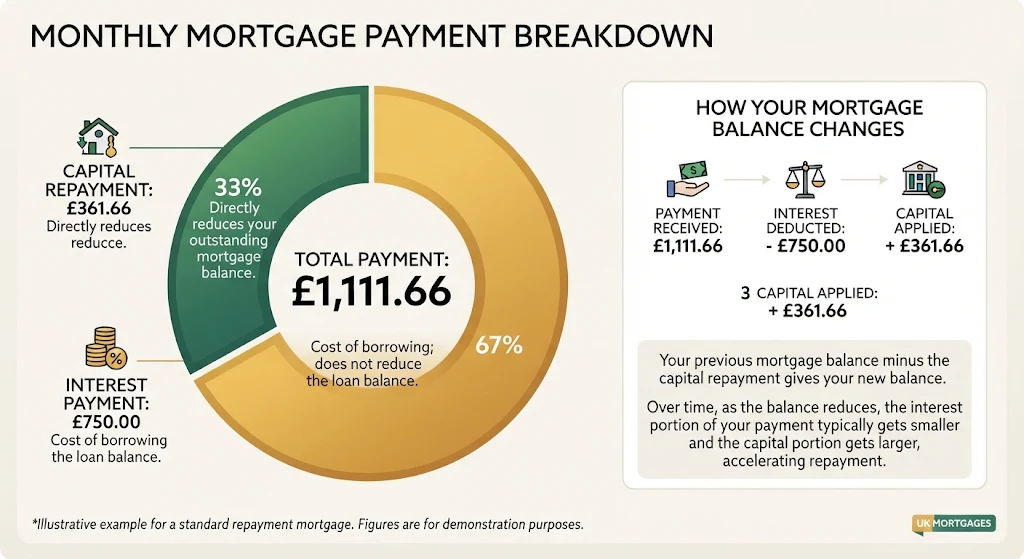
At the start of the mortgage, the outstanding balance is £200,000.
At a monthly interest rate of 0.375%, the first month’s interest is approximately £750.
Your first payment of £1,111.66 is therefore split roughly as follows:
| Payment breakdown | Amount |
|---|---|
| Monthly payment | £1,111.66 |
| Interest portion | £750.00 |
| Capital repaid | £361.66 |
The remaining mortgage balance would be approximately £199,638.34 after this payment.
In later months, interest is calculated on the reduced balance. As a result, the interest portion gradually falls and the capital portion increases.
How to Calculate Monthly Mortgage Payments Yourself
If you want to understand how to calculate monthly mortgage payments without a calculator, follow these steps.
Step 1: Work out the amount you need to borrow
Subtract your deposit from the property purchase price.
For example:
- Property price: £250,000
- Deposit: £50,000
- Mortgage required: £200,000
Step 2: Find your annual interest rate
Use the rate offered by your lender or the rate you want to test.
For this example, assume an annual interest rate of 4.5%.
Step 3: Convert the interest rate into a monthly figure
Divide 4.5 by 12 to get 0.375% per month.
For the formula, write this as 0.00375.
Step 4: Convert the mortgage term into months
A 25-year mortgage has:
25 × 12 = 300 monthly payments.
Step 5: Calculate the monthly repayment
Use the repayment formula or enter the figures into a mortgage calculator.
This gives you an estimated payment of approximately £1,111.66 per month.
Although you can calculate a payment manually, using a calculator is usually quicker when you want to compare different interest rates or mortgage terms.
How Does the Interest Rate Affect Your Mortgage Payment?
The interest rate is one of the most important factors in your monthly mortgage cost.
When the rate increases, the interest charged on your outstanding mortgage balance generally increases too. This can raise your monthly payment, particularly when you are on a variable-rate deal or your fixed-rate period ends.
Consider the same £200,000 mortgage over 25 years at different interest rates:
| Annual interest rate | Estimated monthly repayment |
|---|---|
| 3.5% | £1,001 |
| 4.0% | £1,056 |
| 4.5% | £1,112 |
| 5.0% | £1,169 |
| 5.5% | £1,228 |
These are illustrative repayment estimates, not current mortgage offers.
A fixed-rate mortgage normally keeps the agreed rate unchanged during the fixed period. A tracker or other variable-rate mortgage can change when its reference rate or lender’s pricing changes.
When comparing mortgage deals, check the initial rate, how long it lasts, any arrangement fees and the rate that may apply when the deal ends.
How Does the Mortgage Term Change Monthly Repayments?
The mortgage term is the length of time you have agreed to repay the loan.
A longer term spreads the borrowing over more months. This usually reduces the required monthly payment, but it can increase the total interest paid because you are borrowing for longer.
Using the same £200,000 mortgage at 4.5%, here is an approximate comparison:
| Mortgage term | Estimated monthly repayment |
|---|---|
| 15 years | £1,530 |
| 20 years | £1,265 |
| 25 years | £1,112 |
| 30 years | £1,013 |
| 35 years | £947 |
The lower monthly payment on a 35-year mortgage may look attractive, but the total interest cost would generally be higher than on a shorter term.
The right term depends on your income, monthly budget, age, future plans and the lender’s affordability requirements. Do not choose a longer term based only on the lower payment without checking the lifetime cost.
Repayment Mortgage vs Interest-Only Mortgage
The way your mortgage is structured also changes how your monthly payment is calculated.
Repayment Mortgage
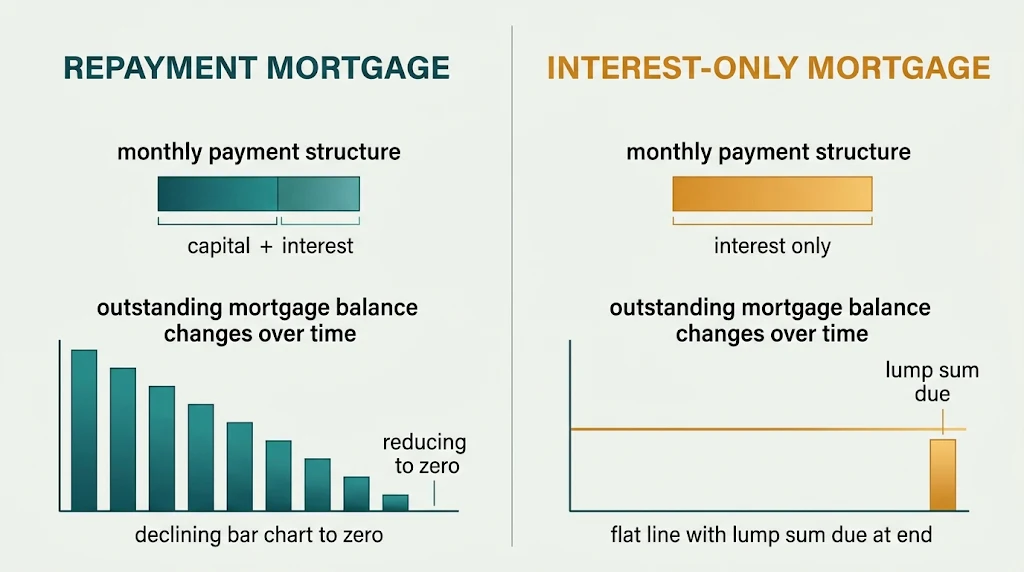
With a repayment mortgage, each monthly payment covers interest and part of the original loan.
If you make the required payments throughout the agreed term, the mortgage should be fully repaid by the end.
This is the most common structure for residential mortgages.
Interest-Only Mortgage
With an interest-only mortgage, your monthly payment covers the interest but does not reduce the original loan balance.
For example, on a £200,000 mortgage at 4.5%, a simple monthly interest calculation would be:
£200,000 × 4.5% ÷ 12 = £750.
You would pay approximately £750 per month in interest under this simplified example, but you would still owe the original £200,000 at the end of the term.
You therefore need a credible plan to repay the capital. Interest-only mortgages are subject to lender criteria and are not suitable for everyone.
What Other Factors Can Affect Your Mortgage Payments?
The loan amount, interest rate and term form the basis of the repayment calculation. However, other details can affect the amount you actually pay.
1. Your Deposit and Loan-to-Value Ratio
A larger deposit means you need to borrow less.
It can also reduce your loan-to-value ratio (LTV), which compares your mortgage against the property’s value. Some lenders offer different interest rates depending on the LTV band.
For example, a borrower with a 10% deposit may have access to different deals from someone with a 25% deposit.
2. Mortgage Fees
Arrangement fees, valuation fees and other charges can increase the overall cost of getting a mortgage.
Some lenders allow an arrangement fee to be added to the loan. If you choose this option, you may pay interest on the fee as well as the original borrowing.
3. Interest Rate Changes
If you have a variable-rate mortgage, a change in the rate can affect your monthly payment.
If you have a fixed-rate mortgage, your payment normally remains unchanged during the fixed period, but it may change when that deal ends and a new rate applies.
4. Overpayments
Some lenders allow borrowers to make additional payments towards their mortgage.
Overpayments can reduce the outstanding balance and may lower the total interest paid. However, check your mortgage terms first because early repayment charges or overpayment limits may apply.
Use a Mortgage Calculator to Estimate Your Monthly Repayments
You do not need to work through the formula every time you want to compare mortgage options.
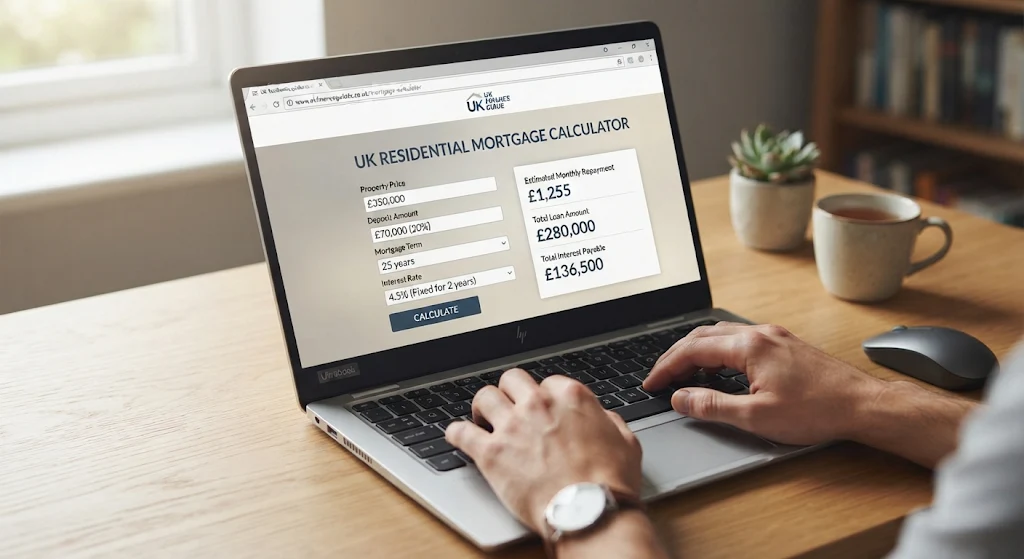
The Residential Mortgage Calculator UK & CA on MortgageToolsHub lets you adjust the property price, deposit, interest rate and mortgage term.
You can compare repayment and interest-only options and review estimated monthly payments and total interest.
For a useful comparison, try changing one figure at a time:
- Increase or decrease the deposit.
- Test a higher or lower interest rate.
- Compare a 20-year, 25-year and 30-year term.
- Switch between repayment and interest-only options.
This can help you understand how each decision affects the estimated cost before speaking to a lender.
Remember that calculator results are estimates. Your lender’s formal mortgage illustration will show the actual product terms, payment schedule and charges.
Frequently Asked Questions
How are mortgage payments calculated in the UK?
For a repayment mortgage, the lender uses the amount borrowed, interest rate and mortgage term to calculate a regular payment covering both capital and interest. The calculation is designed to repay the loan by the end of the agreed term, assuming the rate and payment schedule remain as expected.
How do I calculate my monthly mortgage payment?
You need the mortgage amount, annual interest rate and repayment term. Convert the annual rate into a monthly rate and the term into the total number of monthly payments, then use the standard amortisation formula. A mortgage calculator can do this automatically.
What is the formula for calculating mortgage repayments?
The standard repayment formula is M = P × [r(1 + r)ⁿ] ÷ [(1 + r)ⁿ − 1]. Here, P is the amount borrowed, r is the monthly interest rate and n is the total number of monthly payments.
Does a bigger deposit reduce monthly mortgage payments?
Usually, yes. A bigger deposit reduces the amount you need to borrow. It may also improve your loan-to-value ratio, which could help you access a different range of mortgage rates.
Do mortgage payments include interest and capital?
On a repayment mortgage, yes. Each payment covers interest and reduces some of the outstanding capital. On an interest-only mortgage, the monthly payment covers interest only, leaving the original loan to be repaid separately.
Why do I pay more interest at the beginning of my mortgage?
Interest is calculated on the outstanding mortgage balance, which is highest at the beginning. As you repay the capital, the balance falls and less interest is charged. This means a larger share of later payments can go towards reducing the loan.
Will my mortgage payment change if interest rates increase?
It depends on your mortgage deal. A fixed-rate mortgage normally keeps the same rate during its fixed period. A tracker or other variable-rate mortgage may change when its rate changes. Your payment may also change when a fixed deal ends and a new rate applies.
Final Thoughts
Mortgage payments are mainly calculated using three figures: the amount you borrow, the interest rate and the length of the mortgage term.
Understanding how these figures work together makes it easier to compare mortgage options and see the difference between a lower monthly payment and a lower overall borrowing cost.
Before choosing a mortgage, compare the monthly repayment, total interest, fees and repayment structure. Use a calculator to explore different scenarios, then check the final figures against a formal illustration from your lender.
This guide is for general information only and is not personal financial advice. MortgageToolsHub is not an FCA-authorised mortgage adviser or lender. Consider speaking to a suitably qualified mortgage adviser before making a borrowing decision.
Sources and Further Reading
- MoneyHelper – Mortgage Repayment Calculator
- MoneyHelper – Interest-Only and Repayment Mortgages Explained
- MoneyHelper – Understanding Mortgages and Interest Rates
To see how every payment splits between interest and capital over the full term, our mortgage amortization schedule calculator lays it out month by month.