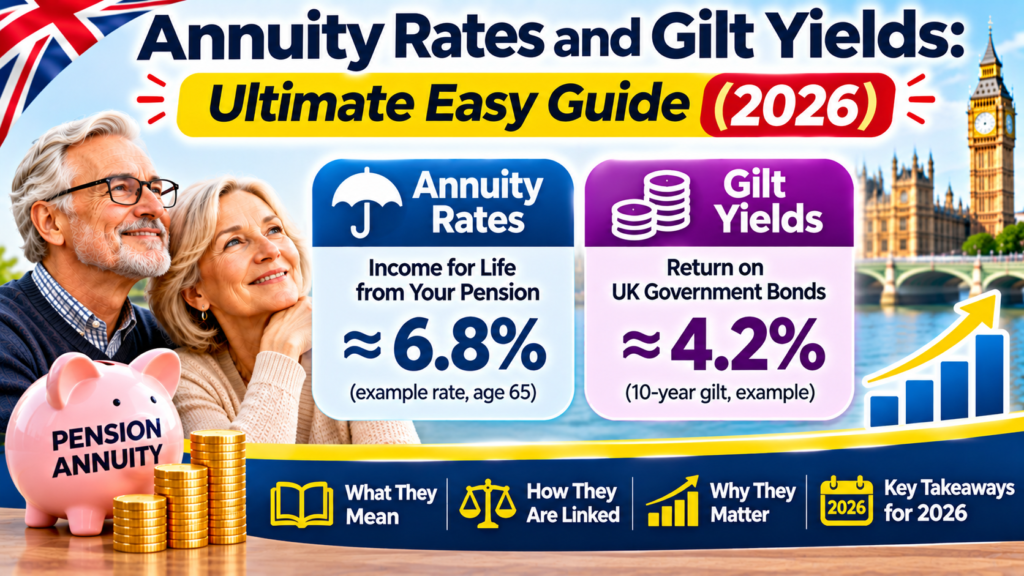
If you’ve noticed that annuity quotes jumped this autumn, you weren’t imagining it. The reason is the bond market. Annuity rates and gilt yields move together, and in October 2026 gilt yields hit levels the UK hasn’t seen in a generation.
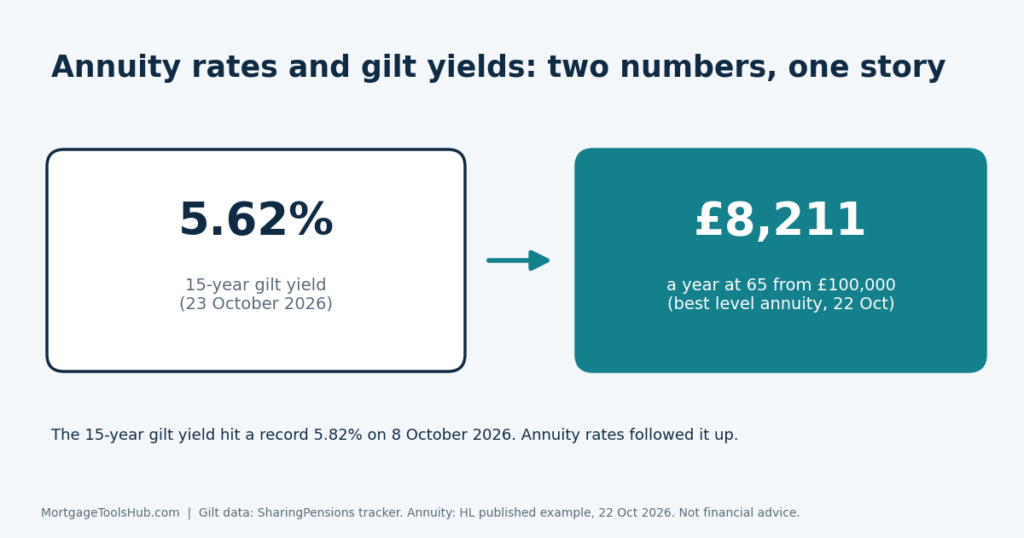
Here’s the short version. Annuity providers back their promises mainly with long-dated government bonds, called gilts. When the yield on those gilts goes up, the income an insurer can afford to pay you goes up too. The 15-year gilt yield, which is the one annuities track most closely, reached a record 5.82% on 8 October 2026. In the same stretch, the best level annuity for a healthy 65-year-old with £100,000 rose from £8,081 to £8,211 a year.
What are gilts, and why do annuity providers care?
Gilts are UK government bonds. You lend money to the government, it pays you a fixed amount of interest, and it gives your money back at the end. They’re among the safest investments there are, which is why insurers like them.
An annuity is a long promise. The insurer agrees to pay you a fixed income for life, so it needs investments that pay a steady, predictable income for decades. As Which?’s pensions expert Paul Davies explains, annuity rates are closely tied to gilt yields and the Bank of England base rate. Gilts pay a fixed amount, so they’re a natural match for a fixed annuity.
The UK Debt Management Office publishes the details on gilts if you want to look further.
Annuity rates and gilt yields: the simple link
The link between annuity rates and gilt yields is direct. When yields rise, the insurer earns more on the bonds it buys with your money, so it can pay you more. When yields fall, the opposite happens.
The specialist tracker SharingPensions gives a rule of thumb. A rise of 0.3 percentage points in the 15-year gilt yield would typically lift annuity rates by about 3%, although providers can take time to change their prices. Scaled up, one full percentage point in yields is worth roughly 10% on your annuity income.
On the best published rate of £8,211 a year, that’s about £820 a year for every percentage point. It’s only a guide, but it shows how much your income depends on the day you buy.
The lag is real. SharingPensions reported that 15-year yields rose by 22 basis points to 5.72% during September 2026, yet standard annuity rates went up by an average of only 0.96% that month. The rule of thumb would have suggested a rise of about 2.2%. Providers move at their own speed.
Why it’s the 15-year gilt, not the Bank Rate
It’s tempting to think annuities follow the Bank of England’s Bank Rate. They’re related, but the Bank Rate is a very short-term rate, while annuity rates and gilt yields are tied together through much longer bonds. A 65-year-old might be paid for 15 to 25 years or more, so the 15-year gilt yield is the closest match.
The two can move very differently. In 2026, Bank Rate stayed at 3.75% from December 2025 right through the autumn, while 15-year gilt yields climbed well above 5%. On 5 November 2026, the Associated Press reported that the Bank raised Bank Rate to 4%, its first increase in more than three years, because rising energy prices were pushing up inflation. You can follow the latest on the Bank of England’s Bank Rate page.
How annuity rates and gilt yields reached the 2026 highs
The story starts with the long period of very low yields. Here are some points from SharingPensions’ 15-year gilt yield tracker:
| Date | 15-year gilt yield | What it meant for annuities |
|---|---|---|
| 30 September 2021 | 1.24% | Yields still very low, but starting to rise |
| 3 June 2022 | 2.42% | Highest in seven years; annuity rates rising |
| October 2023 | 5.13% | A multi-year high for annuity rates |
| December 2023 | 3.95% | Yields fell 1.18 points; annuity rates ended 2023 about 4.4% lower |
| October 2025 | 4.81% | Yields fell 0.32 points; providers cut enhanced rates by about 2.7% |
| 8 October 2026 | 5.82% | Record high for the 15-year yield |
| 23 October 2026 | 5.62% | Yields eased back but stayed high |

This chart joins selected readings with straight lines, so it shows the direction, not every move in between. Yields have been bumpy, which is exactly why annuity quotes change from week to week.
Other markets saw the same thing. According to a Reuters-sourced summary at Your Wallet Manager, the 30-year gilt yield touched 6.036% on 7 October 2026, its highest since January 1998, before easing back, and the 10-year reached about 5.48%. A report from Restless linked the rise to the US–Iran conflict, worries about inflation and government borrowing.
Why is the annuity rate higher than the gilt yield?
This confuses a lot of people. The 15-year gilt yield is 5.62%, but the annuity rate is 8.21%. How can an insurer pay more than it earns?
Because an annuity pays back your capital as well as interest. Here’s a simple way to see it. Suppose you paid out £100,000 over a fixed term at a 5.62% return, with no insurer involved:
| Paid out over | Yearly income from £100,000 |
|---|---|
| 10 years | 13.3% |
| 15 years | 10.0% |
| 20 years | 8.5% |
| 25 years | 7.5% |
| 30 years | 7.0% |
An 8.21% income is what that simple sum gives you if the money lasts for about 21 years. But a lifetime annuity keeps paying after that, however long you live. The insurer can afford it because it pools thousands of customers, and the ones who die early help fund those who live long. It also invests in more than gilts. So the annuity rate sits well above the gilt yield, and that gap is made of returned capital and pooled longevity, not magic.

This is a simplified illustration, not how insurers actually price. But it explains why annuity rates and gilt yields can look so different yet still move in step. Our guide to best annuity rates 2026 shows how the rate changes with age.
What would happen to annuity rates and gilt yields if the market moved?
Nobody knows where yields will go. But the rule of thumb lets you see how annuity rates and gilt yields could interact. Starting from £8,211 a year at 65 and applying roughly 10% for each percentage point:
| If long gilt yields… | Rough income from £100,000 at 65 |
|---|---|
| Fell by 1 point | about £7,390 |
| Fell by 0.5 points | about £7,800 |
| Stayed the same | £8,211 |
| Rose by 0.5 points | about £8,622 |
| Rose by 1 point | about £9,032 |

This is an illustration, not a forecast. Which? expects annuity rates to stay high for the foreseeable future, but that’s an opinion, and yields can fall as easily as they rise. The Which? pensions expert’s view is useful, but your own plan shouldn’t depend on a guess.
What do annuity rates and gilt yields mean if you’re buying an annuity?
- Remember the link. Because annuity rates and gilt yields move together, a quote can change between the day you ask and the day you buy.
- A quote only reflects the day it was produced. Yields eased back from their October peak, so quotes can differ from one week to the next. Gather the quotes you want to compare in the same short window.
- Don’t try to time the market. If you wait for yields to rise further, they might fall. Waiting also costs you income. See our guide to annuity vs drawdown for how people balance this.
- Consider buying in stages. Using part of your pot now and more later spreads the timing risk.
- Compare providers. Providers react to yields at different speeds, so the best rate can come from a different company each time. Our guide to the £100,000 annuity shows the gap.
- Check your options. An enhanced annuity can add to your income whatever yields do, and a rising income is priced differently from a level one.
Does it work the same for every type of annuity?
The link between annuity rates and gilt yields is the same for every type, but the details differ. A level annuity follows ordinary gilt yields. An annuity that rises with inflation is priced from different, inflation-linked yields, which is partly why it starts so much lower. Joint life annuities and guarantee periods change how long the insurer expects to pay, which changes the rate but not the link to yields.
Common mistakes about annuity rates and gilt yields
- Watching only the Bank Rate. The 15-year gilt yield is a better guide to where annuity rates are heading.
- Expecting instant changes. Providers can take weeks to react, as the September 2026 figures showed.
- Treating the rule of thumb as a promise. It’s an average, not a guarantee.
- Waiting for the “perfect” moment. Nobody can call the top or the bottom of yields.
- Forgetting everything else. Your age, health and options matter at least as much as the yield on the day.
Try it with your own numbers
Put your age and pot into the Annuity Rates Calculator for a rough income today, then use the table above to see how annuity rates and gilt yields might interact if yields changed. It runs in your browser, and what you type isn’t stored or sent anywhere. The Pension Annuity Calculator can help you compare an annuity with other options.
Frequently asked questions
How are annuity rates and gilt yields connected?
Insurers back annuities mainly with gilts. When gilt yields rise, they earn more on the bonds they buy, so they can pay more income. When yields fall, annuity rates tend to fall.
Which gilt yield matters most for annuities?
The 15-year gilt yield is the one most closely followed, because it roughly matches how long a typical annuity might pay out.
Do annuity rates follow the Bank of England base rate?
Indirectly. Bank Rate is a short-term rate, and it influences yields, but annuities follow long gilt yields. In 2026 the two moved quite differently for most of the year.
How much does a rise in gilt yields increase annuity rates?
As a rough rule, a 0.3-point rise in the 15-year yield can lift annuity rates by about 3%, so a full point is worth around 10%. Providers can take time to pass it on.
Why did annuity rates rise in 2026?
Gilt yields climbed to levels not seen for many years. The 15-year yield hit a record 5.82% on 8 October 2026, and the best level annuity at 65 rose from £8,081 to £8,211 between 10 September and 22 October.
Will annuity rates fall if gilt yields fall?
Usually yes, though not instantly. When yields dropped from 5.13% to 3.95% in late 2023, annuity rates ended the year about 4.4% lower, according to SharingPensions.
Should I wait for gilt yields to rise before buying an annuity?
Nobody can predict yields reliably, and waiting costs you income. Many people compare quotes across the market and consider buying in stages.
Do annuity rates and gilt yields always move at the same speed?
No. Gilt yields change every day, but providers reprice less often. In September 2026, 15-year yields rose 22 basis points, yet standard annuity rates rose only about 0.96% on average that month.
Why is the annuity rate higher than the gilt yield?
Because an annuity returns your capital as well as interest, pools longevity risk across many customers and can also use other investments. A lifetime annuity at 8.21% is roughly what a fixed payout of about 21 years would give at 5.62%, but it keeps going for life.
Next step
Annuity rates and gilt yields move together, so the best time to compare is when you’re ready to buy, not when you think yields have peaked. Run your numbers through the Annuity Rates Calculator, get quotes from several providers, and use Pension Wise or MoneyHelper for free guidance before you decide.
This article is for general information and isn’t regulated financial advice. MortgageToolsHub isn’t FCA authorised and doesn’t recommend or rank providers. Gilt yield and annuity-rate movements are reported from the sources linked above and will have changed by the time you read this. The rule of thumb is an average from a specialist tracker, and the fixed-term payout and “what if yields moved” tables are our own simple illustrations, not forecasts or how insurers price. Check any provider or broker on the FCA Register and speak to a regulated adviser or Pension Wise before buying an annuity.