
Here’s a question worth asking at the kitchen table before you buy anything: what happens to your partner’s money when you die? With a single life annuity, the answer can be uncomfortable. The income simply stops. A joint life annuity is the fix, and it costs less than most people expect.
On the latest figures, a healthy 65-year-old with £100,000 gets about £8,211 a year from a single-life level annuity, or £7,658 from a joint life annuity that pays 50% to a partner three years younger. That’s £553 less each year, about 6.7%, in exchange for £3,829 a year going to your partner for the rest of their life after you’ve gone.

What is a joint life annuity?
A joint life annuity pays you a guaranteed income for life. When you die, it carries on paying a percentage of that income to your husband, wife, civil partner or partner, for as long as they live.
You choose the percentage when you buy. The usual options are 50%, two-thirds (66.7%) and 100%. Everything else works like any other annuity, so you can still pick a level or rising income, add a guarantee period, or apply for an enhanced annuity if your health qualifies.
The trade is straightforward. Because the insurer may now have to pay for two lifetimes rather than one, your starting income is lower.
How much does a joint life annuity cost?
Here are the best published examples from Hargreaves Lansdown’s table dated 22 October 2026, as set out by Pension Bible. They’re for £100,000, level income, no guarantee, with a partner three years younger:
| Age when you buy | Single life | Joint life, 50% to partner | What you give up |
|---|---|---|---|
| 55 | £7,078 | £6,696 | £382 a year (5.4%) |
| 60 | £7,476 | £7,144 | £332 a year (4.4%) |
| 65 | £8,211 | £7,658 | £553 a year (6.7%) |
| 70 | £9,002 | £8,361 | £641 a year (7.1%) |
| 75 | £10,212 | £9,146 | £1,066 a year (10.4%) |

Notice the cost isn’t big when you’re younger, but it grows with age. The reason is that the older you are, the sooner the insurer expects your partner to take over the payments.
These are published examples, not quotes. Your own figures depend on your health, postcode, and your partner’s age and health, so use them as a guide. You can get a rough estimate of your own with the Annuity Rates Calculator.
What does your partner actually get?
This is the part that’s hard to picture. At 65 with the 50% option, your partner would receive about £3,829 a year (half of £7,658) after you die. Whether that was worth the £553 a year you gave up depends on how things play out. Here are three simple scenarios on the same numbers:
| If… | Income you gave up while alive | Income your partner receives |
|---|---|---|
| You die at 70 and your partner lives 25 more years | £2,765 | £95,725 |
| You die at 80 and your partner lives 15 more years | £8,295 | £57,435 |
| You die at 90 and your partner lives 5 more years | £13,825 | £19,145 |

These are simple sums. They ignore tax and inflation, and they assume you’d each live the number of years shown. The point is that a joint life annuity works like insurance. In most cases you’re paying a small yearly price against the chance of a much larger payout, and in the worst case, your partner is left with no annuity income at all.
Choosing the percentage: 50%, 66.7% or 100%?
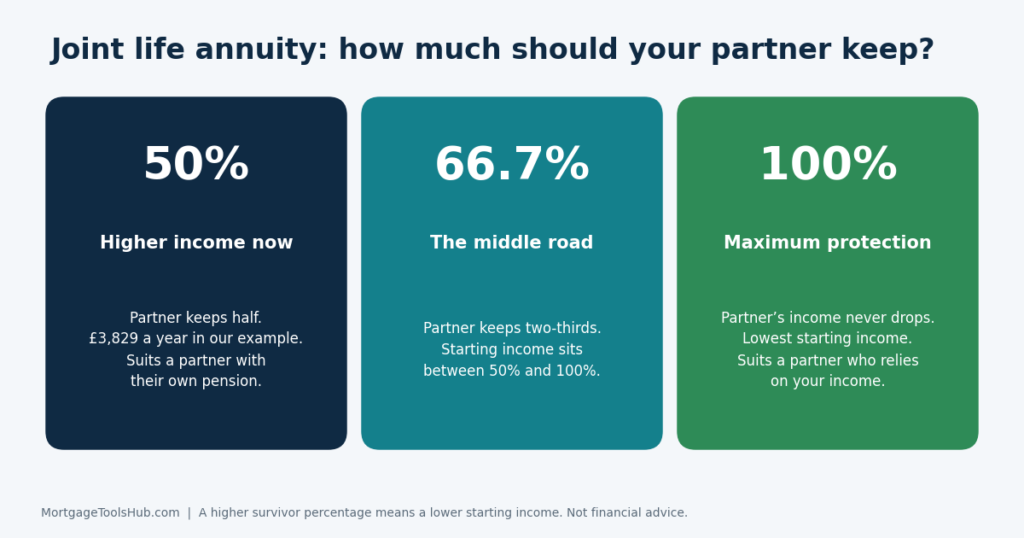
The higher the percentage your partner keeps, the lower your starting income. There’s no single right answer, but here’s how to think about it:
- 50% gives you the most income now. It suits couples where the survivor has their own pension or savings, and whose costs will fall once there’s only one of you.
- 66.7% is a middle option, if you want your partner to keep most of the income without paying the full price for 100%.
- 100% gives the most security, because your partner’s income doesn’t drop at all. It suits couples where one person relies on the other’s annuity to pay the bills.
A useful test is to list your household’s essential bills, then add up what your partner would have left without your annuity: their State Pension, any workplace pension, and any savings. If that covers the bills, 50% may be plenty. If there’s a gap, a higher percentage is worth pricing up.
Published tables usually only show the 50% option, so ask providers for quotes at each level before you decide.
Does the age gap between you and your partner matter?
Yes. The figures above assume your partner is three years younger. A younger partner is expected to collect the survivor income for longer, so the insurer lowers your starting income. A bigger age gap means a bigger drop. An older partner has the opposite effect.
Gender plays a part in real life too. According to the Office for National Statistics, a 65-year-old woman can expect to live about 21.2 more years against 18.7 for a man. And wives are often a little younger, so the survivor in a couple is statistically more often the woman. That’s worth bearing in mind if you’re the husband and wondering whether you really need the cover.
Why a single life annuity can be a risky choice for couples
A single life annuity pays out the most, which is why it looks so attractive in comparison tables. But when you die, the payments stop. If your annuity was the main income in the household, your partner could be left living on their own State Pension and whatever savings there are, and the household may also lose your State Pension.
That doesn’t make single life wrong. It’s a good choice if your partner has plenty of their own income, if you’re single, or if you have no one who depends on you. The mistake is picking it simply because the number on the page is bigger, without thinking about what comes after.
Other ways to protect your partner
A joint life annuity isn’t the only route. Some alternatives:
- A guarantee period. A single life annuity with a five or ten-year guarantee keeps paying for that period even if you die early. It’s a cheap form of cover, but it ends when the period does. Our best annuity rates 2026 guide shows a five-year guarantee cost only about £65 a year in the latest table.
- Life insurance alongside a single life annuity. This can pay your partner a lump sum, but you’d need to be able to get cover at a sensible price. Our Life Insurance Calculator can give you a feel for the amounts involved.
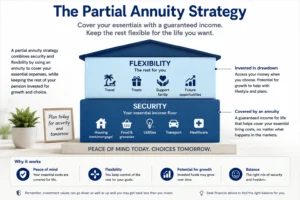
- A partial annuity and drawdown. Use an annuity for essential bills and keep the rest invested, so money is still there for your partner. Compare the options with our Pension Annuity Calculator and Pension Drawdown Calculator.
- Other pensions. Check whether any workplace or defined benefit pension you have pays a spouse’s pension, since it may already cover part of the gap.
Is joint life annuity income taxed?
Yes. Annuity income counts as taxable income. When your partner takes over the payments, it’s taxed as income in their hands, against their own personal allowance and tax rates, not yours. If you want to see how it sits alongside the State Pension, try our State Pension Forecast Calculator.
Questions to ask before you buy a joint life annuity
- What percentage will my partner receive, and does it change if my partner dies first?
- Does my partner qualify under the provider’s rules? Most providers cover a husband, wife or civil partner, and some may cover other partners, so check.
- Is the income level or rising, and is there a guarantee period?
- How are the quotes affected if I declare health conditions? See our guide to the enhanced annuity.
- How long is the quote valid for?
Compare the answers across several providers, since rates differ a lot between them. And if you want to know how rising income changes the picture, read our guide on the level or escalating annuity break-even age.
Try it with your own numbers
Start with the Annuity Rates Calculator to see a rough starting income for your age and pot. It runs in your browser, and what you type isn’t stored or sent anywhere. Then ask providers for single life and joint life quotes side by side. For a simple benchmark first, see how much annuity £100,000 will buy.
Frequently asked questions
What is a joint life annuity?
It’s an annuity that pays you an income for life and then continues paying a percentage of it to your partner after you die.
How much less does a joint life annuity pay?
In the 22 October 2026 table, a 50% joint life annuity at 65 paid £7,658 a year against £8,211 for single life, about 6.7% less. Higher survivor percentages and bigger age gaps cost more.
Is a joint life annuity worth it?
It’s worth considering if your partner would struggle without your income. If they have plenty of their own pension and savings, a single life annuity may suit you better.
What percentage should I choose for my partner?
Many couples choose 50% or two-thirds. Choose 100% if your partner depends on your income to pay the bills.
What happens to a joint life annuity if my partner dies first?
It depends on the terms. Always ask the provider whether your income stays the same or drops if your partner dies before you.
Can I get a joint life annuity if I’m not married?
Often you can, but rules vary by provider, so ask whether an unmarried partner qualifies.
Does a joint life annuity pay anything if we both die early?
Only if you added a guarantee period. Without one, payments end when the last of you dies.
Can I change from single to joint life after buying?
No. Once an annuity is bought, the type is generally fixed for life, so decide carefully before you commit.
Next step
A joint life annuity is the simplest way to make sure the person you share your life with isn’t left short. Price it against a single life annuity, run your numbers through the Annuity Rates Calculator, and use Pension Wise or MoneyHelper for free guidance before you decide.
This article is for general information and isn’t regulated financial advice. MortgageToolsHub isn’t FCA authorised and doesn’t recommend or rank providers. Figures are illustrative best-buy examples from Hargreaves Lansdown’s published table dated 22 October 2026 (as set out by Pension Bible) and will have changed by the time you read this. The scenarios are our own simple calculations before tax and inflation. Check any provider or broker on the FCA Register and speak to a regulated adviser or Pension Wise before buying an annuity.