
Here’s a fear a lot of people have about buying an annuity: “What if I die a year later and lose the lot?” A single life annuity with no extras does stop the moment you die. That’s where an annuity guarantee period comes in. It’s a safety net, and it’s one of the cheapest add-ons you can buy.
On the latest figures, a healthy 65-year-old with £100,000 gets about £8,211 a year with no guarantee, or £8,146 with a five-year guarantee. That’s just £65 a year less. In return, at least £40,730 will be paid out even if you die straight after buying.

What is an annuity guarantee period?
An annuity guarantee period is a minimum number of years your annuity will keep paying, whether you’re alive or not. If you die inside that period, the remaining payments go to someone you’ve chosen, such as a partner, child or other beneficiary. If you live beyond it, nothing changes. You keep getting paid for life.
You pick the length when you buy. Most people choose five or ten years, though providers offer anything from one month up to thirty years. According to Canada Life, which cited FCA data, around three out of four annuities sold come with some kind of guarantee, and most are five or ten years.
Here’s how it works with real numbers. Say you buy at 65 with the five-year guarantee, getting £8,146 a year:
- You die after 2 years: your beneficiary receives the remaining 3 years of payments, which is £24,438.
- You die after 7 years: the guarantee has already finished, so nothing further is paid.
- You live to 95: you receive £8,146 a year for the whole time, exactly as you would without a guarantee.
How much does an annuity guarantee period cost?
Less than you’d think, and it depends heavily on your age. These figures compare the single life, level annuity with and without a five-year guarantee, from Hargreaves Lansdown’s 22 October 2026 table, as set out by Pension Bible, for a £100,000 pot:
| Age when you buy | No guarantee | 5-year guarantee | What it costs you |
|---|---|---|---|
| 55 | £7,078 | £7,070 | £8 a year (0.1%) |
| 60 | £7,476 | £7,461 | £15 a year (0.2%) |
| 65 | £8,211 | £8,146 | £65 a year (0.8%) |
| 70 | £9,002 | £8,886 | £116 a year (1.3%) |
| 75 | £10,212 | £9,950 | £262 a year (2.6%) |
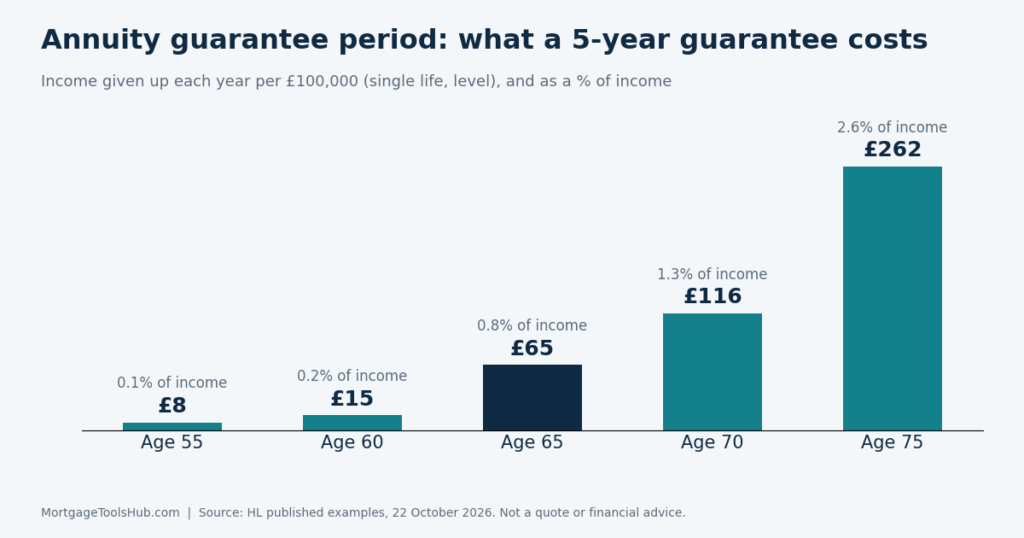
The pattern makes sense. The older you are, the more likely you are to die inside the guarantee period, so the insurer charges more for the cover. At 55 it’s almost free. By 75 it’s still only about 2.6% of your income.
To put £65 a year in context: over 20 years you’d give up around £1,300 in income at age 65. If you died in the second year, your family would get £24,438. If you lived the full 20 years, you’d have paid £1,300 for peace of mind.
These are published examples, not quotes. For a rough idea of your own numbers, try the Annuity Rates Calculator.
5 years or 10 years: which annuity guarantee period should you pick?
A longer guarantee costs more but protects more. Current tables for guarantees beyond five years are harder to find, so here’s an illustration from Canada Life on £100,000. It used lower rates than today, so the actual costs now would differ, but the shape of the pattern holds:
| Guarantee period | Income per year | Cost per year | Minimum guaranteed |
|---|---|---|---|
| None | £6,532 | – | – |
| 5 years | £6,522 | £10 | £32,610 |
| 10 years | £6,489 | £43 | £64,890 |
| 20 years | £6,270 | £262 | £125,400 |
| 30 years | £5,879 | £653 | £176,370 |
That example comes from Canada Life’s “money-back annuities” analysis. Look at how the jump works. Going from five to ten years adds about £33 a year of cost and doubles the safety net. Going from ten to thirty years adds over £600 a year. The first few years of cover are the best value, and every extra year after that costs more.

So how do you choose between five and ten years?
- Five years is the budget option. It covers the highest-risk window right after you buy and costs almost nothing at younger ages.
- Ten years doubles the cover for a modest extra cost. It suits you if you want to leave something meaningful or if your health is uncertain.
- Longer than ten starts to look like a money-back plan, where the income paid out is guaranteed to exceed what you put in. It costs noticeably more, so price it before deciding.
Rates change often, so get quotes for each length from the providers you’re comparing.
Who should choose an annuity guarantee period?
A guarantee is worth a serious look if:
- you’re buying a single life annuity and someone would miss the income, such as a partner or an adult child you support;
- you want to leave something behind, rather than risk handing the insurer your whole pot after a short retirement;
- your health is uncertain and you’re worried about dying early; or
- you’re a younger buyer, where the cost is so low it’s hard to argue against it.
You might skip it if no one depends on your income, you want the highest possible starting figure, or you’re buying at an older age where the cost starts to bite. Even then, it’s worth pricing, because the difference is often smaller than expected.
How likely is it that you’ll actually need it? According to the Office for National Statistics, a 65-year-old man can expect to live around 18.7 more years and a woman 21.2, and the large majority of people who reach 65 are still alive five years later. So an annuity guarantee period is insurance against an unlikely event, but a costly one for your family if it happens.
How are annuity guarantee payments taxed?
This part matters, because it can change what your family actually receives. The rules depend on how old you were when you died:
| If you die… | Tax on guarantee payments |
|---|---|
| Before age 75 | Usually free of income tax for your beneficiary |
| At 75 or over | Taxed as income at your beneficiary’s own marginal rate |
As Canada Life explains, remaining guaranteed payments can be paid into your estate or straight to your beneficiary. Money paid into your estate may be charged inheritance tax, whereas money paid straight to a beneficiary generally shouldn’t be. That’s worth discussing with your provider when you set it up.
There’s also a limit on how much can be paid out tax-free across all your pensions, called the lump sum and death benefit allowance, normally £1,073,100. For most people it won’t matter, but check if you have a large total pension.
Annuity guarantee period vs value protection vs joint life
A guarantee period isn’t the only way to protect what you leave. Here’s how the three main options compare:
| Option | What it does | Best for |
|---|---|---|
| Guarantee period | Pays for a fixed number of years, whatever happens | A cheap safety net against early death |
| Value protection | Returns some or all of your original pot, minus income already paid, as a lump sum | Leaving a defined amount to your family |
| Joint life annuity | Keeps paying your partner for the rest of their life | Protecting a partner who relies on your income |
In Canada Life’s illustration, 50% value protection cost about £27 a year and 100% cost about £144 on the same £100,000, so it sits between a short guarantee and a long one on price. Value protection can pay a lump sum, while a guarantee period usually pays continuing income.
The key difference between a guarantee and joint life is that a guarantee ends. If your partner will need income for decades, a joint life annuity protects them for life. If you mainly want to avoid losing your pot after a very short retirement, a guarantee is the cheaper tool. You can also combine both.
What if your health is poor?
If you smoke or have a health condition, start by asking for an enhanced annuity quote, since it can pay noticeably more. Then price the guarantee on top. Because an insurer expects you may not live as long, a guarantee on an enhanced annuity may cost more than the same guarantee on a standard one, so compare actual quotes rather than assuming.
How to choose your annuity guarantee period

- Ask who depends on your income. If it’s a partner, price a joint life annuity first.
- Get quotes with no guarantee, five years and ten years. Use the same provider and the same pot so the comparison is fair.
- Look at the cost as a percentage of income. Under 1% is very cheap. Above 3% deserves more thought.
- Check how the payments would reach your family, and whether to name a beneficiary.
- Get free guidance from Pension Wise, and check any broker on the FCA Register.
Common mistakes with an annuity guarantee period
- Ignoring it completely. At younger ages it costs almost nothing, and many people only find out after they’ve bought.
- Assuming it lasts for life. A guarantee ends after the period you chose. It isn’t the same as joint life cover.
- Buying the longest one without pricing it. Long guarantees cost far more per year than short ones.
- Not naming a beneficiary. This can leave payments in your estate and may mean more tax and delay.
- Comparing quotes with different guarantees. A quote with a guarantee will always look lower than one without. Compare like with like. Our guide on best annuity rates 2026 shows the effect.
Try it with your own numbers
Use the Annuity Rates Calculator to see a rough income for your age and pot, then compare it with the Pension Annuity Calculator. They run in your browser, and what you type isn’t stored or sent anywhere. Then ask providers for quotes with different guarantee periods. For a simple benchmark first, see how much annuity £100,000 will buy. And if you’re weighing rising income too, read our level or escalating annuity guide.
Frequently asked questions
What is an annuity guarantee period? It’s a minimum number of years your annuity will keep paying. If you die during that time, the remaining payments go to your chosen beneficiary.
How much does a 5-year annuity guarantee period cost? In the 22 October 2026 table, it cost £65 a year at 65 (0.8%), £116 at 70 (1.3%) and £262 at 75 (2.6%) on a £100,000 pot.
Is a 10-year guarantee worth it? It can be if you want a bigger safety net. In Canada Life’s illustration it cost £43 a year against £10 for five years, and guaranteed £64,890 rather than £32,610. Get a current quote to see today’s cost.
What happens after the guarantee period ends? Nothing changes if you’re still alive. Your annuity keeps paying for the rest of your life. The guarantee only matters if you die within the period.
Who gets the money if I die during the guarantee period? The beneficiary you name, or your estate if you don’t name anyone. Payments to your estate may be exposed to inheritance tax.
Is guarantee period income taxable? If you die before 75 it’s generally tax-free for your beneficiary. If you die at 75 or over, it’s taxed at their marginal rate.
Is a guarantee period the same as a joint life annuity? No. A guarantee pays for a set number of years, while a joint life annuity pays your partner for the rest of their life. See our joint life annuity guide.
Can I add a guarantee period after buying? No. The terms of an annuity are fixed when you buy, so decide before you commit.
Next step
An annuity guarantee period is one of the few add-ons where the cost is small and the downside it covers is painful. Price a five-year and a ten-year option alongside your no-guarantee quote, run your numbers through the Annuity Rates Calculator, and use Pension Wise or MoneyHelper for free guidance before you decide.
This article is for general information and isn’t regulated financial advice. MortgageToolsHub isn’t FCA authorised and doesn’t recommend or rank providers. Figures for the 5-year guarantee come from Hargreaves Lansdown’s published table dated 22 October 2026 (as set out by Pension Bible); the longer-guarantee figures are a Canada Life illustration from a period of lower rates. Tax rules and allowances can change and depend on your circumstances. Check any provider or broker on the FCA Register and speak to a regulated adviser or Pension Wise before buying an annuity.